Ukrainian Astronomers Discover ‘Exocomets' around Another Star
-
 Loading...
 - Amon Mostafa
- 05 Oct 2022
- 61 Views
- 0 Like
- 0 Comment
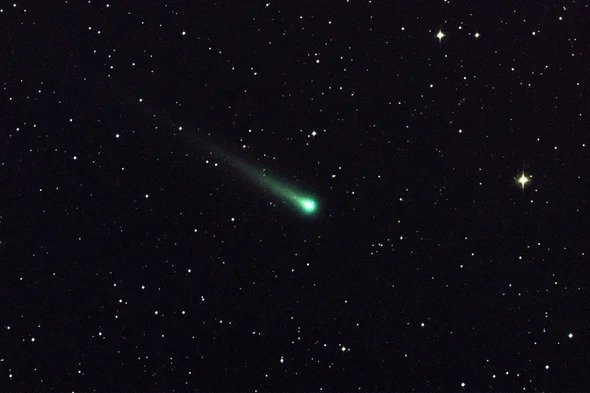
When a comet dips near the sun, it’s a spectacular and rare sight from here on Earth. Our solar system is brimming with these small chunks of ice, though, orbiting a great distance from the sun in the far-out Oort Cloud. Given comets’ ubiquity here, scientists figure that other planetary systems likely have them as well.
Astronomers from the Main Astronomical Observatory (MAO) of the National Academy of Sciences of Ukraine in Kyiv recently published a discovery of five new exocomets—comets orbiting a star other than the sun—in the journal Astronomy & Astrophysics, using data from the Transiting Exoplanet Survey Satellite (TESS). They also independently confirmed a handful of exocomets that were previously detected by other researchers.
Within our solar system, comets are studied as relics of the past, providing clues to the chemistry of how Earth and its neighbor planets formed. They’re a particularly important component of Earth’s story as well, because comets are thought to have brought water to Earth, setting the stage for our planet to burst with life.
“I think exocomets are exciting and important for the same reason that comets in our own solar system are important,” says Andrew Vanderburg, a physicist at the Massachusetts Institute of Technology who was not involved in the new finding. “Comets have clearly played an important role in the development of our solar system…. If the story of our own solar system depends so much on exocomets, how can we hope to understand other planetary systems without knowledge of their comets?”
These newly discovered exocomets are swirling around a star named Beta Pictoris, a well-studied favorite of astronomers that lies only around 65 light-years from Earth—fairly nearby in cosmic terms. Beta Pictoris (a.k.a. Beta Pic) is much younger than the sun, only 10 to 40 million years old compared to the solar system’s 4.5 billion years, making it a useful snapshot of what happens during a planetary system’s youth. This star is orbited by a gas giant planet 11 times larger than Jupiter (called Beta Pic b) and an enormous disk of dust almost 40 billion miles in diameter, known as a debris disk. Read More...