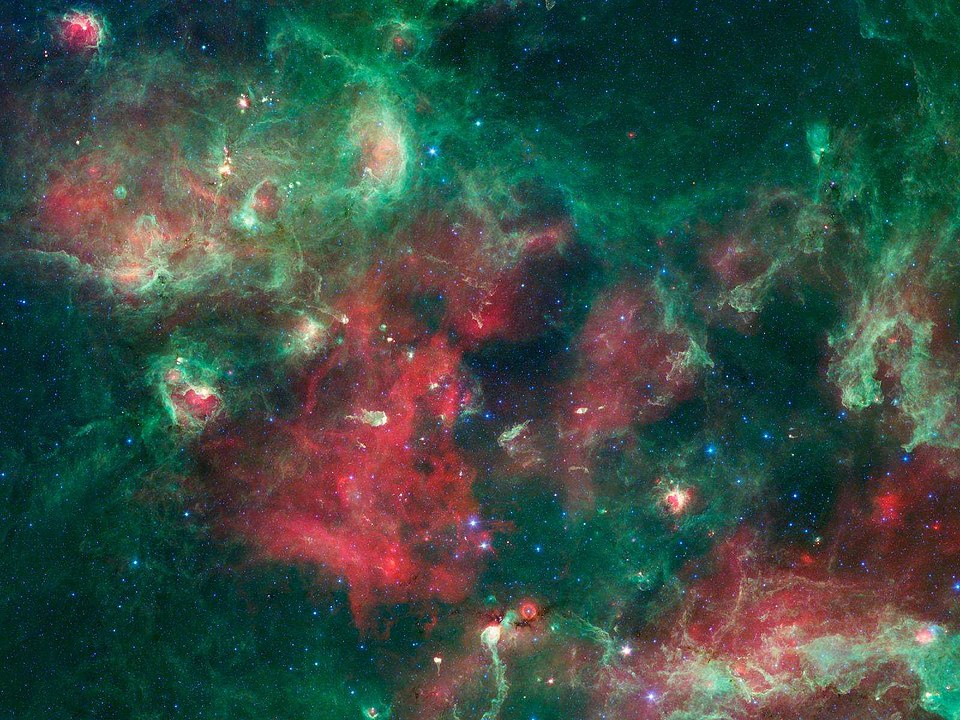
Speedrunning Star Formation in the Cygnus X Region
-
 Loading...
 - Margarita Zavala
- 24 Mar 2023
- 65 Views
- 0 Like
- 0 Comment
Stars are born in molecular clouds, massive clouds of hydrogen that can contain millions of stellar masses of material. But how do molecular clouds form? There are different theories and models of that process, but the cloud formation is difficult to observe.
A new study is making some headway, and showing how the process occurs more rapidly than thought.
Molecular clouds are an important part of the interstellar medium (ISM) and are embedded in atomic gas, the other main component of the ISM. The third component of the ISM is ionic gas, and all three play roles in star formation.
There are unanswered questions about how molecular hydrogen clouds form from the ISM and then form stars. Molecular hydrogen is notoriously difficult to observe because of its lack of absorption lines in visible, infrared, and UV light. New research shows how one component of the ionized gas in the ISM—ionized carbon (CII)—can be observed to trace how molecular clouds form.
The new research appears in Nature Astronomy. The article is “Ionized carbon as a tracer of the assembly of interstellar clouds,” and the lead author is Nicola Schneider. Schneider is a researcher at the University of Cologne, Germany.
The research focuses on Cygnus X, a massive star-forming region about 4,600 light-years away in the constellation Cygnus. It’s associated with one of the largest molecular hydrogen clouds scientists know of. Studies show that Cygnus X has been forming stars rapidly for the last 10 million years and is still forming them today.

Stars are born in clouds of molecular hydrogen, but astrophysicists wind the clock back further than that to find their origins. Molecular hydrogen clouds form from reservoirs of atomic hydrogen (HI) in galaxies, though the exact mechanism is not clearly understood. Astrophysicists have developed different models of the mechanism. Some lay out a slow process where gravity, turbulence, and magnetic fields are in equilibrium until disturbed by stellar feedback or spiral arm density. Once disturbed, there’s a slow buildup of density that forms pockets of molecular hydrogen gas. Stars are eventually formed in those pockets. Read More…