What makes a mammal a mammal? Our spine, say scientists
-
 Loading...
 - Francesca Galloway
- 24 Sep 2021
- 907 Views
- 0 Like
- 0 Comment
Mammals are unique in many ways. We're warm-blooded and agile in comparison with our reptilian relatives.
But a new study, funded by the National Science Foundation (NSF) and led by Harvard University researchers Stephanie Pierce and Katrina Jones, suggests we're unique in one more way -- the makeup of our spines. The researchers describe their finding in a paper published this week in the journal Science.
"The spine is basically like a series of beads on a string, with each bead representing a single bone -- a vertebra," said Pierce, curator of vertebrate paleontology at Harvard. "In most four-legged animals, like lizards, the vertebrae all look and function the same.
"But mammal backbones are different. The different sections or regions of the spine -- like the neck, thorax and lower back -- take on very different shapes. They function separately and so can adapt to different ways of life, like running, flying, digging and climbing."
While mammal backbones are specialized, the regions that underlie them were believed to be ancient, dating back to the earliest land animals.
Mammals made the most of the existing anatomical blueprint, or so scientists believed. However, the new study is challenging this idea by looking into the fossil record.
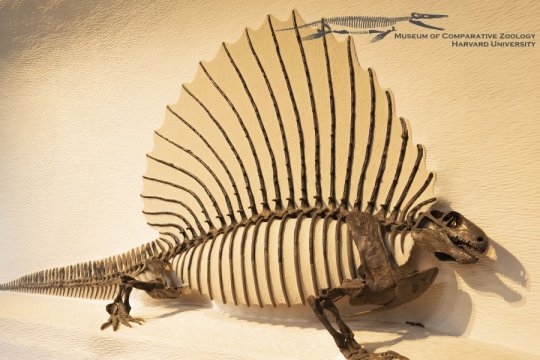
"There are no animals alive today that record the transition from a 'lizard-like' ancestor to a mammal," said Jones, lead author of the study. "To do that, we have to dive into the fossil record and look at the extinct forerunners of mammals, the non-mammalian synapsids."
These ancient ancestors hold the key to understanding the origin of mammal-specific characteristics, including the spine.
But studying fossils isn't easy. "Fossils are scarce and finding extinct animals with all 25-plus vertebrae in place is incredibly rare," Jones said.
To tackle this problem, the researchers combed museum collections around the world to study the best-preserved fossils of animals that lived some 320 million years ago.
"Looking into the ancient past, an early change in mammals' spinal columns was an important first step in their evolution," said Dena Smith, a program director in NSF's Division of Earth Sciences, which funded the research. "Changes in the spine over time allowed mammals to develop into the myriad species we know today."
Pierce and Jones, along with co-author Ken Angielczyk of the Field Museum in Chicago, examined dozens of fossil spines, as well as more than 1,000 vertebrae of living animals, including mice, alligators, lizards and amphibians.
They wanted to find out whether mammal vertebral regions were as ancient as previously thought, or if mammals were doing something unique.
"If vertebral regions had remained unchanged through evolution, as hypothesized, we would expect to see the same regions in the non-mammalian synapsids that we see in mammals today," said Pierce.
But that doesn't seem to be the case. When the researchers compared the positioning and shape of the vertebrae, they found something surprising. The spine had gained new regions during mammal evolution.
"The earliest non-mammalian synapsids had fewer regions than living mammals," said Jones.
About 250 million years ago, a new region evolved near the shoulders and front legs. Dramatic changes also began to appear in the forelimbs of animals known as non-mammalian therapsids.
These simultaneous developments, the scientists believe, likely occurred in conjunction with changes in how creatures walked and ran.
"There appears to be some sort of cross-talk during development between the tissues that form the vertebrae and the shoulder blade," Pierce said. "We think this interaction resulted in the addition of a region near the shoulder as the forelimbs of our ancestors evolved to take on new shapes and functions."
Later, a region emerged near the pelvis. "It is this last region, the ribless lumbar region, that appears to be able to adapt the most to different environments," said Pierce.
The final step in building the mammal backbone may be linked with changes in Hox genes, important to spine regions early in their development.
"We've been able to make connections among changes in the skeletons of extinct animals and ideas in modern developmental biology and genetics," Jones said. "This combined approach is helping us understand what makes a mammal a mammal."