France's housing market still buoyant despite pandemic
-
 Loading...
 - Lucy Richard
- 29 Nov 2021
- 774 Views
- 0 Like
- 0 Comment
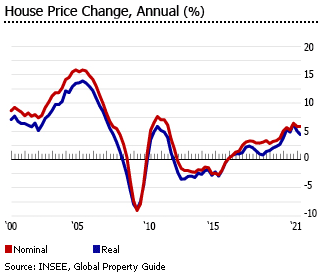
France’s housing market remains strong, with the highest price rises in a decade. In Metropolitan France, house prices rose by a robust 5.85% during the year to Q2 2021 (4.41% inflation-adjusted), following y-o-y growth of 5.86% in Q1, 6.4% in Q4 2020, 5.21% in Q3 and 5.64% in Q2, according to the National Institute for Statistical and Economic Studies (INSEE).
Quarter-on-quarter, house prices rose 1.57% in Q2 2021 (0.8% inflation-adjusted).
However the house price rises are lowest in the centre. During the year to Q2 2021:
- In Île-de-France, the country’s wealthiest and most populated region, the average apartment price rose by 2.1% y-o-y (0.7% inflation-adjusted) to €6,710 (US$ 7,665) per sq. m., according to the La Chambre des Notaires de Paris.
- In the Petite Couronne the average price of apartments rose by 4.5% y-o-y (3% inflation-adjusted) to €5,390 (US$ 6,157) per sq. m.
- In the Grande Couronne the average price of apartments increased 4.1% y-o-y (2.7% inflation-adjusted) to €3,290 (US$ 3,758) per sq. m.
- In Hauts-de-Seine, one of the country’s most populous departments, apartment prices increased 4.3% y-o-y (2.9% inflation-adjusted) to €6,590 (US$ 7,528) per sq. m.
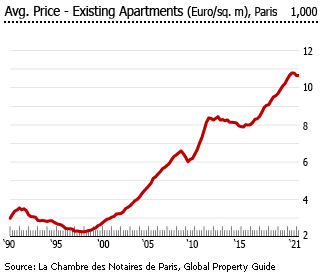
In Paris, house prices even declined slightly – it seems the capital’s high cost of living is prompting some rural relocations. The average price of existing apartments in the capital city fell by 0.2% (-1.5% inflation-adjusted) to €10,650 (US$ 12,166) per square metre (sq. m.) during the year to Q2 2021, according to the La Chambre des Notaires de Paris. In a recent study conducted by the University of Paris and King’s College London, almost half of Parisians think that the city is too expensive and 43% believe that they could find a better quality of life elsewhere. The pandemic has clearly been pushing people away from cities towards greener areas.
Both demand and supply are now recovering. New dwellings authorized in France were up 25% y-o-y to 351,066 units in the first three quarters of 2021, and new dwelling starts increased 13.7% to 296,906 units. Existing home sales rose by 22.6% y-o-y in August 2021 to an annualized 1,208,000 units, after falling by 4% during 2020, according to the General Council for the Environment and Sustainable Development (CGEDD). Likewise, new home sales rose by 29% y-o-y to 61,718 units in the first half of 2021, following a decline of 22.8% last year, according to Ministère de la Transition Écologie.
The French economy, eurozone’s second largest, contracted by a huge 7.9% during 2020, its worst performance in recent history. The economy is expected to rebound with GDP growth of 6.5% this year, according to the European Commission.
France’s house price boom and after
During the long housing boom which lasted from 1997 to 2007, French house prices surged by 150% (112.5% inflation-adjusted). Since then the French housing market has not moved much.
The market started to weaken in 2008. Price falls were moderate, as have been price rises since then. After falling by an annual average of 1.7% in 2012-2015, house prices started to rise again in 2016.
Despite the pandemic, house prices increased 6.4% during 2020 – the highest growth since 2010.
There are no restrictions on foreign ownership in France. Most property is freehold. Apartments are mostly held in two forms of freehold: co-ownership (which has meetings of co-owners, with votes taken and accounts kept), and volumes, adapted mostly for mixed-use developments. There are also leaseholds, for up to 99 years. Read More...