
Students 'cannot multi-task with mobiles and study'
-
 Loading...
 - J. Oliveira
- 09 Jun 2020
- 893 Views
- 0 Like
- 0 Comment
Students cannot successfully multi-task in using mobile phones while they are studying, US research suggests.
Researchers found that students sending and receiving messages while studying scored lower test results and were less effective at tasks such as note taking.
The study examined how a generation of "voracious texters" might be affected by so many online distractions.
It found that when students did not use mobiles, they were better at being able to recall information.
With the exam season under way, the research by academics at Ohio University, Illinois State University and Nebraska University might add to family arguments about whether teenagers really can learn at the same time as using several online devices.
Competing for attention
The study, Mobile Phones in the Classroom: Examining the Effects of Texting, Twitter, and Message Content on Student Learning, carried out a series of tests with 145 undergraduates.
It wanted to find out how well young people could carry out a task, such as watching a lecture on a video and then taking notes and answering questions, while facing a series of interruptions on their internet-connected mobile phones.
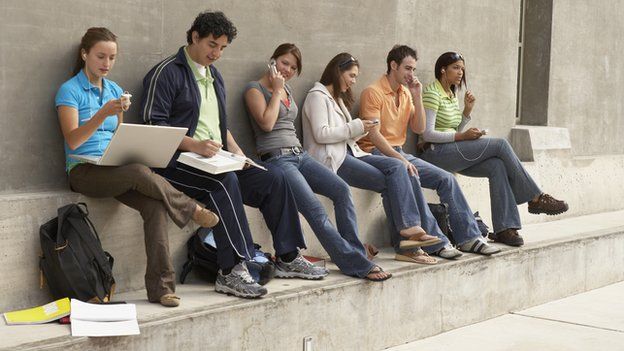
How should education adapt to students who never switch off mobile phones and online devices?
Mobiles and portable devices are now such a pervasive part of young people's lives, the researchers wanted to see how much students could really study at the same time as interacting online.
Among US university undergraduates, the study says it is quite common for students to use mobile phones through classes and in lectures, as well as when they are studying at home.
"It is a common occurrence to observe students who are physically present, yet mentally preoccupied by non-course-related material on their mobile devices.
"As mobile devices have deeply saturated the college student population, this problem will likely continue to pose a significant obstacle," says the study, by Jeffrey Kuznekoff, Stevie Munz and Scott Titsworth.
The study showed students video lectures, while getting them to use mobile phones in different ways - such as asking them questions related to their social life or sending a link to a photo or asking a question related to the lecture.
There were also experiments with the impact of different numbers of texts and messages.
Students also watched the same lecture without any interruptions.
When the students were tested on their ability to recall information and in multiple-choice questions, there were significantly better results for those who had "abstained" from using mobile devices.
Part of the test also examined whether text messages or tweets specifically about what was being shown on the video would make a difference - and this had a much less negative impact than "irrelevant" information, such as planning where to go out that evening.
This suggested that the content of messages was another variable factor.
The study says how to respond to students' use of mobile phones and online devices is going to remain an important question for educators.
There are some suggestions that mobiles should be incorporated into lessons and others who want an outright ban.
"Perhaps one of the biggest challenges instructors face in the 21st Century college classroom is the struggle of retaining student interest and engagement while students remain connected to the outside world through their mobile devices," say the researchers.
There have been debates in the UK about whether mobiles should be allowed in school.
Last month, a study published by the London School of Economics looked at schools in four English cities and found test scores increased by more than 6% in those which banned phones.
Researchers concluded that it was the low-achieving pupils who were most likely to be distracted by mobile phones.


