12 Tips to Help You Capture Stunning Landscape Photos
-
 Loading...
 - Shyla Reddy
- 07 Jun 2022
- 264 Views
- 0 Like
- 0 Comment
1. Location, location, location
Landscape photography is as much about planning as it is about the actual process of photography. You should always have a clear idea of where you are planning to go, and at what time of the day you will be able to capture the best photograph. Learn how to read maps, and understand how you can utilize them to find the perfect location. By planning your exact location, you will be able to maximize your time there, and ensure not only that you get to your location safely and in plenty of time, but also that you find your way back (usually after sunset).
2. Be patient
It’s amazing the number of times that the elements conspire to ruin a perfectly composed photograph. Landscape photography requires patience, just in case that white cloudy sky disperses just long enough to allow the sun to break through for you to take your shot. The key is to always allow yourself enough time at a location so that you are able to wait if you need to. Forward planning can also help you hugely, so make sure to check weather forecasts before leaving, maximizing your opportunity for the weather you require.

3. Don’t be lazy
One of the reasons we are often stunned by impressive landscape photos is because it is a view taken in a way that we have never seen before. A photo taken from the top of a mountain which requires a huge amount of time and effort to get to is a view that most people won’t get to see for themselves. So don’t rely on easily accessible viewpoints that everyone else can just pull up to and see. Instead, look for those unique spots (provided they are safe to get to) that offer amazing scenes, even if they require determination to get there.
4. Use the best light
Light is one of the most important factors in any photograph, but even more so in landscape photography. It really doesn’t matter how great the location, is or how you compose your photo – if the light doesn’t do the scene justice, then the image will fail. The best light for landscape photography is early in the morning or late afternoon, with the midday sun offering the harshest light.
But part of the challenge of landscape photography is about being able to adapt and cope with different lighting conditions; for example, great landscape photos can be captured even on stormy or cloudy days. The key is to use the best light as much as possible, and be able to influence the look and feel of your photos with it.

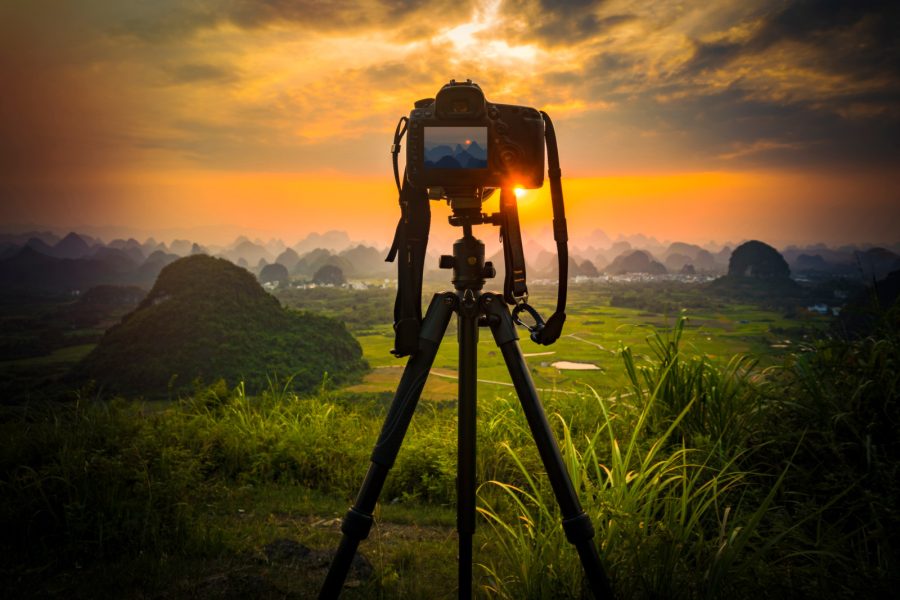
5. Carry a tripod
Simply put, if you want to capture the best photographs, at the best time of the day, at the highest quality possible, then a tripod is an essential piece of equipment. Photography in low light conditions (e.g. early morning or early evening) without a tripod would require an increase in ISO to be able to avoid camera shake, which in turn means more noise in your images. If you want to capture a scene using a slow shutter speed or long exposure (for example, to capture the movement of clouds or water) then without a tripod you simply won’t be able to hold the camera steady enough to avoid blurred images from camera shake.
6. Maximize the depth of field
Choosing your depth of field is an important part of capturing stunning landscapes. Landscape photos usually require the vast majority of the photo to be sharp (the foreground and background) so you need a deeper depth of field than if you are taking a portrait of someone. But a shallower depth of field can also be a powerful creative tool if used correctly, as it can isolate the subject by keeping it sharp, while the rest of the image is blurred. As a starting point, if you are looking to keep the majority of the photo sharp, set your camera to Aperture Priority (A or Av) mode so you can take control of the aperture. Start at around f/8 and work up (f/11 or higher) until you get the desired effect.

7. Think about the composition
As much as possible you should always aim to get your composition right when taking the photo, rather than relying on post-production. If the scene doesn’t look right when you look at it through your viewfinder, then it won’t look good in the final output. There are several techniques that you can use to help your composition (such as the rule of thirds), but ultimately you need to train yourself to be able to see a scene, and analyze it in your mind. With practice this will become second nature, but the important thing is to take your time.
8. Use neutral density and polarizing filters
Neutral Density filters and polarizers are an essential piece of kit for any landscape photographer. Often you will need to manipulate the available light, or even try to enhance the natural elements. For example, if you are taking photos which include water, you may find you get unwanted reflections from the sun, which is where a polarizing filter can help by minimizing the reflections and also enhancing the colors (greens and blues). But remember, polarizing filters often have little or no effect on a scene if you’re directly facing the sun, or it’s behind you. For best results position yourself between 45° and 90° to the sun.
One of the other big challenges of landscape photography is getting a balanced exposure between the foreground, which is usually darker, and a bright sky. Graduated ND filters help to compensate for this by darkening the sky, while keeping the foreground brighter. This can be replicated in post-production, but it is always best to try and capture the photo as perfectly as possible in-camera.
 9. Use the histogram
Histograms are an essential tool in photography, which you should aim to learn how to read and utilize the findings to improve your photos. A histogram is a simple graph that shows the different tonal distribution in your image. The left side of the graph is for dark tones and the right side of the graph represents bright tones.
For instance, if you find that the majority of the graph is shifted to one side, this is an indication that your photo is too light or dark (overexposed or underexposed). This isn’t always a bad thing, and some images work perfectly well either way. However, if you find that your graph extends beyond the left or right edge, this shows that you have parts of the photo with lost detail (pure black areas if the histogram extends beyond the left edge and pure white if it extends beyond the right edge). This is something you should avoid, so by seeing the evidence in the histogram, you are able to correct it by either recomposing the image or compensating for the exposure.
10. Never settle for a good photo
This is true of any photograph that you are taking. It doesn’t matter if it is a landscape or a portrait; if you can do it better, then you should. But often because of the time and effort that landscape photography requires, people settle for a good photo, rather than waiting or coming back to take a better one. You should always aim to photograph anything at the best possible time, in the best possible way, even if that means waiting or coming back later. Read More...