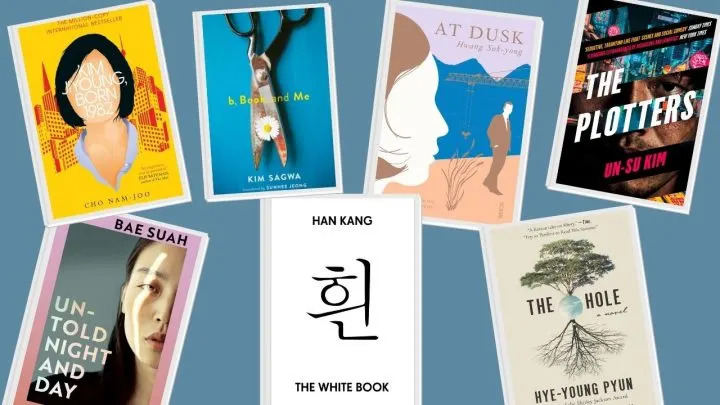
17 Must-Read Korean Novels in English

Korean novels frequently bend and break genres, explore often untouched social and political themes, and speak to our very souls.
Outstanding Korean Novels in Translation
If you’re looking for the best Korean novels in English translation, this list of ten is the perfect place to start.
Many of the Korean authors (and translators) mentioned here have entire libraries available for you to explore once you’ve exhausted this list.
You can also subscribe to the Korean Literature Now Magazine and browse their website to keep with the latest news, poetry, fiction, and articles.
A note on names: In Korea, family names come first, and publishers of Korean novels in translation seem to often disagree over whether or not to flip them for English language readers. Some do, some don’t. You get used to it.
Kim Jiyoung, Born 1982 by Cho Nam-joo
Translated by Jamie Chang
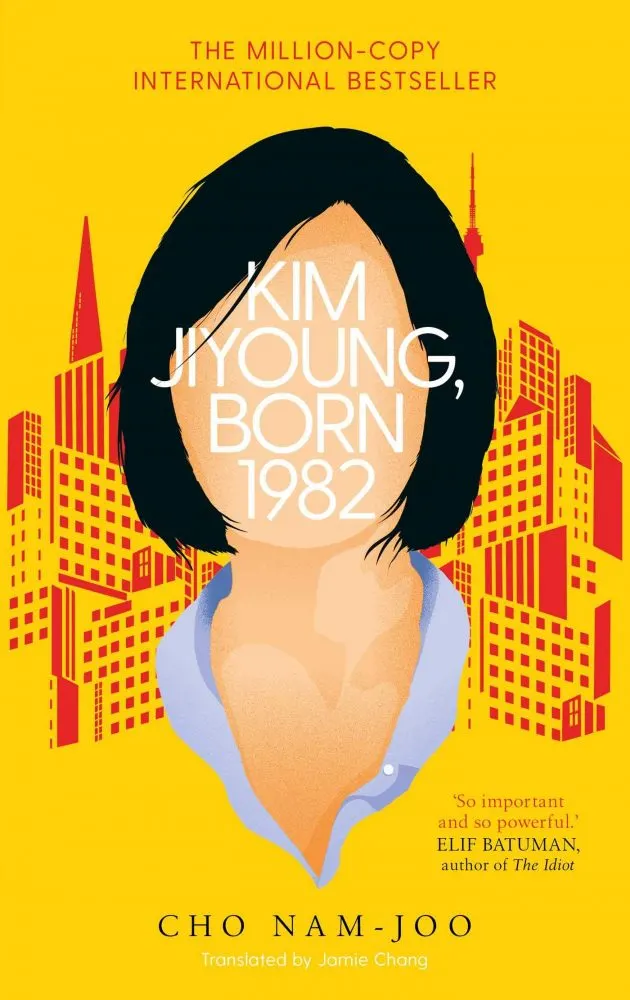
Approaching a book like Kim Jiyoung, Born 1982 is an enormous undertaking; something that should be done with real consideration.
The novel has sold over a million copies in its native South Korea, has been adapted into a successful Korean film, and has been a huge spark for the fires of the #metoo movement in South Korea.
Kim Jiyoung, Born 1982 is a novel that has achieved so much, done so much good, and is now finally available to English-speaking readers.
Even knowing where to begin with reviewing it is a trial. This book is important. It really matters.
Kim Jiyoung, Born 1982 can be seen as the novelisation of the lived experiences of every ordinary Korean woman for the past forty years. It traces the life of a single woman from early childhood to marriage and motherhood.
The book begins with her being given an appointment with a psychiatrist in 2016 after she has developed a disturbing condition wherein she impersonates the voices of, and embodies the personalities of, the women in her life both alive and dead.
This condition is what initially introduces us to her character, and it is a very clear statement to the reader that Kim Jiyoung speaks for every ordinary woman of 20th and 21st Century South Korea.
Everything you may have heard about Kim Jiyoung, Born 1982 being an impactful and important piece of feminist fiction is true.
It is a book that brings to light the everyday misogyny, sexism, ignorance, aggression, bias, and abuse (both active and passive) that women in South Korea (and, of course, the world over) suffer and do their best to survive in this modern world.
To really get the most out of Kim Jiyoung, Born 1982, one of the most powerful Korean novels, it’s important to first understand the novel’s purpose.
It is not a story with a view to entertaining us. It is a book that enlightens, and encourages anger in, its readers. Kim Jiyoung is not an individual.
She is not a character to form a bond with. She is every abuse victim. She is every woman who has encountered sexism at home, at school, in the workplace, and on the street, and who perhaps never even realised it.
Love in the Big City by Sang Young Park
Translated by Anton Hur
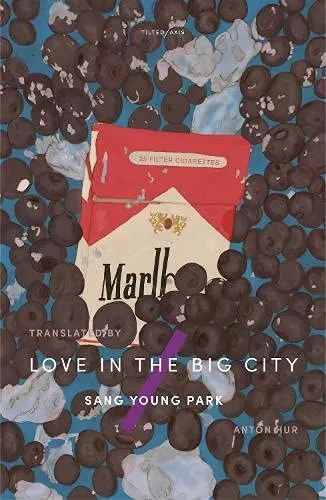
Love in the Big City is a queer Korean love story. It is a tale of hedonism and friendship; a book about looking at life from all angles: with love and hate and anger and fear in our eyes.
Divided into four acts, Love in the Big City begins with Young at university, living his best life with close friend Jaehee.
The two of them live together, party hard, sleep around, and look out for one another. But, eventually, Jaehee wants to get married and grow up.
This Korean novel’s second act explores Young’s relationship to his mother, now and in the past, and the third act sees him chasing love, finding it, being let down by it, and finding it again.
Translated elegantly and beautifully by Anton Hur, Love in the Big City considers how we live our lives when time is ticking, when there is fun to be had and things to be seen; when there are things to fear and people who want to hurt us.
This is also a novel full of charming details. Young and Jaehee, in their early days, look out for one another.
He keeps her stocked with Marlboro cigarettes and she keeps the fridge full of fruits (blueberries are his favourites).
Those details aren’t all positive — the novel doesn’t shy away from moments of pain and fear and difficulty. Young encounters homophobia and his relationship with his mother is strain in more ways than one.
Love in the Big City paints a raw and honest but ultimately kind picture of love and life in the modern day, and for that, it is one of the finest modern Korean novels.
Violets by Kyung-sook Shin
Translated by Anton Hur
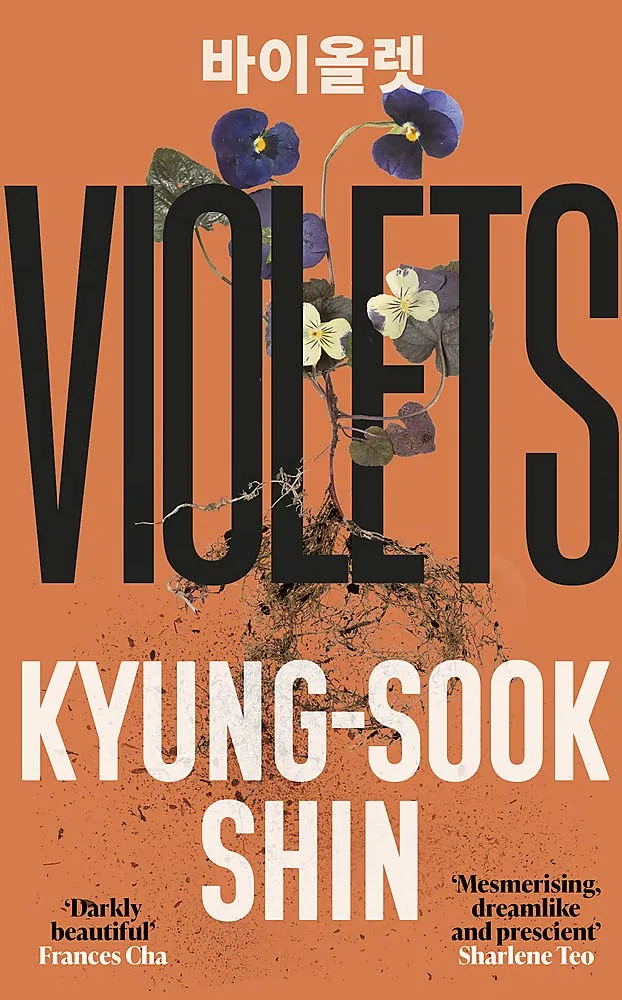
Kyung-sook Shin is one of South Korea’s most beloved and revered authors. One read of Violets and it’s easy to see why.
This is a feminist tale about friendship in the modern world, and about the insidious, subtle ways in which men abuse women on a daily basis.
One of the most impactful and changing Korean novels of the past few years, Violets begins with its protagonist, San, as a young girl in 1970. She lives in a small village and is a lonely social outsider.
In the opening chapter, San shares a moment of tender intimacy with her best friend. For San, this is an awakening. For her friend, it is frightening and wrong.
They don’t see each other again, and we spend the rest of the novel with San as a twenty-something living in Seoul.
When San takes a job as a florist, she develops a sweet friendship with her coworker, who soon moves in with her. But San is also at the whim of men.
She learns how men violate the spaces and bodies of women on a daily basis, in a way that seems almost invisible.
Violets has the power to reshape how we all see the social dynamics at play between men and women.
The physical and verbal weapons softly used by men to scare, suppress, and intimidate the women in their lives. It’s a novel that leaves a mark, but also a tender and beautiful narrative. Read More…