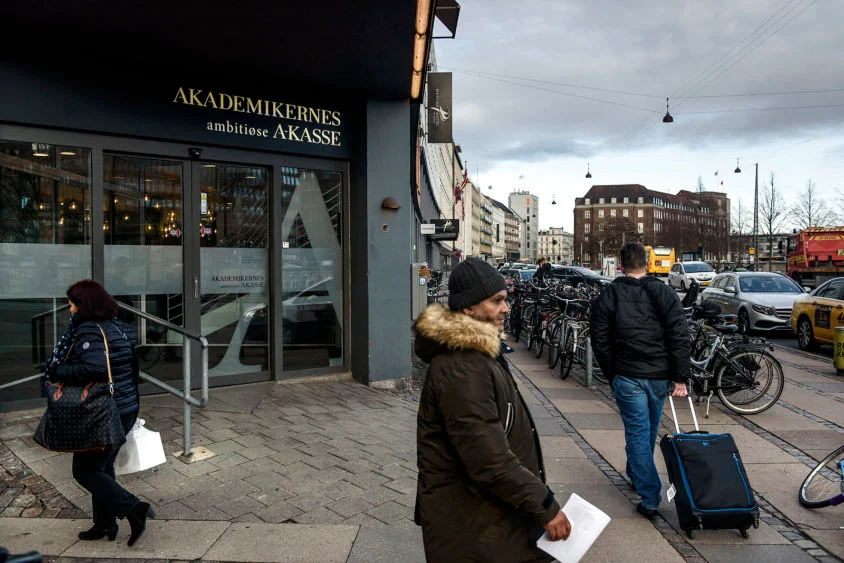
A-kasse: Everything foreigners need to know about unemployment insurance in Denmark
-
 Loading...
 - Michael Sorensen
- 29 Apr 2022
- 324 Views
- 0 Like
- 0 Comment
The prospect of Denmark experiencing an economic recession is now among business leaders’ top three concerns, according to a recent survey from PricewaterhouseCoopers (PwC).
Following Russia’s invasion of Ukraine, Denmark’s Ministry of Finance laid out three scenarios for how the Danish economy is likely to be affected, two of which anticipate a recession while all three scenarios project reduced GDP, increased inflation, and rising unemployment.
Even outside of a potential recession, Mads Storgaard Pedersen, consultant and assistant attorney at the Federation of Danish Industry (DI), said it’s important to understand how Denmark approaches unemployment benefits.
“The unemployment insurance scheme is an integral aspect of the Danish model of ‘flexicurity’,” Pedersen told The Local. Denmark’s flexicurity system, which aims to balance flexibility and security, relies on the ability to hire (and fire) employees with relative ease, he added, with unemployment benefits serving as an interim safety net.
However, it’s important to understand that unemployment insurance in Denmark is voluntary, said Michel Klos, chief consultant at Danske A-kasser, an industry organisation representing Denmark’s unemployment insurance funds. This means employees in Denmark are not automatically insured against unemployment.
Instead, unemployment benefits are administered by private unemployment insurance funds known as A-kasser (or arbejdsløshedskasse). According to Maja Krøjgaard, job consultant and team leader at the unemployment insurance fund Min A-kasse, 2.1 million Danes are members of an A-kasse.
Whether or not an A-kasse membership is right for you, it’s important for foreigners working in Denmark to better understand the Danish unemployment system. Here, The Local answers 20 common questions foreigners are likely to have about Denmark’s unemployment insurance fund scheme.
1. How do A-kasser work?
A-kasser are private associations who have been authorised by the Danish state to administer unemployment benefits. According to Danske A-Kasser, the state regulates the requirements for receiving benefits while the A-kasse administers the benefits.
Those interested in A-kasse membership need to apply to the A-kasse of their choice, either as a full-time or part-time insured member. A-kasse members pay a tax-deductible monthly fee, which gives them the right to receive unemployment benefits (dagpenge) should they become unemployed.
However, members must meet certain eligibility requirements to receive unemployment benefits, which include being a member of an A-kasse for at least 12 months. According to Denmark’s digital self-service website Borger.dk, one must also have earned at least 246,924 kroner (2022) in the past three years for full-time insured and 164,616 kroner (2022) for part-time insured.
Those who have previously received unemployment benefits must renew their eligibility by hours worked rather than income. “This means that you become eligible for benefits again once you have worked 1,924 hours within a three-year period,” Krøjgaard told The Local.
2. Who is eligible to join an A-kasse?
To join an A-kasse, you have to be at least 18 years of age (or have completed a vocational education of at least 18 months), have more than two years left before reaching retirement age, and reside in Denmark.
Some A-kasser specialise in particular industries while others accept members of all professions. Some accept self-employed individuals and others offer student memberships (some for free).
In addition to Danish nationals, both EU/EEA nationals and third country nationals are eligible to join an A-kasse. “The right to unemployment benefits is the same for everyone – regardless of nationality – if you have a legal residence and have a work permit,” Klos said.
3. Can foreign unemployment fund contributions count toward my eligibility to receive unemployment funds in Denmark?
Although members have to contribute to an unemployment insurance fund for one year, it is possible to apply to use periods from another EU/EEA country to fulfil the one-year requirement. Third country citizens living in Denmark can only aggregate insurance periods within the Nordic countries, according to Borger.dk.
To do so, one must be a resident in Denmark and become a member of a Danish unemployment insurance fund. There are additional criteria, depending on whether or not a person has been a member of a Danish unemployment insurance fund within the last 5 years, outlined on Borger.dk.
What impact does Brexit have on unemployment benefits for UK citizens working in Denmark?
“The UK is now considered a third country after Brexit,” Krøjgaard said, adding that UK nationals residing in Denmark before January 1st 2021 were covered by a withdrawal agreement so long as they received a new residence document from the Danish Agency for International Recruitment and Integration (SIRI) to preserve their rights.
“This meant that they could still reside and work in Denmark.”
SIRI confirmed this to be the case in a statement to The Local, adding that “UK nationals who do not hold a residence permit on the basis of the withdrawal agreement are regarded as third country nationals and conditions for third country nationals apply here.”
4. Are third country nationals able to use the A-kasse system?
Third country nationals are permitted to join an A-kasse and receive cover in the event of unemployment, but must have legal residence (and currently reside) in Denmark. This is because A-kasse rules require members to be available to accept job offers at short effect.
There must not be any legal or factual matters that prevent an A-kasse member receiving unemployment benefits from taking over reasonable work within a day’s notice.
“For foreign citizens that means that the person must have a right to reside and work in Denmark,” Klos said, noting that such rules fall under the expertise of SIRI.
It should be noted that a residence permit issued for the purpose of work, is likely to be withdrawn if the person holding the residence permit no longer is employed. In that case, third country nationals can apply for a job search permit (jobsøgningstilladelse), SIRI, told The Local in a written statement.
A condition for a job search permit, which gives six months to stay and search for a job in Denmark, is that you have been out of work through no fault of your own (uforskyldt ledig).
It’s also worth noting that some older guides to Denmark’s unemployment insurance scheme still list a rule that one must be a resident in Denmark or another EU/EEA country for at least seven out of the last eight years. However, that requirement has since been terminated.
5. How do A-kasser work for students?
Students may be entitled to free A-kasse membership if they meet a number of conditions. They must be pursuing a vocational qualification or academic degree that will take at least 18 months, earn a maximum of 232,212 kroner (2022) per year before tax (including state education grants, or SU), not receive any public support other than SU, and be under 30 years of age.
Those over 30 must meet stricter requirements, including having paid into the early retirement scheme since their 30th birthday and having been a member of an unemployment insurance fund.
Another requirement, regardless of age, is that one’s course of study in general entitles them to SU. According to Denmark’s Ministry of Higher Education, one must normally be a Danish citizen to receive SU, however, foreign citizens who fulfil certain conditions may be granted equal status to Danish citizens to receive SU.
6. How much would I receive in unemployment benefits?
“The benefit from the insurance is the same in every A-kasse,” Klos said, adding that the benefits can amount to a maximum of 90 percent of your previous salary. That percentage is calculated based on the 12 months in which you had the highest income within the past 24 months.
There is also a maximum compensation of 19,351 kroner(2022) per month as full-time insured and 12,901 kroner (2022) per month as part-time insured.
For people with high salaries who might struggle to maintain one’s standard of living on the above maximum, Krøjgaard said it’s also possible to purchase salary insurance (lønforsikring). This allows members to insure up to 80 percent of their current salary.
7. For how long can I receive unemployment benefits?
According to Borger.dk, A-kasse members are entitled to two years of unemployment benefits within a three-year period. However, this is calculated in hours (3,848 hours within three years).
There are several ways to extend the period of three years, for example in the case of maternity leave. It’s also possible to extend the unemployment benefit period of two years, based on wage hours paid since the unemployment benefits began. Visit Borger.dk for a more detailed explanation.
According to Krøjgaard, 50 percent of Min A-Kasse members find a new job within three months, and 75 percent find a job within six months.
8. What benefits am I entitled to if I quit my job?
“If you quit your job, you can still receive unemployment benefits,” Krøjgaard said. However, there is a three-week waiting period before a person who has quit their job becomes eligible to receive unemployment benefits.
9. How do taxes work in regards to unemployment benefits?
Recipients of unemployment benefits are required to pay taxes on their benefits.
“Although everyone’s tax situation is unique, it’s probable that you will pay less in taxes because you will be making less,” Krøjgaard said. She recommends correcting one’s tax information with the Danish Tax Agency just as one would if they changed jobs.
10. What else do A-kasser offer?
“Of course, the biggest reason to join an a-kasse is the economic support if you lose your job,” Krøjgaard said. However, she added, unemployment insurance funds also offer assistance during members’ job search, from career counselling to CV workshops.
Krøjgaard also said some unemployment insurance funds, including Min A-Kasse, offer career counselling for people who are looking to pivot in their careers.
These services may be of particular interest to foreigners working in Denmark, she said.
“I’ve worked with a lot of people coming from abroad who may not fully understand the Danish job market,” she said.
For example, that unsolicited calls are not only acceptable but common among job seekers in Denmark or that Danish employers want a CV that is less than three pages long and includes a photo. “We can also direct our members where to look for available jobs,” she said.
11. What’s the difference between an A-kasse and a trade union?
Many unemployment insurance funds in Denmark are closely connected to a trade union and may even be located in the same office and share the same brand.
Although you may be asked to sign up for a union when you join an A-kasse (or vice versa), it’s not a requirement to join an A-kasse associated with your union (or vice versa). Joining both trade unions and unemployment insurance funds are voluntary; you can join one or the other, both, or neither.
12. How do I choose which A-kasse to join?
“If you want to be insured in an A-kasse – and I think you should be if you stay here for an extended period – you will have to choose which A-kasse you would like to be a member of,” Klos said.
There are more than 20 A-kasser in Denmark. When selecting an A-kasse, most people consider membership fees, specialisations, internal rules, membership benefits, and reviews/member satisfaction. Read More...