A New Type Of Photonic Time Crystal Gives Light A Boost
-
 Loading...
 - Vanessa Eder
- 06 Apr 2023
- 73 Views
- 0 Like
- 0 Comment
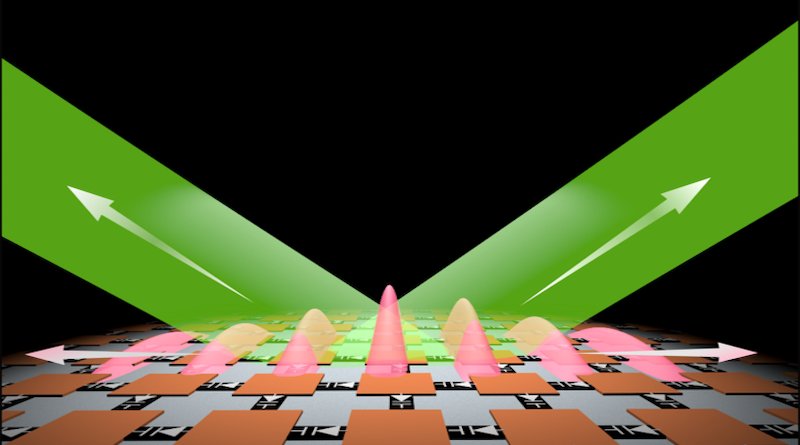
Researchers have developed a way to create photonic time crystals and shown that these bizarre, artificial materials amplify the light that shines on them. These findings, described in a paper in Science Advances, could lead to more efficient and robust wireless communications and significantly improved lasers.
Time crystals were first conceived by Nobel laureate Frank Wilczek in 2012. Mundane, familiar crystals have a structural pattern that repeats in space, but in a time crystal, the pattern repeats in time instead. While some physicists were initially sceptical that time crystals could exist, recent experiments have succeeding in creating them. Last year, researchers at Aalto University’s Low Temperature Laboratory created paired time crystals that could be useful for quantum devices.
Now, another team has made photonic time crystals, which are time-based versions of optical materials. The researchers created photonic time crystals that operate at microwave frequencies, and they showed that the crystals can amplify electromagnetic waves. This ability has potential applications in various technologies, including wireless communication, integrated circuits, and lasers.
So far, research on photonic time crystals has focused on bulk materials – that is, three-dimensional structures. This has proven enormously challenging, and the experiments haven’t gotten past model systems with no practical applications. So the team, which included researchers from Aalto University, the Karlsruhe Institute of Technology (KIT), and Stanford University, tried a new approach: building a two-dimensional photonic time crystal, known as a metasurface. Read More..