Argentine paleoartist reconstructing prehistoric animals
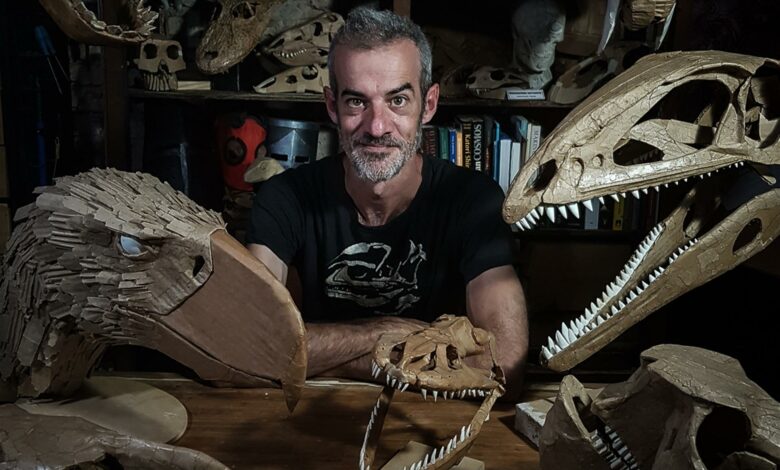
Merging science with art, Argentine paleoartist Santiago Reuil, starting with fossil fragments, reconstructs the morphology of animals that went extinct thousands or millions of years ago.
It’s a task that he began almost three decades ago for museums and universities, and which today he is pursuing via his “Paleocarton” audiovisual project, where he invites people to replicate his professional work with everyday materials.
With a passionate interest in paleontology, not to mention being precocious and persevering, Reuil began his career at age 14 when he volunteered at Argentina’s Bernardino Rivadavia Museum of Natural Sciences (MACN), something that he had wanted to do since he was 10.
He worked there for a long time, moving through different laboratories, learning the trade and, later, he began working with different museums and universities around the country and abroad, putting his skills to use in technical and artistic work.
For some years now, Santiago has had his surname attached to a species of sauropod from Argentina’s Patagonia region – Puertasaurus reuili – fossilized remains of which were found by his colleague Pablo Puerta, and for which he reconstructed a vertebra from a mass of tiny bone fragments.
“Many hours of jigsaw puzzle work, trying one fragment against another, and finally I was able to assemble a neck vertebra, which up to that point (had not been done),” the paleoartist told EFE.
Regarding the distinction honoring Puerta and Reuil that comes with the ancient animal’s name, a name bestowed on the beast by MACN paleontologist Fernando Novas, who is in charge of the project, the artist said that “It was one of the most incredible things that had happened to me in my career.”
“In recent years, not many months have passed without our receiving news of a new dinosaur species,” Reuil said, noting that right now he is working on two more reconstructions: an herbivore from Patagonia and a carnivore with the Abelisaurus family that was found in northern Argentina, where its remains had never been uncovered before.
Regarding the scientific study of the latter dino’s fossils, Reuil was invited by his colleagues to participate and he will also be featuring his reconstruction of it in his audiovisual project.
Before fossilized remains can be exhibited in a museums, there are several stages starting with extracting the fossils themselves and proceeding through the reconstruction process, including cleaning and restoring all the bone fragments.
Since it is very rare for a complete skeleton to be found, many of the reconstructions of the dinosaurs’ and other animals’ body structures in museums are prepared with a mixture of fossils and artificial parts, a task that is not as easy as it might sound.
“To make that reconstruction a phylogenetic study is made, that is, we examine what other animals were related to it, what the anatomy of the group to which it belongs is … to see how that general anatomy is adapted to the remains we have and then we do what’s called a parsimonious reconstruction,” he said. Read More…