Astronomers ponder 'cosmic mystery' over powerful radio wave bursts
-
 Loading...
 - Asir Hoque
- 14 Jun 2022
- 256 Views
- 0 Like
- 0 Comment
Powerful bursts of radio waves emanating from a distant dwarf galaxy that were detected using a massive telescope are moving scientists closer to solving what one called a "cosmic mystery" that has lingered for years.
Since being discovered in 2007, astronomers have struggled to understand what causes phenomena called fast radio bursts involving pulses of radio-frequency electromagnetic radiation originating from places inside our Milky Way and other galaxies. Radio waves have the longest wavelengths in the electromagnetic spectrum.
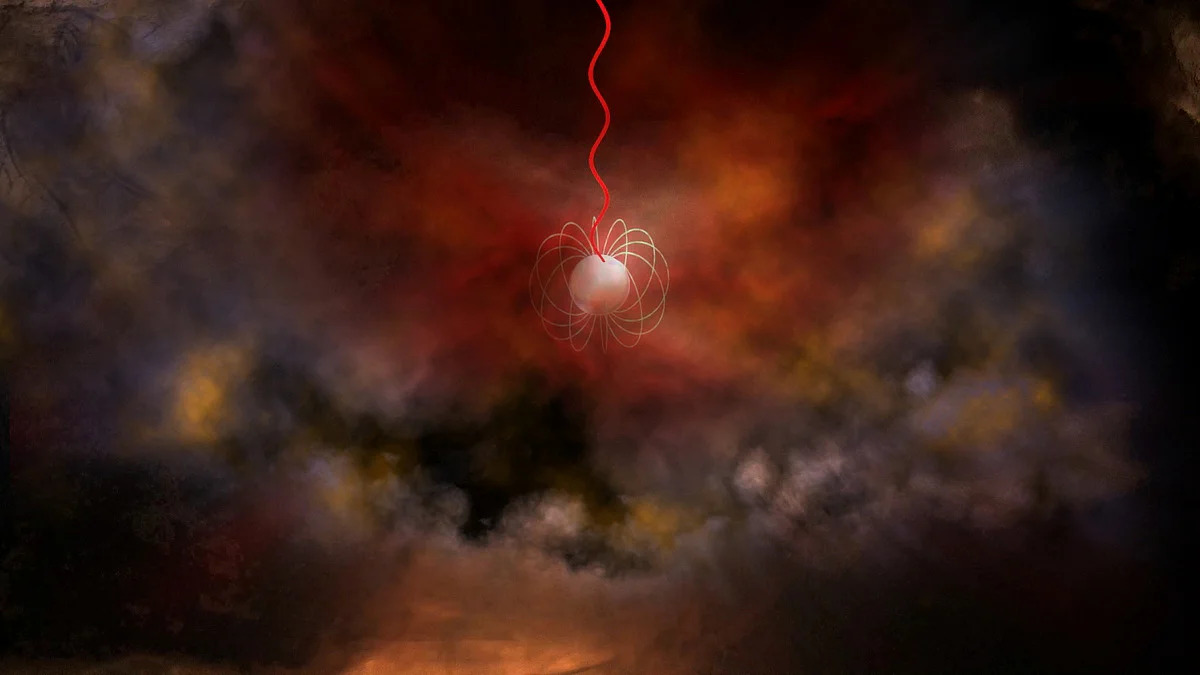
Astronomers suspect that these bursts may be unleashed by certain extreme objects. These might include: a neutron star, the compact collapsed core of a massive star that exploded as a supernova at the end of its life cycle; a magnetar, a type of neutron star with an ultra-strong magnetic field; and a black hole messily eating a neighboring star.
Researchers on Wednesday said they have detected a fast radio burst, or FRB, originating from a dwarf galaxy located nearly 3 billion light-years from Earth. A light year is the distance light travels in a year - 5.9 trillion miles (9.5 trillion km). This galaxy's collective star mass is roughly one-2,500th that of our Milky Way.
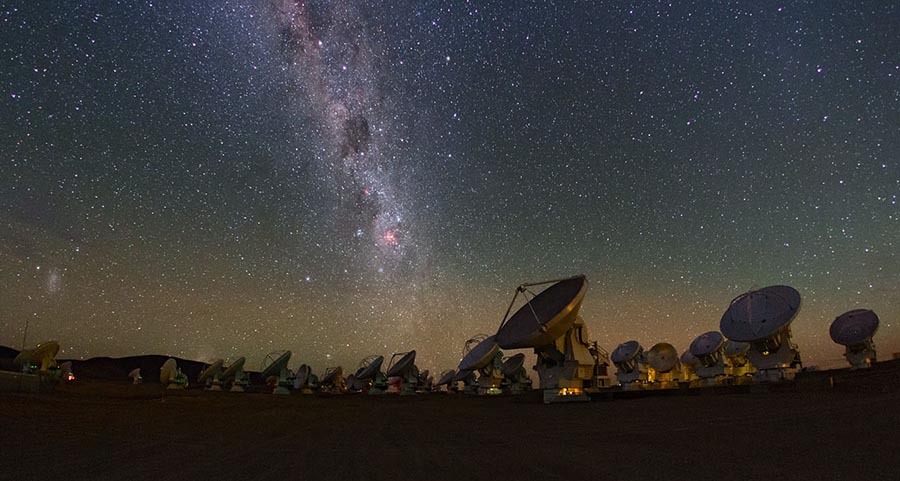
The FRB was first spotted in 2019 using the FAST telescope in the province, the world's largest single-dish radio telescope, which possesses a signal-receiving area equal to 30 football fields. It was studied further using the VLA telescope.
"We still call fast radio bursts a cosmic mystery and rightfully so," said astrophysicist Di Li of the Academy of Sciences, the FAST chief scientist and co-author of the research published in the journal Nature.
"Fast radio bursts are intense, brief flashes of radio light that are powerful enough to be seen from across the universe," added Caltech astronomer and study co-author Casey Law. "The burst blinks on and off in about a millisecond, far faster than the blink of an eye. Some sources of FRBs have been found to emit multiple bursts in what look like storms of activity, but others have only been seen to burst once." Read More...