What is ALMA telescope, that will soon get a ‘new brain’?
-
 Loading...
 - James Fisher
- 05 Apr 2023
- 67 Views
- 0 Like
- 0 Comment
Fully functional since 2013, ALMA has helped astronomers make groundbreaking discoveries, including that of starburst galaxies and the dust formation inside supernova 1987A
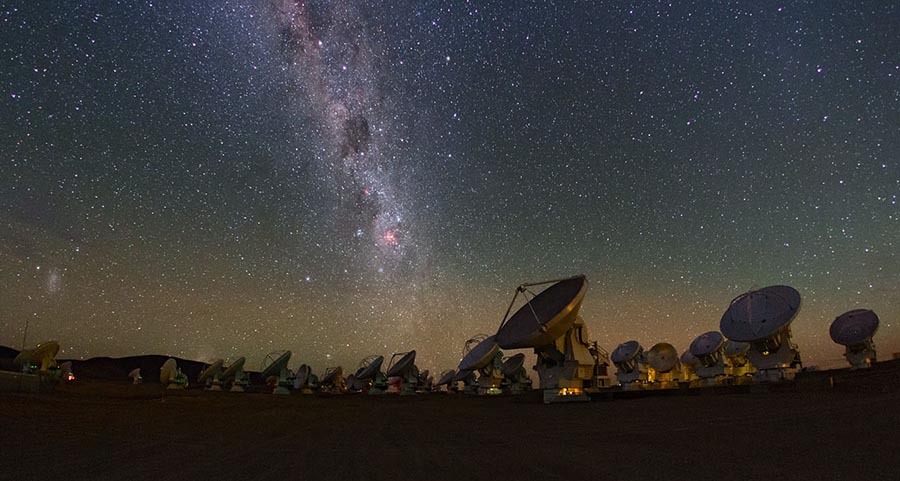
The Atacama Large Millimetre/submillimetre Array (ALMA) — a radio telescope comprising 66 antennas located in the Atacama Desert of northern Chile — is set to get software and hardware upgrades that will help it collect much more data and produce sharper images than ever before, the journal Science reported recently. It added that the upgrades would take around five years to finish and cost $37 million.
The most significant modernisation made to ALMA will be the replacement of its correlator, a supercomputer that combines the input from individual antennas and allows astronomers to produce highly detailed images of celestial objects.
“Today, ALMA’s correlators are among the world’s fastest supercomputers. Over the next 10 years, the upgrade will double and eventually quadruple their overall observing speed,” said the National Research Council of Canada (NRC), whose Herzberg Astronomy and Astrophysics Research Centre will work along with the U.S. National Science Foundation (NSF) National Radio Astronomy Observatory (NRAO), Massachusetts Institute of Technology (MIT) Haystack Observatory and a Canadian industry partner to upgrade the telescope’s “brain”.
As ALMA is operated under a partnership among the United States, 16 countries in Europe, Canada, Japan, South Korea, Taiwan, and Chile, the announcement came after all the partners cleared the funding required for the improvements.
Fully functional since 2013, the radio telescope was designed, planned and constructed by the US’s National Radio Astronomy Observatory (NRAO), the National Astronomical Observatory of Japan (NAOJ) and the European Southern Observatory (ESO). Over the years, it has helped astronomers make groundbreaking discoveries, including that of starburst galaxies and the dust formation inside supernova 1987A.
What is ALMA?
ALMA is a state-of-the-art telescope that studies celestial objects at millimetre and submillimetre wavelengths — they can penetrate through dust clouds and help astronomers examine dim and distant galaxies and stars out there. It also has extraordinary sensitivity, which allows it to detect even extremely faint radio signals.
As mentioned before, the telescope consists of 66 high-precision antennas, spread over a distance of up to 16 km. Read More…