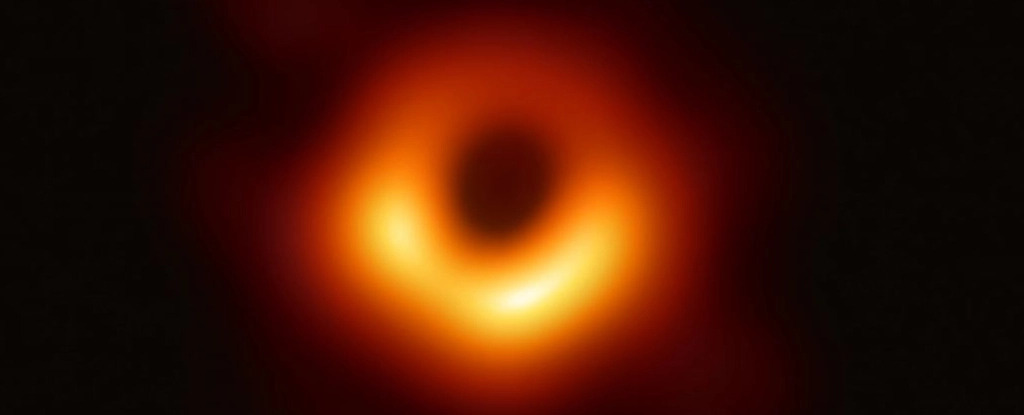
Astronomers Reveal a Black Hole's Photon Ring For The Very First Time
-
 Loading...
 - Gwen Hebert
- 22 Aug 2022
- 57 Views
- 0 Like
- 0 Comment
In 2019, the Event Horizon Telescope gave us our first direct image of a black hole. It was a powerful image, but not one with much detail. It looks like a blurry orange donut.
To be fair, the real meat of the discovery was in the data, not the image. And as a recent study shows, there's a great deal more in the data than what we've seen.
One of the important things to understand about the EHT image is that it doesn't show the glow of the black hole itself. Black holes don't emit light directly.
And unlike less detailed images of supermassive black holes we have, the glow isn't due to jets of plasma or a torus of superheated gas around the black hole.
Instead, the image shows radio light that was focused by the black hole.
The black hole in M87 is bathed in light from nearby gas, including radio light. When a particular beam of light passes close to the black hole, the warping of spacetime causes it to change direction a bit.
We've observed the slight deflection of light from things such as the stars and galaxies numerous times, but close to a black hole the light can change direction significantly.
It could loop around to make a right-angle turn, or even end up heading back from the direction it came. The closer the path to the black hole, the more radical the change in direction.
Light is passing near the black hole in all sorts of directions, but from our perspective, we can only see the light that is focused toward us. Any beam of light that loops around the black hole and heads our way, we should be able to see. Read More…