At the Marinduque Wildlife Sanctuary, stunning crawlers abound

Because of how Marinduque is shaped, the island-province located in MIMAROPA is known as the heart of the Philippines.
And in the heart of the Marinduque lies its Wildlife Sanctuary.
The Marinduque WIldlife Sanctuary (MWS) is a sprawling area of mountainous terrain that covers some 9,700 hectares within five municipalities, or some 23 barangays.
Rain or shine, MWS holds quite the wildlife — and no, we don't mean huge majestic beasts or enchanting creatures. We critters. Incredible, out-of-this-world critters crawling on the ground.
In an episode of "Born to be Wild," Doc Nielsen Donato, together with Dr. Doreen Mascareñas of the Marinduque State College, visited the protected area to survey the richness of life it has to offer.
Weather was dark and gloomy, but MWS showed off. Immediately, Doc Nielsen found blue worms amid dry fallen leaves,
Blue worms are glossy skinned earth worms that boast of tips that are color blue. They don't just crawl on the ground, blue worms can breathe in water too.
And perhaps a testament to their penchant for water: Blue worms come out of the wood work when it's raining. When it's hot and sunny, they squirt out acid from pore-like holes on their back.
Blue worms feast on rotting organic matter, and when they poop it out, they return the nutrients to the ground, making for healthier and better fauna. This somehow explains the lushness of the MWS forest.
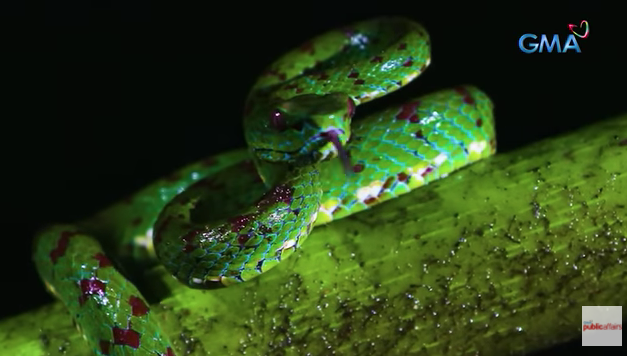
But that's not all. Apart from blue worms, Doc Nielsen also spotted pit vipers, lithe, vibrant green snakes with arrow-shaped heads. According to Doc Nielsen, pit vipers often live on trees but in the occasion they saw the snake, it was crawling on the ground, thanks to the rainy weather.
Pit vipers have hemotoxic venom, which means it can paralyze and kill smaller preys. What happens when they bite humans? They can cause necrosis, or the death of body tissues. Wild things, pit vipers are.
According to Doc Nielsen, the pit vipers in MWS are still pretty young, "an indication na nagpaparami pa sila," he said.
Dr. Doreen Mascareñas said MWS has been declared a protected area since 2004. "Kailangan talaga ingatan itong gubat na ito. Habitat ito ng mga important wildlife," she began.
"Pasalamat nga kami na declared siya as protected area kasi kung hindi, malamang kinaingin na talaga ito ng mga tao." Read More…