Bolivia's Venice Biennale Pavilion Has Been Marred By Accusations of Nepotism and Plagiarism
-
 Loading...
 - Maria Asenova
- 25 Jul 2022
- 99 Views
- 0 Like
- 0 Comment
Ever since Bolivia announced in early April the Warmichcha Collective as the artists behind the country’s pavilion at the 2022 Venice Biennale, the choice has been mired in controversy.
The multidisciplinary collective and the pavilion’s commissioner, the Indigenous artist Mamani Mamani (officially listed on the Biennale’s website as Roberto Aguilar Quisbert), are set to present “Wara Wara Jawira” (“River of Stars”) this week, during the Biennale’s professional previews, ahead of its public opening on April 23.
However, two Bolivian artists and a curator have accused Mamani of nepotism and plagiarism.
The complaint has come from the curator Marisabel Villagómez and artists Maximiliano Siñani and Iván Cáceres, who allege that their proposal to represent Bolivia at the Biennale was approved in January by the Ministry of Cultures, Decolonization, and Depatriarchalization, as well as Mamani, the counselor of the Cultural Foundation of the Central Bank of Bolivia, an entity that previously organized the Bolivian Pavilion with the Ministry.
Shortly after their acceptance, according to Siñani, the Ministry and Mamani cut off communication, except for a WhatsApp message in which Mamani told Villagómez that she had worked in a cultural position under former president Jeanine Añéz, who is currently in prison and has been charged with unconstitutionally assuming the presidency in November 2019, in what has been described by some as a coup against former president Evo Morales. The implication: that Villagómez’s association with Añéz was disqualifying.
Days after the acceptance, the Ministry unveiled the Bolivian Pavilion, with the recently formed Warmichacha Collective as representatives and Mamani as the Pavilion’s commissioner. The collective’s curatorial proposal, said Siñani, “contains various points of our curatorial proposal.”
“In Quechua there is a saying that says ‘ama sua, ama llulla, ama quella,’ which means you will not steal, you will not lie and not be lazy,” Siñani said.
In the trio’s view, because Bolivia has never had a transparent selection process for Biennale participation, Mamani was able to make a decision that appears both politically motivated and designed to benefit him personally. Mamani hired his sons, Illimani and Illampu Aguilar, to provide “logistical support” for the pavilion, though Mamani told ARTNews that he personally paid their salaries.
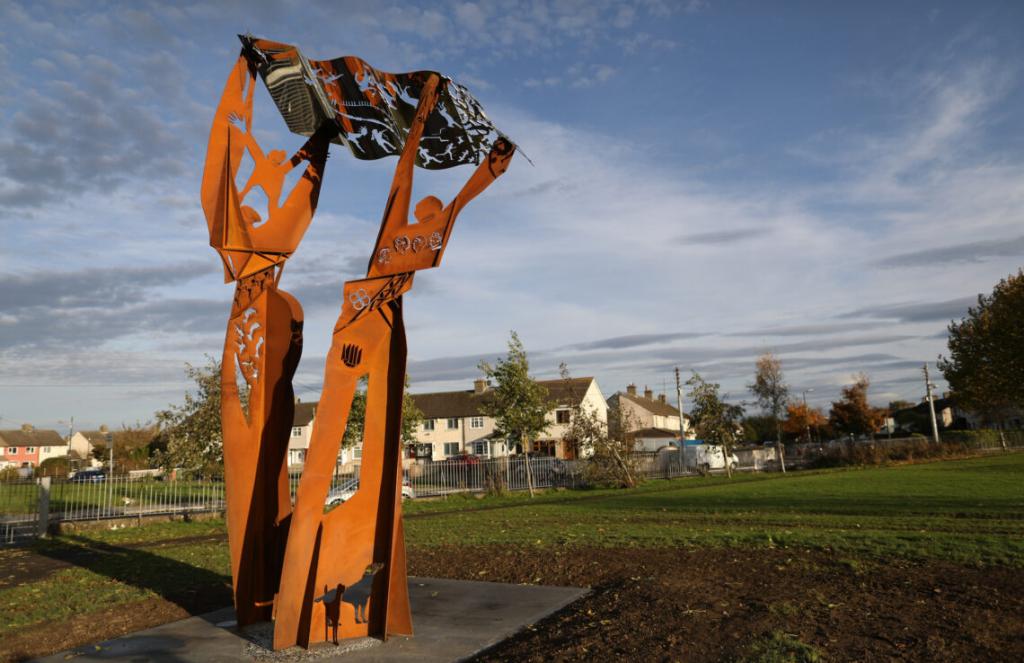
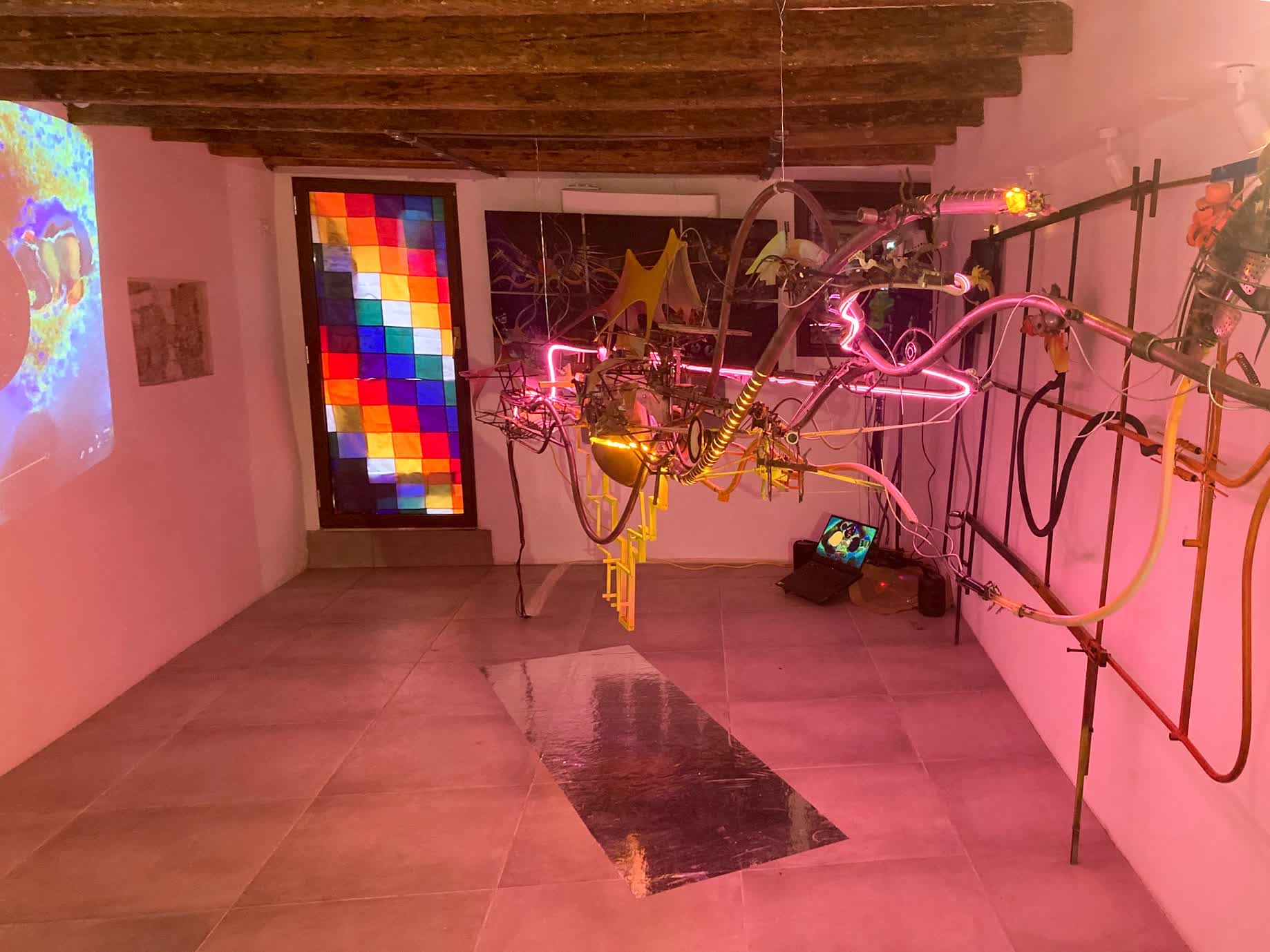
“Wara Wara Jawira,” the exhibition now on display in Venice at the venue Artspace4rent (Cannaregio 4120), is defined in a press release as a “collective vision that investigates the peripheries and the cracks of the dominant discourses and proposes a different starting point, an introspective paradigm, from a culture alive and ancestral, with a mystical and animist worldview, such as the indigenous worldview.” The work is a “sound-visual-plastic” installation consisting of a metallic sculpture, audiovisual projections, and 25 individual works by each member of the group.
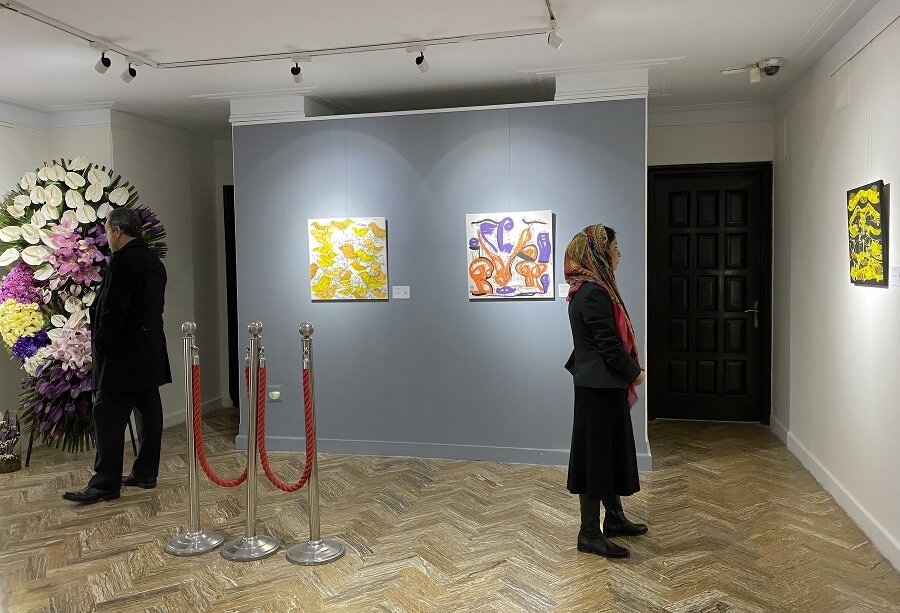
An open entranceway to a small gallery space with a free-standing sign notifying visitors that it is the Bolivia National Pavilion.
The Bolivian Minister of Culture, Sabina Orellana Cruz, declined to comment for this article.
Mamani, for his part, said that his role as counselor to the Central Bank Foundation is not a conflict of interest to serving as commissioner, but a qualification. Further, he said, the Warmichacha proposal “celebrates diversity, plurality and collective thought as foundation and base, forming a community that breaks with the dominant traditional Western paradigms.”
The project proposed by Villagómez, Siñani, Cáceres, entitled “El desvío,“ was based on a sculptural installation and a cartography that similarly translated the Andean landscape with a cosmic and mystical background.
Mamani’s curatorial text, Villagómez said, “misuses and messes up the concept of cultural landscape that I use in my curatorship.”
However, most members of the collective—which is comprised of mostly 20-something anthropologists, musicians, philosophers, and poets—have little or no experience with international exhibitions or are not even artists. The Collective did not respond to a request for comment. However, when asked about the composition of the group, Mamani seemed to cast it as a strength. Read More...