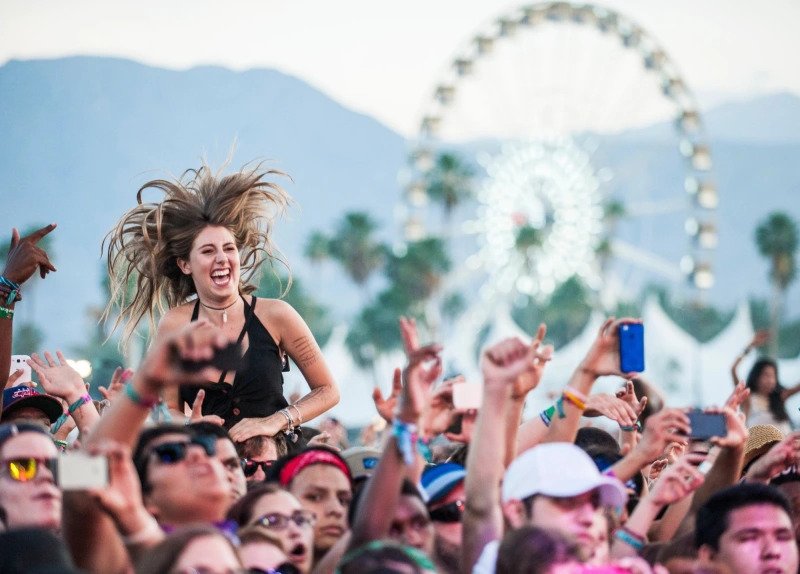
Coachella 2022: Fans talk About Return to Festival in Post-COVID-19 Environment
-
 Loading...
 - Luna Becerra
- 14 Apr 2022
- 313 Views
- 0 Like
- 0 Comment
Justin Cohen has waited for the gates to the Coachella Valley Music and Arts Festival to reopen for a long time.
How long? The 32-year-old West Hollywood dog walker bought his ticket in June 2019 and has held onto it ever since.
“I remember when it got postponed in March 2020,” Cohen says. “I said right then, ‘When we can go back to Coachella, it’ll be almost like an invisible finish line for us.’”
Michael Recon bought his VIP wristband for the 2022 festival in June 2021, operating under the belief that by April 2022 the world would be safe enough to gather with 125,000 fans at the desert fest.
But by December, Recon, a senior accounting assistant for Riverside County who moonlights as a dance and choreography instructor, wasn’t so sure.
“I actually thought that things would be a lot better,” the 38-year-old Moreno Valley resident says. “A lot of things are opening up and everything, but I’m still cautious.
“I don’t think we’re at like herd immunity yet, and I think that’s a big deal,” Recon says. “I mean, we’re still out in the open – but you never know.”
Recon decided to sell his wristband and sit out this Coachella in the end.
The festival opens Friday, and for the next three weekends – two for the Coachella lineup, and a third for the Stagecoach Festival – tens of thousands of fans will congregate in front of the stages and inside the tents on the grounds of the Empire Polo Club.
The festivals will be packed and festivalgoers, performers, artists and vendors are thrilled to be back. But no one can guarantee that COVID-19 won’t be present in the Coachella crowds this month, as festival organizers Goldenvoice made explicitly clear on the festival’s website.
“There is an inherent and elevated risk of exposure to COVID-19 in any public place or place where people are present,” a bolded statement on Coachella.com reads. “And there is no guarantee, express or implied, that those attending the festival will not be exposed to COVID-19.”
In other words, you’ve been warned.
Public health perspectives
When the 2022 Coachella lineup was announced in January with headliners including Harry Styles and Billie Eilish, the festival still required attendees to wear masks and provide proof of vaccination based on state rules for large events.
A month later, in response to a sharp decline in COVID-19 cases, the state eased its vaccine and mask rules, and the Coachella organizers dropped the requirement for both.
Riverside County Public Health Director Kim Saruwatari, in an interview Tuesday, said that while there’s concern any time a large group of people gathers, the risk of Coachella and Stagecoach becoming super-spreader events “is a lot less than it was six or seven months ago.”
The county’s positivity and case rates are low, but the wild card is what those rates are in the areas where festivalgoers are coming from, Saruwatari said, adding that she has “some comfort” in the partnership between her department and Goldenvoice.
Goldenvoice “has been in regular communication with our team that is running our COVID response,” Saruwatari said. The promoter “want(s) to make a safe environment” at the festivals, she said.
A private contractor will offer tests at the polo grounds, while a Riverside County testing bus will roam in the vicinity of the festival for three weeks and hours at testing sites near the polo grounds will be expanded, Saruwatari said, noting that people can visit myturn.ca.gov or www.rivcoph.org/coronavirus for information on where to get tested and vaccinated.
The Coachella website includes more specifics on the availability of rapid 15-minute antigen tests at the Indian Wells Tennis Garden and in the Camping Hub on the festival grounds.
The county has set up a “pathway” for those suspected of having or testing positive for COVID-19 at the festivals to be evaluated to see if they should be treated with therapeutics, Saruwatari said.
She urged festivalgoers to get vaccinated beforehand. Those at the festivals should wear masks – N95 masks offer the best protection, but “anything is better than nothing,” Saruwatari said.
While social distancing is a tall task amid hundreds of thousands of people, it’s encouraged, Saruwatari said. Festivalgoers should also stick to the same group of people so they can be informed quicker if someone in their group gets infected, she said.
Festivalgoers also might want to test once they’ve returned from Indio, especially if they have family members at high risk of severe illness or death from COVID-19, Saruwatari said. Read More...