David Lynch’s Art is The Key to Unlocking His Cryptic Films
-
 Loading...
 - Mandisa Aziz
- 29 Jan 2025
- 42 Views
- 0 Like
- 0 Comment
It’s often said that trying to explain David Lynch’s films is a fool’s errand, as they are intentionally crafted to induce confusion and provoke thought. Yet, despite the inherent ambiguity, audiences continue to seek clarity in his work. In a nod to this desire for understanding, Lynch once provided a list of ten “clues” to accompany the DVD release of his 2001 film Mulholland Drive. These clues were meant to unlock the film’s mysteries, with the first hinting that two clues were revealed even before the opening credits rolled.
As a teenager, I spent countless hours rewinding and rewatching those initial moments of Mulholland Drive, convinced that a hidden truth lay just beneath the surface. However, as an adult, I’ve come to realize that the film’s riddle is not meant to be cracked, even with Lynch’s guidance. This sentiment extends to his entire body of work, from the unsettling Blue Velvet (1986) to the bizarre What Did Jack Do? (2017), where Lynch interviews a capuchin monkey who may have committed murder.
Lynch’s films are filled with surreal imagery: a severed ear, animated rabbits, a grotesque baby, and a mysterious blue box. These elements signify one thing—strangeness. Lynch’s artistic vision suggests that life is fundamentally enigmatic, and the best we can do is accept that peculiarity and enjoy the ride.
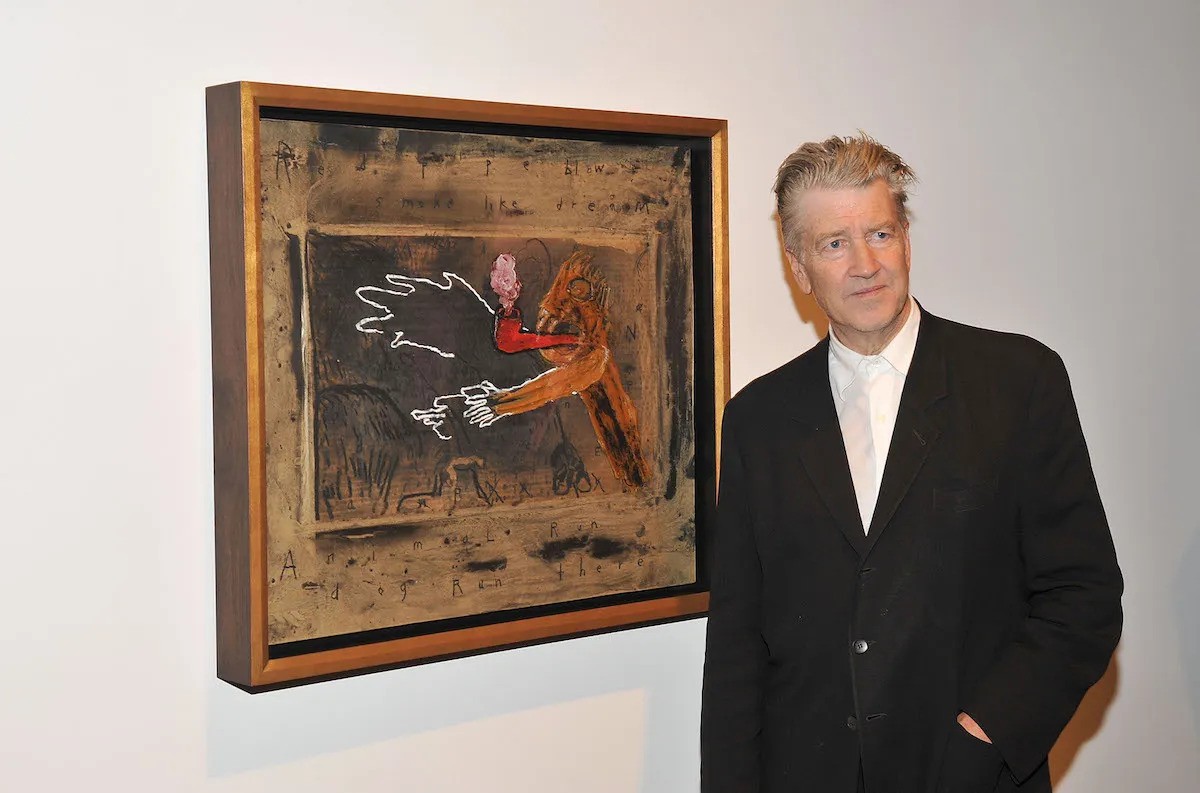
However, there is a pathway to understanding why Lynch chooses to represent the world in such a cryptic manner, and that path leads to his paintings. For decades, Lynch has produced art alongside his films, referring to this creative outlet as his “art life.”
While some critics, like Roberta Smith, have dismissed Lynch’s paintings as “familiar, unoriginal, and slick,” there are moments where his art shines with humor and charm. Regardless of their artistic merit, Lynch’s paintings offer valuable insight into his motivations as a filmmaker.

The thematic connections between his films and his art are striking. For instance, his 1988 painting Shadow of a Twisted Hand Across My House echoes the themes of Blue Velvet. The painting depicts a seemingly idyllic suburban scene—a small house under a clear sky—but the sky is ominously black, and a giant hand-shaped tree looms over the house, ready to crush it. This imagery mirrors Blue Velvet’s exploration of the dark underbelly of small-town America.
Recurring characters from his films also appear in his artwork. The horrifying infant from Eraserhead was sketched by Lynch long before the film’s completion in 1977. Similarly, a version of the mask-wearing “jumping man” from Twin Peaks: Fire Walk with Me reappears in Ant on My Arm, a piece featured in Lynch’s 2022 Pace Gallery show.
While Lynch enthusiasts may find numerous connections between his art and films, the true intrigue lies in his artistic process. Lynch’s approach to painting emphasizes a handmade aesthetic that contrasts with the polished nature of his films.
In interviews, Lynch has described his painting process as tactile and physical, often incorporating unconventional materials like glue, paint, and ashes—an homage to his habit of smoking. He frequently refers to the textured surfaces he creates as “organic phenomena,” suggesting a fascination with the transformation of invisible forces into tangible art.
Lynch’s artistic journey was influenced by Robert Henri’s 1923 book The Art Spirit, which he read as a teenager. Henri’s ideas about art as a means of discovering creativity and becoming “clairvoyant” resonated with Lynch, who initially sought to explore other realms through painting before turning to film.
Early works, such as an untitled piece from 1965-1969, showcase Lynch’s desire to tap into the spirit world. Against a black void, a crimson spray—perhaps a cascade of blood—emerges beside a gaping maw, evoking a sense of malevolence and the unknown.
Lynch’s figurative paintings from his time at the Pennsylvania Academy of Fine Arts (PAFA) also delve into darkness, featuring distorted figures: women with knife-like mouths and men with elongated limbs. These creatures move in and out of shadows, reflecting Lynch’s quest to conjure the unseen.
One of the joys of Lynch’s art is its unclassifiable nature; it defies easy categorization within art history. While some critics have drawn parallels between Lynch’s work and that of postwar Los Angeles artists, Lynch himself has claimed ignorance of art history, further emphasizing the uniqueness of his vision.
For Lynch, film became a medium to amplify the oddity of his paintings. His 1967 work Six Men Getting Sick, which depicts exactly what the title suggests, was transformed into his first film by projecting images onto the painting and filming the results. Similarly, Gardenback, a painting from 1968-1970, shares its name with an unrealized film concept that revolved around the theme of cheating.
Film scholars often view Lynch’s paintings as mere stepping stones toward his cinematic achievements, but I argue that works like Gardenback already served as powerful conduits for channeling otherworldly experiences. Lynch’s films can be seen as extensions of his artistic explorations, where each frame functions as a piece of a larger installation, brought to life by performers.
This perspective is particularly evident in Eraserhead, where Lynch meticulously crafted many elements seen on screen. The film’s distinctive lighting fixtures resemble the sculptural lamps he later showcased, and he continued to create art during its production, using drawings to visualize the images he aimed to manifest. Unlike traditional storyboarding, these sketches were more akin to preparatory studies for an ambitious painting, with the film itself becoming the final artwork.
A captivating photograph from the Eraserhead set captures Lynch drawing between takes, with actor Jack Nance waiting for the next shot. Instead of sketching Nance, Lynch’s pencil meanders across the page, forming a line that winds around a hand gripping a gun. Notably, he uses a clapboard as a surface for his drawing, merging the tools of filmmaking with his artistic practice.
David Lynch’s art provides a crucial lens through which to understand his films. The peculiarities and enigmas present in his cinematic works are deeply rooted in his artistic philosophy and practice. By examining his paintings, we gain insight into the creative impulses that drive Lynch, revealing a world where the boundaries between art and film blur, and where the strange and the beautiful coexist in a dance of imagination.