Deep ocean bacteria discovered to play large role in carbon capture
-
 Loading...
 - Jen Murphy
- 28 Nov 2020
- 1036 Views
- 0 Like
- 0 Comment
Marine bacteria that live in the dark depths of the ocean play a newly discovered and significant role in the global carbon cycle, according to a new study published in Science.
The "dark ocean" -- everything that lies below 200 meters -- makes up 90 percent of the ocean. Very little is known about the microscopic life in this realm and its critical role in transforming carbon dioxide to cell material, proteins, carbohydrates and lipids. This freshly produced organic material can then be consumed by other marine organisms enhancing the productivity of the ocean.
Most dark ocean carbon is captured in the mesopelagic zone, which lies between 200 and 1000 meters below the ocean surface. Identities of microorganisms performing this process and the energy sources involved have remained a great mystery. By analyzing the genomes found in seawater samples from this zone, scientists from Bigelow Laboratory for Ocean Sciences have now identified some of most significant contributors -- nitrite-oxidizing bacteria.
"We knew these bacteria were there and involved in the global carbon cycle, but their role is so much larger than what scientists previously thought," said Maria Pachiadaki, postdoctoral scientist at Bigelow Laboratory.
These bacteria derive their energy from the oxidation of nitrogen compounds. They account for fewer than 5 percent of the microbial cells in the dark ocean, which previously led scientists to greatly underestimate their contribution. This study reveals that despite their relatively low abundance, nitrite-oxidizing bacteria capture more than 1.1 gigatons of carbon dioxide in the mesopelagic zone annually. This is comparable to prior estimates of the total carbon captured in the entire dark ocean.
The team analyzed the composition of microbial mesopelagic communities based on genetic information in seawater samples from 40 locations around the world. They then used single cell genomics tools to fully sequence individual cells and examine their biology based on their genetic blueprints.
"Before genomics techniques, the dark ocean was a black box, because microorganisms from this environment refuse to grow in research laboratories," said Ramunas Stepanauskas, a senior research scientist at Bigelow Laboratory and director of the Single Cell Genomics Center. "Now, using contemporary tools that were developed by our group, we can open this black box and understand who is living there, what they are doing, and how they are doing it."
The research behind this Science paper began with an effort to identify new groups of microscopic organisms in the mesopelagic zone. According to Pachiadaki, the previously accepted explanation for carbon capture in the dark ocean did not seem correct under close inspection. Archaea, a much more abundant group of microorganisms in the dark ocean, had been credited with doing most of the work, but the math just didn't add up. The team set out to discover the unidentified organisms that were the true champions of carbon dioxide capture in the vast dark ocean.
The team analyzed nearly 3,500 genomes of bacteria and archaea. When they didn't find any other organisms that had the metabolic pathways to capture carbon and that occurred in great enough abundance, they started to take a closer look at the nitrite-oxidizing bacteria.
About 100 of the analyzed genomes were identified as nitrite-oxidizing bacteria, and the team selected and fully sequenced the genetic information of 30 representative organisms.
"If we didn't have the genomic data, we probably would never have thought to look into these bacteria's impact on the carbon cycle," Pachiadaki said.
Throughout the course of the project, state-of-the-art genomics techniques continued to evolve rapidly, and Bigelow Laboratory's Single Cell Genomics Center added advanced technology that allowed the researchers to estimate cell diameters. Suddenly, the scientists could see that the nitrite-oxidizing bacteria were much larger than the abundant archaea previously thought to be responsible for the majority of carbon capture in the dark ocean.
"They may only make up 5 percent of the population, but the cells of the nitrite-oxidizing bacteria are 50 times larger," Pachiadaki said.
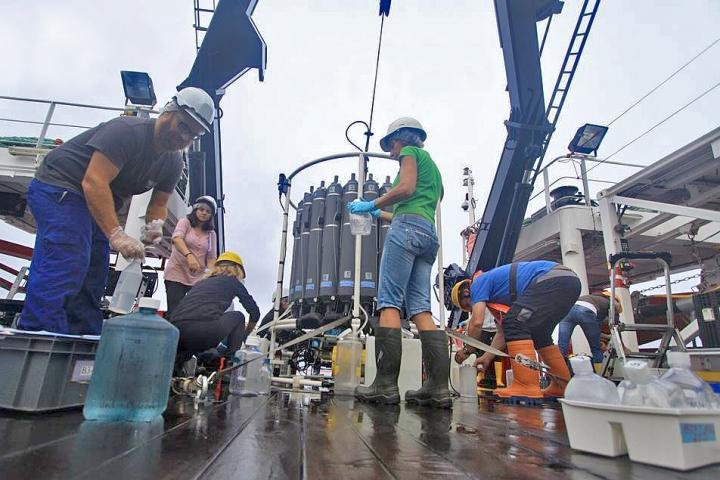
To verify their hypothesis, the team designed a series of experiments with collaborators from the University of Vienna. Professor Gerhard Herndl's research group took seawater samples from the mesopelagic zone in multiple locations in North Atlantic and added carbon dioxide that had been marked with a radioactive tag. This allowed them to determine the amount absorbed by each group of microorganisms, which confirmed the dominant role of nitrite-oxidizing bacteria in carbon capture.
"These results shed new light on the link between nitrogen and carbon cycles in the ocean's interior," Herndl said. "We experimentally demonstrated the major role of nitrite oxidizers in capturing carbon dioxide in the dark ocean and illuminated a group of microbes which has not yet received adequate attention for their impact in the oceanic carbon cycle."