Delayed T cell Response Allows Tuberculosis to Gain Foothold in Monkeys
-
 Loading...
 - Alice Barone
- 03 Jun 2022
- 256 Views
- 0 Like
- 0 Comment
Tuberculosis kills about 1.5 million people worldwide each year. Among infectious diseases, it’s currently second only to COVID-19 as a cause of death. The interaction of the disease’s causative agent, Mycobacterium tuberculosis (Mtb), with its hosts is complex, and there are many unanswered questions about the infection, including why it can linger in the body for months or years. Now, in a study conducted on monkeys and published in Cell Reports on May 17, University of Pittsburgh researchers find that a key subset of infection-fighting immune cells only become fully active three months after the body first encounters Mtb, with a second subset of these cells emerging five months postinfection. The results suggest that a delayed adaptive immune response might be crucial to Mtb’s ability to establish a foothold in a host.
“That [the] TB immune response is unusual compared to other pathogens had been known for years, but people still don’t really understand why,” says Al Leslie, an investigator at the KwaZulu-Natal Research Institute for TB-HIV in South Africa who was not involved in the work but has previously collaborated with the authors. “It is a difficult problem and this study helps to unravel it.”
After a host inhales Mtb, previous research has found that the immune system typically responds by deploying cells such as macrophages and T cells to the lungs, and by forming lung granulomas—structures that contain innate and adaptive immune cells that encapsulate the bacteria. Other components also respond to the infection, but the interplay between them and the pathogen is not well understood. Researchers have found that Mtb is equipped with an arsenal of tools that allow it to escape the immune response, often leading to latent TB with the formation of secondary granulomas that consist of infected macrophages surrounded by immune cells “guards.” The bacteria within those structures sometimes become reactivated months or years later if the immune system weakens due to immunosuppressive therapies or disease.
Probing this phenomenon with animal models has proven difficult. Studies using mice have helped researchers to understand the immune response to the bacterium, but they do not fully recapitulate human disease. “Mice have a different pathology when it comes to TB—they don’t [naturally] have the granulomas,” JoAnne Flynn, one of the coauthors of the new research. So her research group instead studies TB using cynomolgus macaques (Macaca fascicularis), which do form granulomas. In the paper, she and her colleagues infected the monkeys with virulent Mtb and analyzed bacterial growth and cellular composition in the animals’ lung granulomas at 4, 12, and 20 weeks postinfection.
Previous studies from the same and other groups have found that primary and secondary granulomas differ in structure and functionality. The authors decided to track the primary granulomas over time using PET-CT scans. They also euthanized some of the monkeys at each of the designated time points and examined their granulomas’ structure, cellular composition, and function with immunohistochemistry and flow cytometry. The researchers used banked samples of primary granulomas isolated from monkeys at similar time points postinfection to further supplement their data. They found that innate immune cells mediate most granulomas’ immune activity four weeks postinfection. At 12 weeks, the first adaptive immune cells start to kick in.
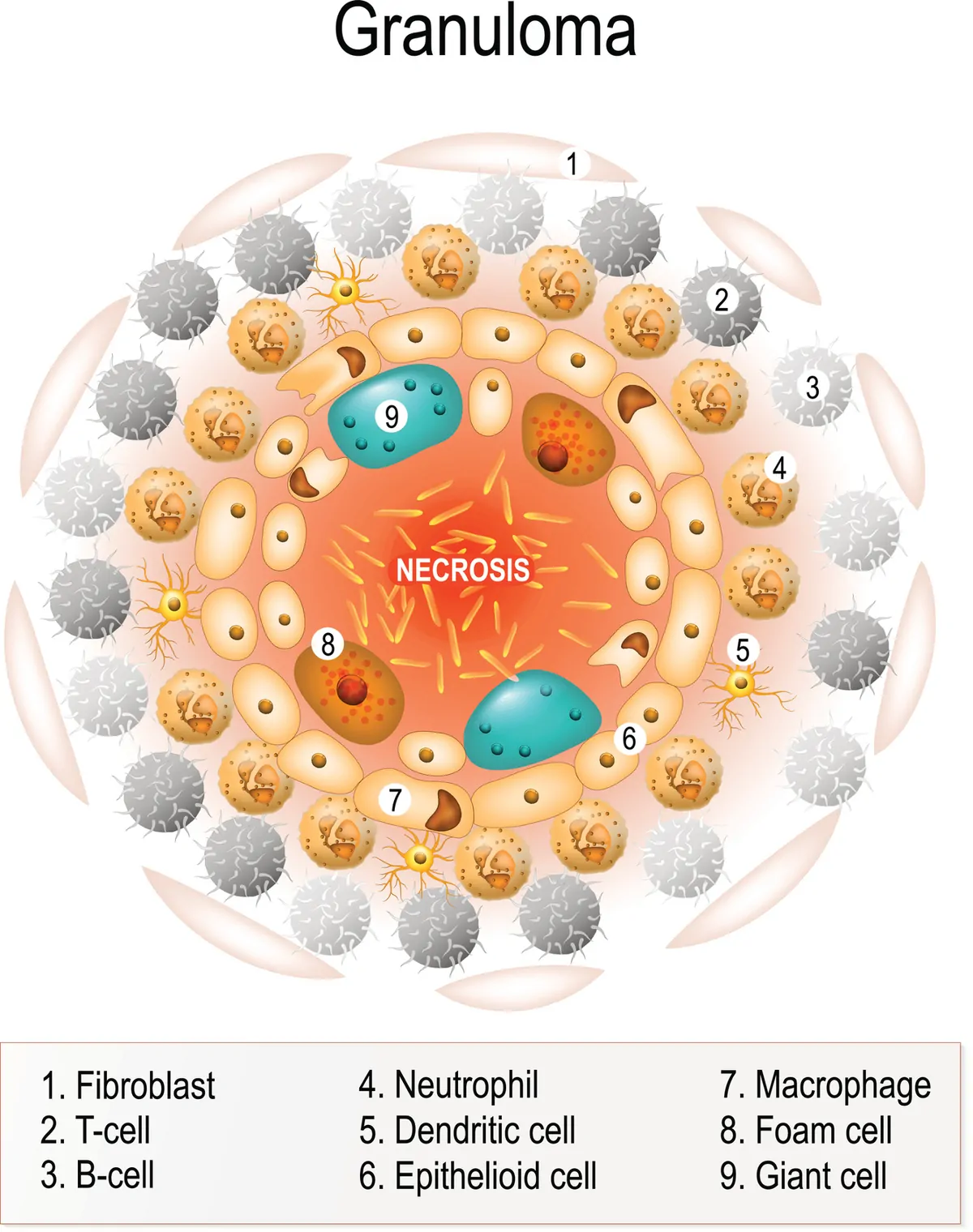
Mtb is an intracellular bacteria, and therefore researchers studying the immune response to it have mainly focused their attention on CD4+ T cells, which specialize in recognizing infected innate immune cells and secrete a variety of cytokines that attract other immune cells to the site of infection. However, growing evidence suggests that CD8+ T cells, which had been thought to become involved in the infection in killing target cells, also play a role in battling Mtb early on. The study found that CD8+ T cells arrived first in the granulomas, becoming detectable at the 12-week timepoint. CD4+ T cells only appeared after 20 weeks. “We know that CD4 [T cells] are important; everybody knows that. But in our parameters, there wasn’t a significant difference in the frequency of those cells until the late time point,” Flynn says.
To gain more information on those T cells, the researchers profiled the expression of transcription factors that reflect immune cell function. Among the transcription factors analyzed, they found that one called T-Bet stood out for its increased expression over the course of infection, first author Nicole Grant tells The Scientist. T-Bet is a pro-inflammatory transcription factor known for its involvement in immune responses to pathogens; previous studies have found that the presence of T cells expressing T-Bet is associated with control of infectious diseases, including TB.
In the new study, the researchers saw that there is an increase in the frequency of T-Bet expression in CD8+ T cells found within the granulomas at 12 weeks, followed by an increased frequency of CD4+T-Bet+ cells at 20 weeks postinfection. The appearance of T-Bet+ T cells corresponded to a reduction of the bacterial burden, further confirming the importance of T-Bet-expressing cells in granulomas.
The researchers hypothesize that the slow evolution of adaptive immunity contributes to the ease with which Mtb establishes infection and supports the development of latent disease. “Even if it doesn’t tell you the mechanism, you see the bacteria go down in this study” when T cell frequency increase, explains Leslie. “This agrees with all the literature that the bugs have more difficulty once the adaptive immune response turns up. [It] all make perfect biological sense.” Neil Schluger, a tuberculosis researcher at Columbia University who was not involved in the study, says the study used an appropriate model system to reach sophisticated findings on the adaptive immune response at the site of the granulomas and its evolution over time, adding to researchers’ knowledge of the complicated human host response to TB. Read More...