Diverticulitis: 9 Home Remedies And Natural Treatments
-
 Loading...
 - Acacia Cavalcanti
- 12 Sep 2022
- 76 Views
- 0 Like
- 0 Comment
Diverticular diseases have seen a sheer increase in the number of cases over the last century. Recent studies indicate that 50% of people older than 60 years are affected by diverticular diseases with 10%- 25% developing diverticulitis (1). Diverticulitis develops due to the formation of infectious pouches on the colon which is associated with extreme discomfort and requires immediate medical intervention. In this article, we take a look at what diverticulitis is and the treatment options available.
In This Article
What Is Diverticulitis?
Diverticulitis Vs. Diverticulosis
Signs And Symptoms
Causes And Risk Factors
How Is Diverticulitis Diagnosed?
Treatments For Diverticulitis
How To Manage The Symptoms Of Diverticulitis Naturally
Home Remedies To Ease The Pain Of Diverticulitis
How Does Your Diet Affect Diverticulitis?
Prevention Tips
What Is Diverticulitis?
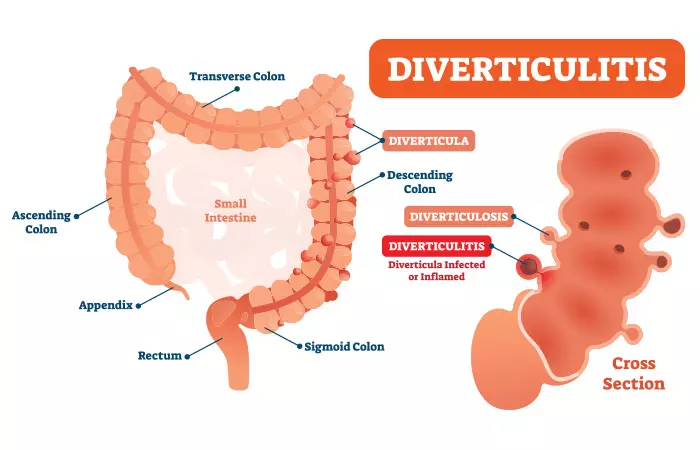
Diverticulitis is associated with the formation of diverticula, which are pouch-shaped formations that occur along your digestive tract. Diverticula most often occur in the colon, i.e., the large intestine.
These pouches are a result of weak spots in the intestinal walls that tend to blow outward. The pouches (diverticula) can become inflamed or infected by bacteria, thus causing diverticulitis.
Diverticula are harmless unless they are inflamed or infected. If you have developed diverticula that are not infected or inflamed, the condition is known as diverticulosis.
Let’s take a quick look a the major differences between diverticulitis and diverticulosis.
Diverticulitis Vs. Diverticulosis
Diverticulitis
It is associated with the formation of pouches called diverticula that become inflamed or infected.
There is a chance of recurrence.
Diverticulitis can also turn chronic in some people.
The risk of developing diverticulitis increases with age.
Diverticulosis
Diverticulosis is associated with the formation of pouches called diverticula that are not infected or inflamed.
It usually doesn’t exhibit any symptoms, and if the condition actually does cause symptoms, it is referred to as symptomatic uncomplicated diverticular disease (SUDD).
In rare cases, diverticulosis can result in the development of diverticulitis.
As in the cases of diverticulitis, the risk of developing diverticulosis increases with age.
Unlike diverticulosis, diverticulitis can cause mild to severe symptoms that can occur all of a sudden or gradually over a few days. Read More...