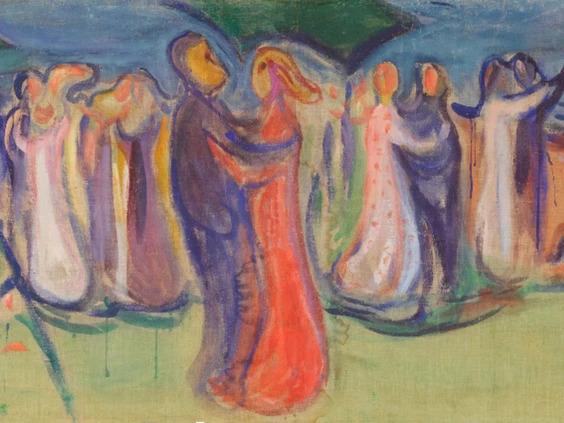
Edvard Munch painting found deep in woods of Norway was hidden from Nazis
-
 Loading...
 - Mandy Hill
- 25 Jan 2023
- 65 Views
- 0 Like
- 0 Comment
The painting, expected to sell for up to US$20 million, was first acquired by a Jewish art historian and curator who was forced to flee Europe ahead of the Second World War
A 13-foot-long painting by artist Edvard Munch — which was found in a barn in the woods of Norway after being hidden from Nazis during the Second World War — will be displayed for the first time since 1979 before being auctioned off in March.
Dance on the Beach was part of a larger work called The Reinhardt Frieze, made up of 12 canvases. It was commissioned by director Max Reinhardt for his avant-garde theatre in Berlin in 1906. The frieze was meant to give the audience an immersive experience and “trailblazed the relationship between performance and art,” auction house Sotheby’s said in a statement.
The painting was considered the most important part of the frieze and was the only section signed in full.
“In the foreground of the canvas are two of the artist’s great loves, affairs with both of whom ended in heartbreak,” according to Sotheby’s.
When Reinhardt’s theatre was refurbished in 1912, art historian and curator Curt Glaser acquired Dance on the Beach. He was also a friend and biographer of Munch.
Glaser and his wife built up an impressive art collection, including Old Master paintings, other pieces by Munch as well as works by Henri Matisse and Max Beckmann — but Glaser, who was Jewish, was persecuted by the Nazis and had to flee Europe in 1933. Read More…