Room for interpretation
-
 Loading...
 - Amanda Miller
- 25 Jan 2023
- 64 Views
- 0 Like
- 0 Comment
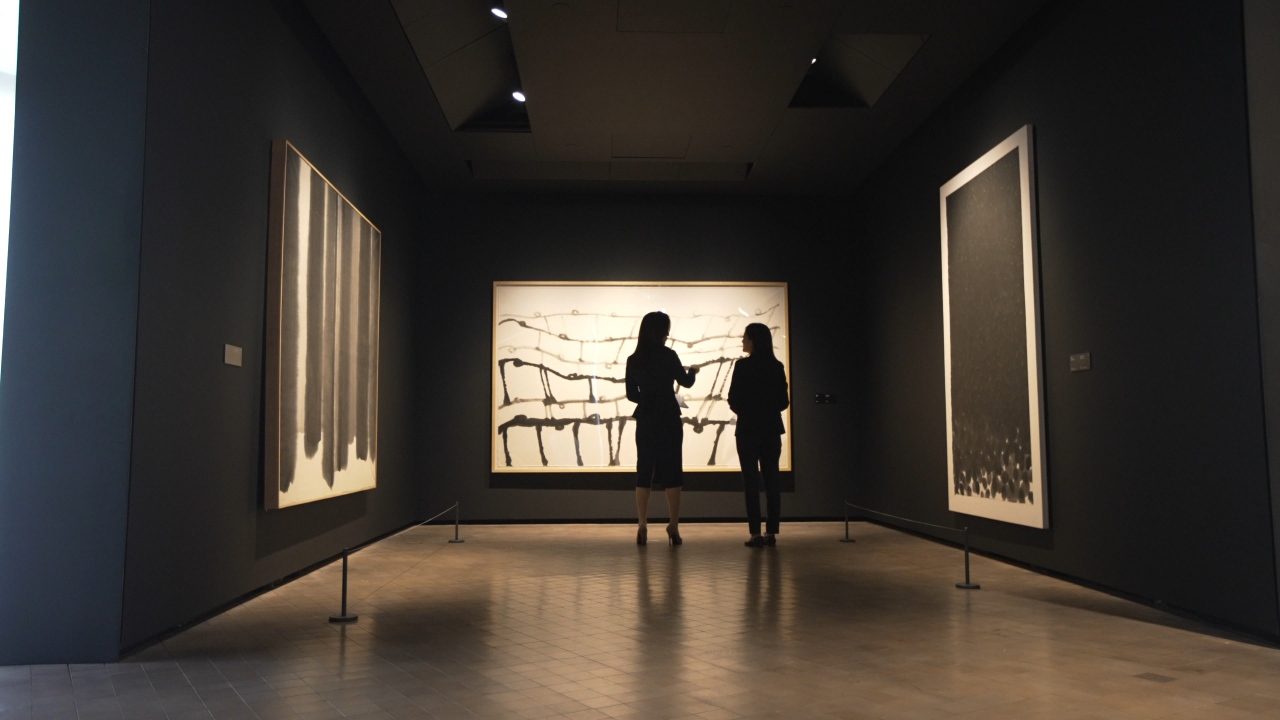
How should one see art, really? Should you try to see the whole in an exhibition or should you focus on parts and fragments? It is intuitively the right thing to look for the whole, but often I am more interested in the cracks: where things open up and leak.
Oslo Artists' Association
Juan Andrés Milanés Benitos: "Don't write it on ice" in the Overlyssalen
Cecilia Jiménez Ojedas: "Marta's drawings" in the Kabinettet
Mickael Marman: "Gemælde" in the Second Floor Rooms
Marita Isobel Solberg: " Agálaš ?uolbma / Valknute / Valknut » in the Window Hall
In several of the exhibitions at Kunstnerforbundet this January, it is precisely such "leaks" that are the most interesting
Played memories
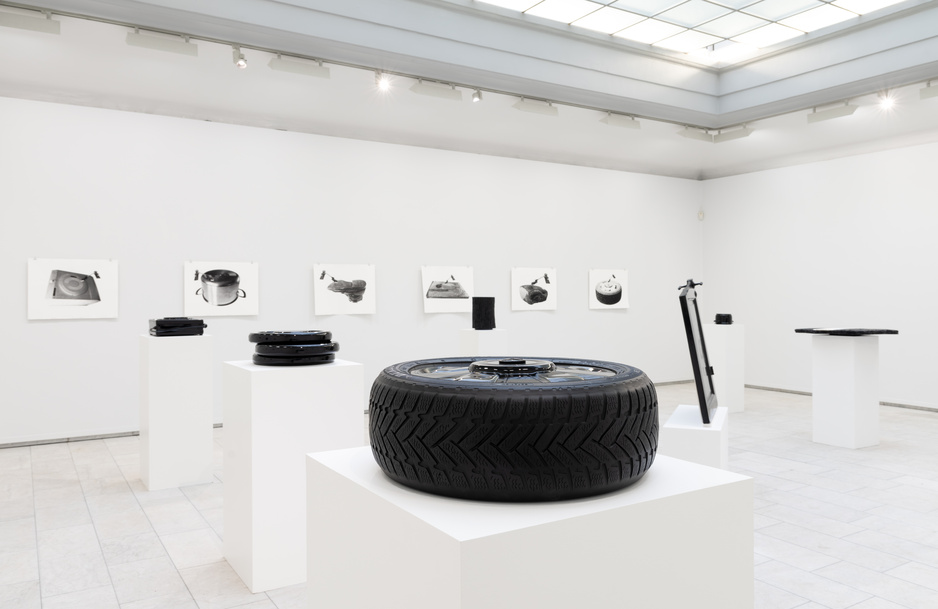
In Juan Andrés Milanés Benito 's Don't write it on ice there are several reproductions of prosaic everyday objects in plastic and epoxy: a kettle, a tree stump, a square section of what looks like a paved road. All the objects are decorated with grooves of the type we find on LP records, and can be played in the same way. On the walls around the objects are pictures of the same arrangement, but here we find slightly different types of things: a fingerprint, a boot, a chair.
Of course, we should be able to listen to memories that are linked to every single thing in this exhibition - the "records" can be played - but I am left thinking about how distinct the exhibition is of how the concrete world around us becomes a storage medium for what we experience, feel, think and do. You don't have to be Marcel Proust to understand how a single object can encapsulate chapters in life that we ourselves may not remember and which can be "played" when we come across them.
In this sense, Don't write it on ice is simple , poetic and clear about the complex relationship between the many many connecting lines between the inner and the outer world.

Intimate oblique
view We also find such a clarifying complication in the exhibition Marta's drawings , where the eminent artist Cecilia Jiménez Ojedas has portrayed an old woman she knows. But not through the face, as we are usually served portraits, but through immersions of fringe phenomena in the woman's reality. Ojeda has reproduced simple drawings drawn by the old man - like fine maps of the woman's immediate surroundings.
In one of them we can see rudimentary sketches of spectacle-like shapes lying on a table, next to some keys and a pencil, also a fairy on a table, in another some mice next to a glass of water. Ojeda has enlarged some of Marta's drawings so that we can immerse ourselves in them. Both type r drawings are placed on a wall with a dozen squares with different patterns, colors and ornaments – all taken from Marta's wardrobe. A vulnerability is introduced through some sculptures of the woman's deformed foot, which forms an immediate proximity to something many may want to be ashamed of or hide. Here the "flaw" is celebrated, where each one is placed on small pillars: it is also multiplied, and it is also adorned with different patterns, presumably from the same wardrobe as the sections on the wall. Read More…