Supersticiones | Rolankay
-
 Loading...
 - Alice Berlusconi
- 29 Jun 2022
- 140 Views
- 0 Like
- 0 Comment
Rolankay chose for him the name of a cult poet in the Chilean tradition. He allowed himself to be born again and baptised himself with a radiant alias. All at the same time. With that freedom, he altered a few consonants and changed Ronald, longer and perhaps less resonant, to Rolan, which sounds as direct as his paintings. The presence of the name and the strength of the brand were the important things. He did not wait for the validation of the academy nor the approval of experts to become an artist: he simply materialised his desire and signed that decision with a new identity. And now we contemplate the results of this boldness.
In two simultaneous spaces, combining drawing and painting, this exhibition seems like a risky debut, as if a rock band were to appear on the record market with a double album. But Rolankay doesn't seem to care about those ghosts. Neither fearful nor arrogant, he is fully committed to his painting and the desires that generated it. An eagerness to tell stories, to define a mythology that seems both private and universal, and to convene - without inhibitions - the modernism of Matisse with the subjectivities of Goya and the primitives of modernity, and the proto-Renaissance. A coven of his, which summons the monsters of the psyche in minimally decorated interiors or landscapes of spectral desolation.
STORIES
Rolankay's pictorial narrative features - on several occasions - solitary characters besieged by strange creatures: Perder Algo, El Rey de los Gatos, Abrazo, Cíclope, Atardeceres en el Desierto and Levitación show different variations of the encounter with the monstrous. Or with the monster that dwells within us. Or the ominous presence of a legion of invisible spirits. 21st-century animism.
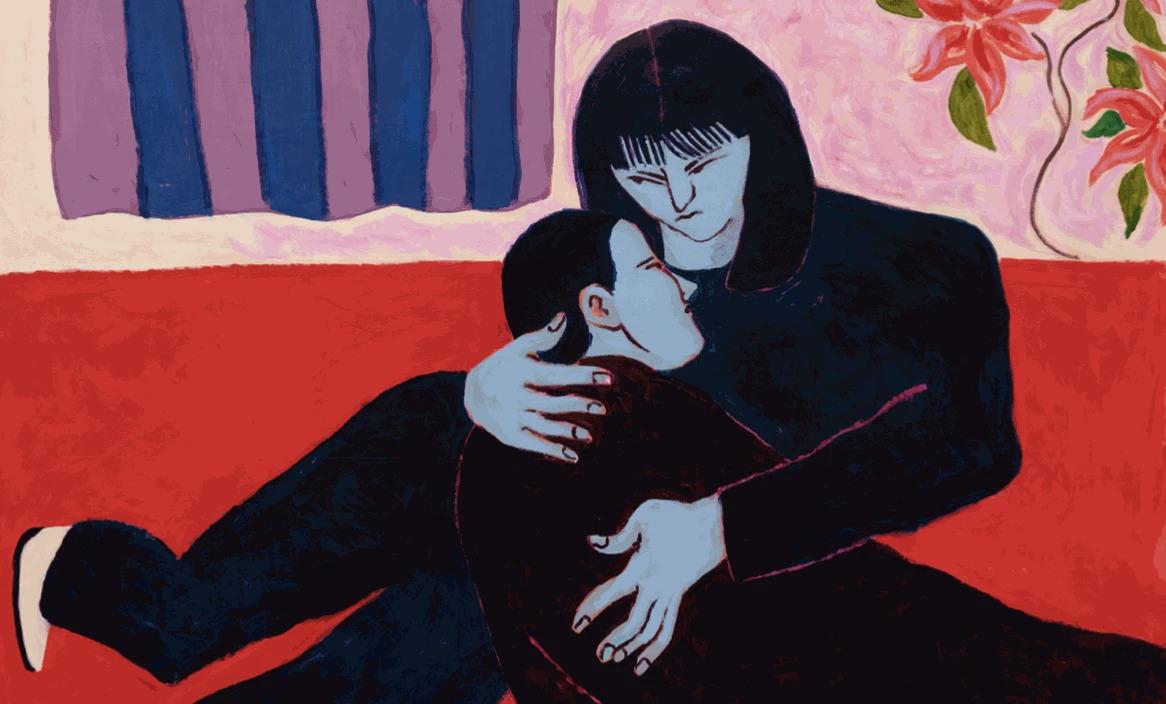
Some stories occur in interiors decorated with wallpaper and resolved with flat perspectives. Boxes that flee from illusion and assume as schematic sets. Spaces that seem comfortable, bourgeois and very modern. The millennial fantasy of interior architecture after leaving a bored or dysfunctional family. Almost always both. Sometimes the ground displays the geometric decoration we see in carpets or ceramic floors, and the indoor plants manage to connect the lower plane with the upper one (Espacio Exterior, S/T). All these elements allow the painter to combine his use of colour and the casual way he applies the oil on the surface of the canvas in different ways. Those scenes are inhabited by subjects languishing alone or in company: Rosas, Levitación or Nubes & Formas.
Rolankay's exteriors - which look equally schematic - shun decoration and seem governed by a silent, metaphysical economy. They are - without exception - spaces of physical violence, places destined for struggle or the silent sacrifice of some beast. The girl in Perder Algo attacks her prey in a vast expanse of red earth. Only two trees interrupt the disturbing monotony of this desolate landscape. The young men in Gallo Negro engage in what looks like a ritual sacrifice - five black candles suggest it - with a calmness as devoid of emotion as the tree that closes the composition on the upper right-hand side lacks leaves.
Almost the same can be said of El Rey de los Gatos or Cíclope. In all cases, the presence of trees, far from suggesting life, seems to accentuate the desolation of these desert spaces. The stripped architecture of northern Chile, the same in which the artist grew up, is the ideal setting for the body-to-body combat of Mediatarde en el Desierto. The witness with the black cap gives an unsettling contemporaneity to the fighters who dominate, like giants, the lower strip. A street fight, presented with the timelessness of mythical combat. The upper stripe is dominated by a black sun. Its lilac rays vibrate against an expanse of turquoise green. They resemble the tentacles of a devouring god, one of those creatures whose will rules the fate of defenceless beings in some cosmic horror manga. I think of Junji Ito as well as Hideshi Hino or Suehiro Maruo. These two planes coexist disturbingly. A plot of harsh rurality threatened by what seems to be an imminent catastrophe.
It is not, however, an explicit relationship with the genre that might be closest to those scenes: horror. No, Rolankay's creatures - monsters and humans alike - may be menacing and predatory, even to the point of lethal attack as with Cíclope or El Rey de los Gatos, but these are first and foremost psychic projections of the subjects that deal with them. Some scenes, despite their aggressiveness, do not seem to anticipate a catastrophe but rather suggest the indifference of a world that will remain cruelly distant. As if none of the threats or pains that afflict his creatures were of any importance. The beasts' abundant and sharp teeth, instead of causing physical death, appear to illustrate a psychic torment from which it is impossible to escape, a harmful and painful presence, invisible to the rest, like the creatures of the Yokai universe, a pantheon of creatures endowed with powers and sometimes pernicious influence in Japanese folklore. Take the human protagonist of El Rey de los Gatos, who falls to the ground, knocked out by a creature whose jaws open vertically, displaying a row of sharp fangs (a dentate vagina?). The victim's mouth, by contrast, is an empty, monochromatic cavity, making his scream exhibit an unexpected pathos. Read More...