From Thread To Beat
-
 Loading...
 - Lucas Moreau
- 19 Jul 2022
- 118 Views
- 0 Like
- 0 Comment
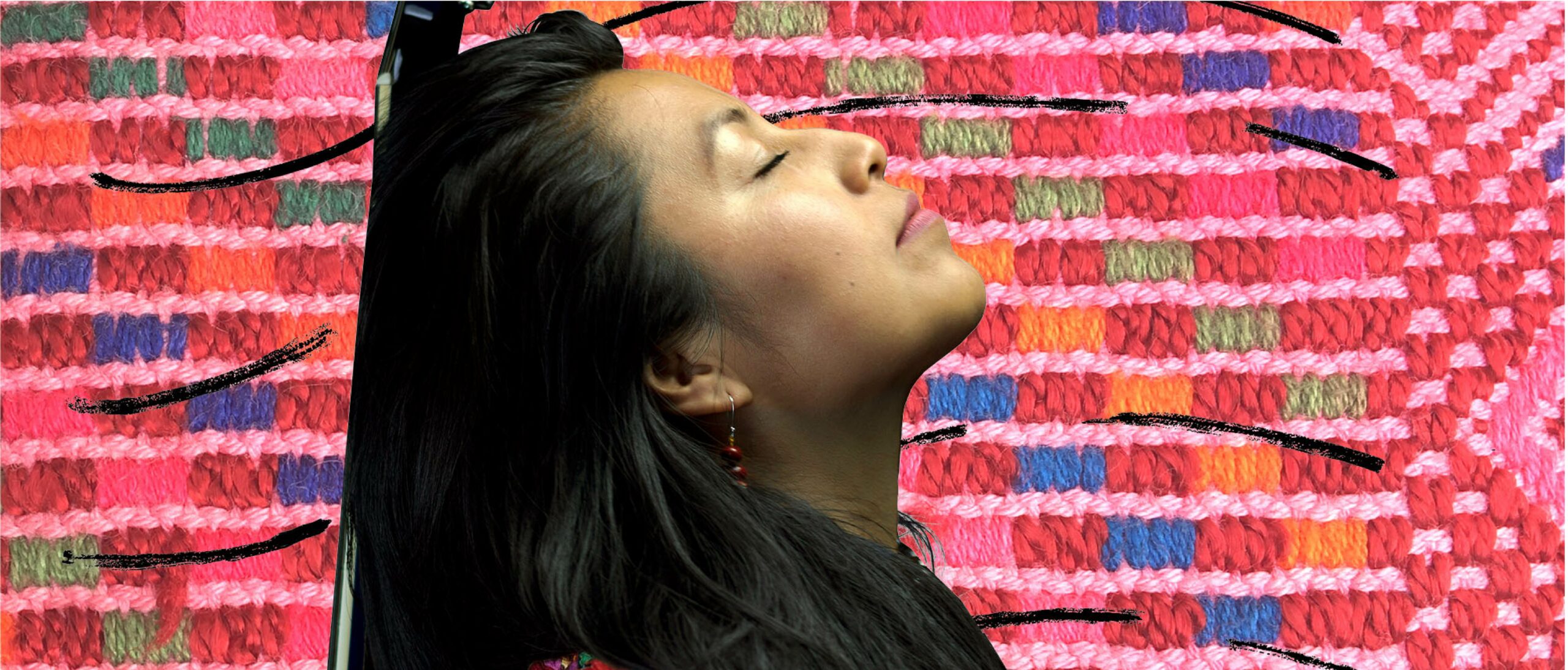
Is it possible to reproduce sounds from a tissue? Aurora Nohemí Chaj, a Mayan K'iche' singer-songwriter and architect, wanted to find out. Through algebra, she searched for numerical patterns in the embroideries of her huipil, the embroidered blouse worn by many Mayan women in Guatemala. Later, she turned them into music.
Narrator: It's May 2020 and Aurora hasn't been out much for a few weeks. She stays in her room, the one in her parents' house, in Olintepeque, a municipality of Quetzaltenango, in western Guatemala.
Aurora moved here two months ago when the COVID-19 pandemic started. The measures to contain the virus, like most of her, made her lock herself up, isolate herself. That time for her also made her somehow reconnect with music.
He resumed his love for the guitar. She dusted off the instrument that accompanied her during her adolescence and at university, when she recorded covers of Violeta Parra, Carlos Mejía Godoy, Facundo Cabral and Los Apson.
He also began to experiment with other instruments, with other formats. After several recordings with the microphone of the hearing aids, playing with new programs on his computer, he lives a Eureka moment.
He leaves his room and sits on the grass of the patio, with the computer on his lap. He smiles and calls his mother to tell her about his discovery.
Nohemí: She told me: “Mom, I know that your embroidery has a sound”. "What a beautiful huipil you wear, those embroideries have sounds."
Narrator: His mother, Nohemí Haz, whom you are listening to, is a K'iche' woman. The huipil that Aurora is talking about is a kind of embroidered blouse that is part of the clothing worn by most Mayan women in Guatemala.
Nohemí looks down. She observes her purple huipil and the embroidered flowers on her neck. She looks at him strangely. She doesn't understand how what she sees can have sound. Aurora insists.
Aurora: I told her: “Mommy, sounds have shapes”, I told her. “And if sounds have shapes, it means that shapes also have sounds. It means that what I'm seeing in your huipil really has a faded sound .
Nohemí: I told him: “How so? You're crazy!" I told her. “How come the embroideries that I have have sound?”. "Yes, they have sound, you'll see, I'm doing an investigation of that."
Narrator: I am Melisa Rabanales, a journalist from Ocote and today I present to you:
Aurora: My name is Aurora Noemí Chaj Haz, I am 35 years old. I am from the west, from the highlands, I am from the K'iche' people of the western highlands here in Guatemala, from Iximulew. I am a self-taught k'iche' composer, performer, producer of experimental music based on Mayan geometry of textile art of native peoples. And I am an architect graduated from the University of San Carlos de Guatemala.
Narrator: Aurora has straight black hair. She is brunette, with large, dark brown eyes, and wears cat-eye glasses. On her cheek, a mole, which hides behind a dimple when she smiles, which she often does.
I speak with Aurora on March 15, according to the Gregorian calendar. In the Mayan calendar, it is the Waxakib' B'atz', a crucial date. It is the day that marks a new lunar year. This coincidence will make sense later, in this episode, to tell her story and that of her work. But let's not get ahead of ourselves yet.
Aurora, as you heard at the beginning, makes music through Mayan textiles. Yes, music based on the patterns of clothing that she and the Mayan women of Guatemala embroider, weave and wear.
Ever since she was little, when she lived in Cantel, about six kilometers from Olintepeque, Aurora discovered that music was part of her identity.
Aurora: Ever since I can remember, my maternal family, especially, since a musical instrument was always in the house. My great-grandparents were marimba players. From then on, the closeness to music was a constant in my family. My aunts sang in different voices: first, second, third voices. My uncle with the guitar, my other uncle with the keyboard and us as boys and girls at that time, well, with whatever we found, right, with anything that made noise.
N arrator: His grandfather Baltazar was a keyboardist and played at the church in his community. Her aunt, Feliciana, was one of the first women in Cantel to play the concertina. Her mother, Nohemi, sings. And when Aurora was about seven years old, her dad gave her a keyboard.
Uncle Santiago taught him to read the staff and play the keyboard. He taught her the basic rules of music: identify scales, octaves, chords, and what it means to sing in first, second, and third voices.
Later, he would learn to play other instruments. The guitar, the clarinet. Everyone watching and listening to their uncles while they played at church or at family parties. He never took classes.
At nine years old, with that same keyboard, Aurora composed her first song. Her parents were her first public.
Aurora: I wrote a poem that was the first that I finished, that I finished, that is called 'Lágrima de Lágrima'. I wanted to tell my parents about this poem in a different way, so I said: “If I read it to them, I don't know if they will understand me”. I wish there was some sound, I said, to accompany me when declaiming this poem. I invented a little music there that accompanied.
Narrator: There was no sound record of Tear of Tear except in the memories of Aurora and her mother, Nohemí.
Nohemí: Well, I felt excited. I said, "She's going to be a great musician, just the same
than his grandfather, just like his uncles.” I thought that was going to be her.
Narrator: And yes, Aurora continued to be passionate about music, but other disciplines also crossed her path . As she grew older, she became interested in geometry, becoming obsessed with patterns. She saw them everywhere.
Aurora: I always admired the geometry that was in the sky, in nature, in the fabrics, especially the colors of the fabrics, I loved them.
Narrator: She saw how her mother designed her and her sister's huipiles. He watched her draw the flowers on a sheet of paper, measure the space between each pattern with her fingers, count the threads and then, with her hands, patiently embroider. Nohemí is not an embroiderer by profession, but every huipil she makes for her family is a work of art for Aurora.
Growing up, Aurora began to do the same. To imitate what her mother did, what her grandmother, her great-grandmother and their mothers had done to her. What Mayan women have done for centuries.
Aurora: So, along with music, I really liked to draw geometric patterns and lines and designs. So at the time when I already had to make the decision to enter the university, I already had a conversation with my family, with my father and my mother, and it was the decision to study architecture.
Narrator: In 2004, Aurora entered the University Center of the West of the University of San Carlos. The headquarters was in Quetzaltenango, very close to Olintepeque. Years later, she had to move to the capital to close the pension. She graduated in 2014. In those years she couldn't dedicate as much time to music. Her academic load was too much, although she promised herself not to put it aside completely.
In March 2020 the whole world came to a standstill. The COVID-19 pandemic arrived and in Guatemala social gatherings, fairs, face-to-face classes were prohibited, and curfews were imposed. Aurora, who by then had returned with her parents to Olintepeque, felt the confinement as an opportunity.
A few months earlier, he had bought a computer. So he began to explore music with instruments from the fairs of Olintepeque and Cantel, the town where he had lived in his childhood: chinchines, drums, flutes... he began to experiment. He recorded his voice and instruments with the microphone of his hearing aids and transferred them to the computer. He listened to them together, separately. Read More...