"Ghost forests" along U.S. coasts are a haunting indicator of climate change
-
 Loading...
 - layla carter
- 24 Apr 2023
- 66 Views
- 0 Like
- 0 Comment
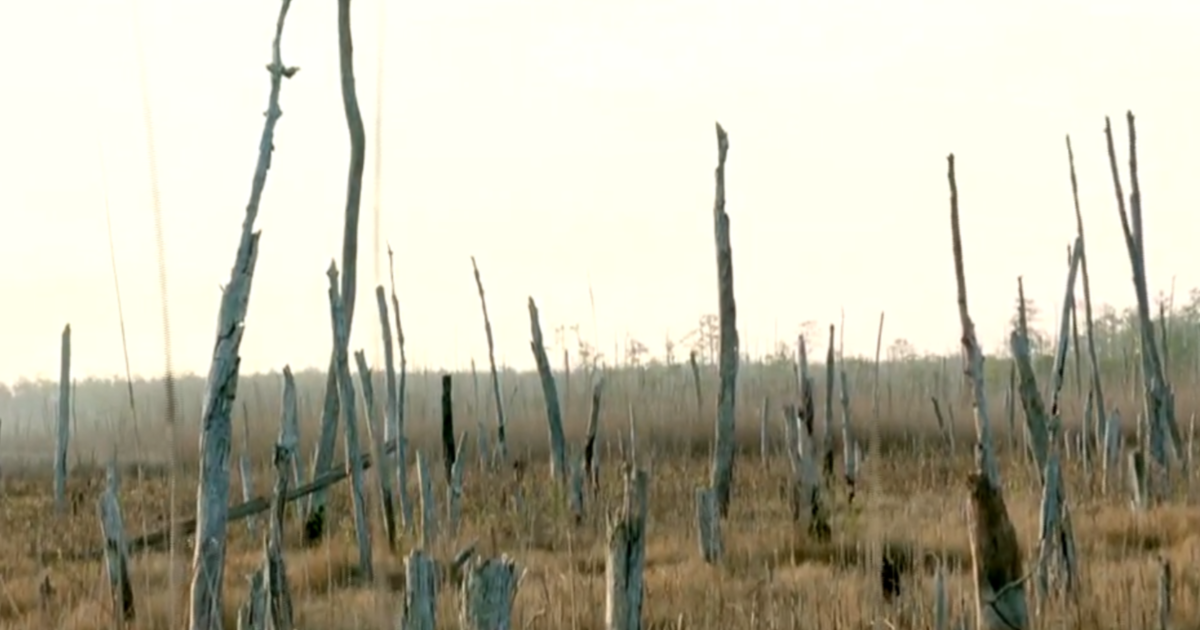
Forests inundated with salt due to rising sea levels are turning into cemeteries of trees — a haunting indicator of climate change. It's a problem on coastlines across the United States, most dramatically between North Carolina and Massachusetts, where the sea level is rising three times faster than global rates.
The Chesapeake Bay is especially vulnerable to "ghost forests" because land in the region is flat. In Maryland, the forest has been retreating at a rate of 15 feet a year — and that rate is accelerating.
"The ghost forests are the most striking indicator of climate change we have anywhere on the East Coast," said Matthew Kirwan, a coastal ecologist at the Virginia Institute of Marine Science who has been studying ghost forests and their impact on coastal ecosystems for years.
"We're used to seeing pictures of glaciers that have melted and retreated back miles, over the last several decades. Well, it's the same thing here," he said. "We have the remains of trees ... that mark where dry land was just decades ago."
Ghost forests result from sea level rise and coastal flooding that bring in salt, which accumulates in the soil. Eventually, the salt builds up to levels the trees can't withstand. They die, surrounded by marsh, with no new trees to replace them, Kirwan said.
The process can be slow, he said. At first, one may only notice a few dead trees each year, but over time, a whole group of trees will disappear.
Since the late 19th century, at least 100,000 acres of forest along Maryland's Chesapeake Bay have turned into a growing collection of tree graveyards. Researchers predict that over the next century, up to 18,000 square miles of dry land in the U.S. — about the size of Maryland and Vermont combined — could be submerged in water.
Kirwan's family has lived along Maryland's Eastern Shore for 10 generations. For him, watching the trees die is not just a scientific concern, but a personal loss as communities disappear.
"Everybody thinks of sea level rise in terms of flooded city streets and subways and catastrophic hurricanes like Katrina," he said. "But really, the impacts of sea level rise in most places are far more subtle." Read More…