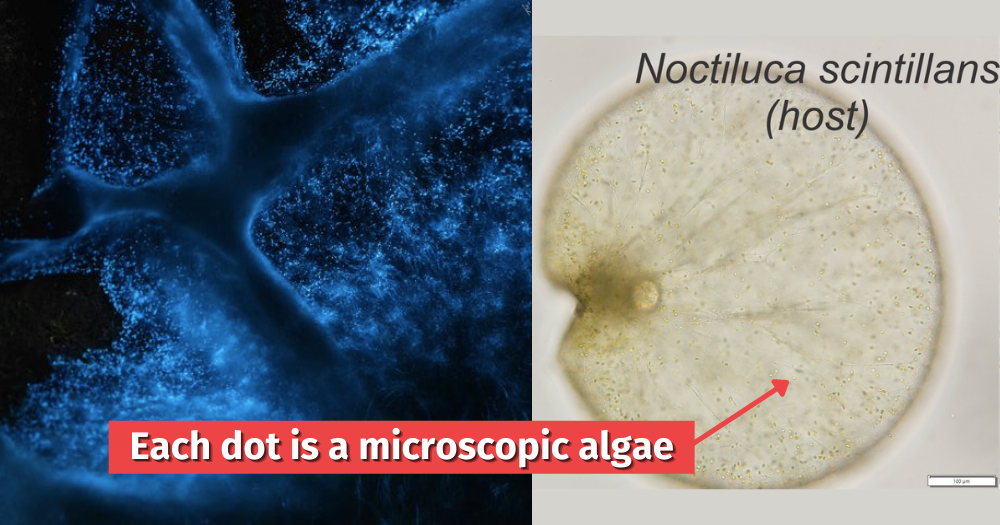
Glowing blue dinoflagellates in S'pore waters host thousands of tiny algae which provide food in return
-
 Loading...
 - Feng Huang
- 05 Apr 2022
- 328 Views
- 0 Like
- 0 Comment
Dinoflagellates have caught the attention of the nation after being named as the cause of the glowing blue waves at Singapore's western coast over the past week.
These single-cell microorganisms emit a bright, blue glow when disturbed, possibly to confuse predators or to attract other organisms to prey on what's threatening them.
While the presence of dinoflagellates may be new to many of us, some researchers in Singapore have been acquainted with them for quite some time.
Not a plant or bacteria
"It seems like everyone knows the word 'dinoflagellate' already, but not many understand exactly what it is," Clarence Sim told Mothership.
Sim is a second-year PhD student at the Genomics and Ecology of EuKaryotes (GEEK) Lab led by Adriana Lopes dos Santos, an Assistant Professor at Nanyang Technological University's Asian School of the Environment.
"You probably know the different kingdoms of living things -- there's animals, plants, bacteria and fungi," said Sim.
But dinoflagellates belong to a whole other group of diverse organisms known as protists, Sim explained.
Dinoflagellates are common marine plankton well known for having close relationships with other organisms.
Corals for example, have a mutually beneficial relationship with some dinoflagellate species that live in them: they protect the dinoflagellates and provide it with carbon dioxide, so the microorganism can share the nutrients that it makes from photosynthesis with the coral.
While these single-cell microbes might seem unassuming, Sim shared that marine microbes (including photosynthetic dinoflagellates) produce about half of the oxygen we breathe.
In comparison, forests only produce about 28 per cent of Earth's oxygen, according to National Geographic.
A bloom of dinoflagellates observed since January
As part of Sim's thesis, he regularly samples Singapore's coastal waters to map the trends of the local plankton community over the years.
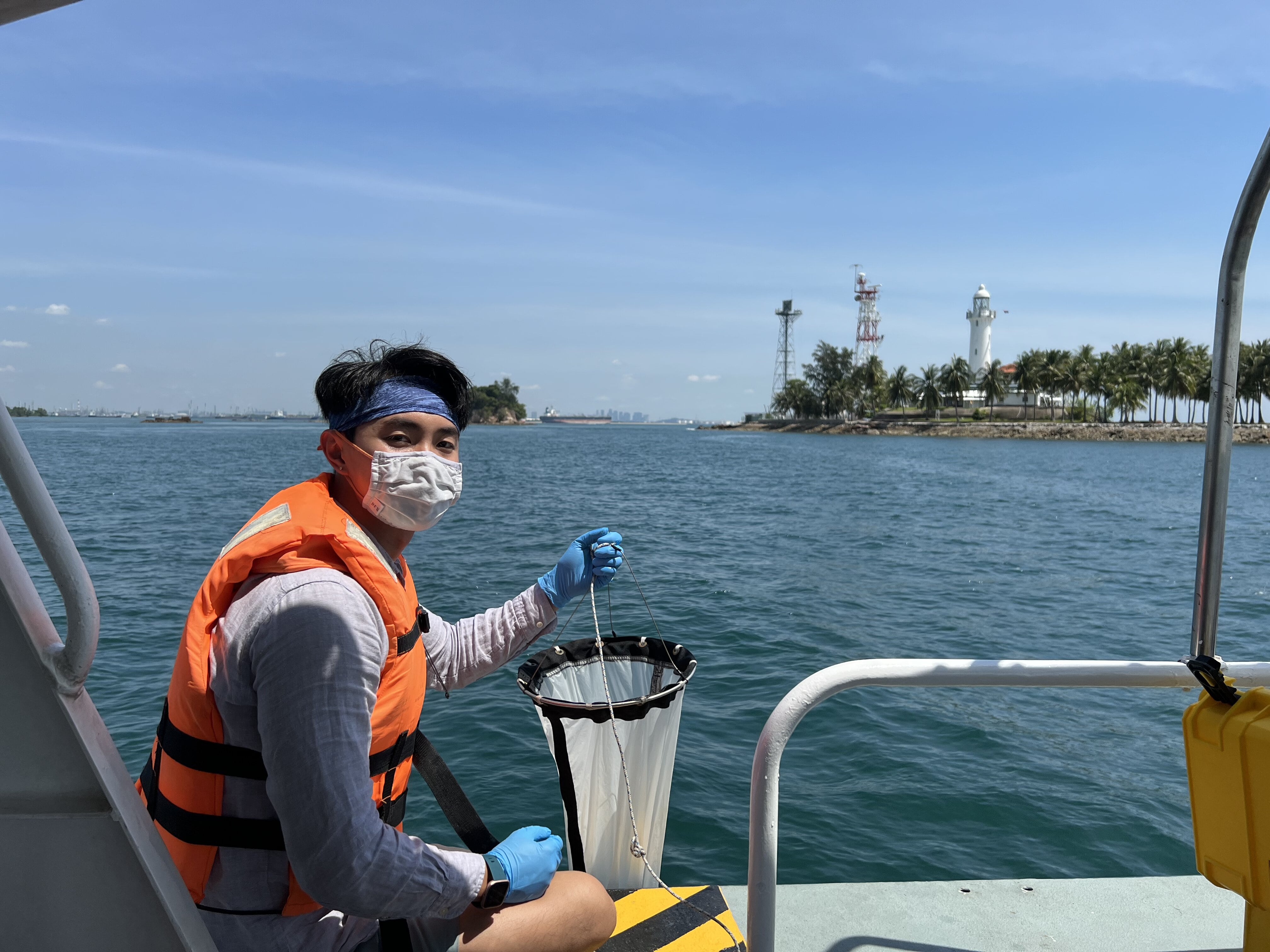
Therefore, the bioluminescent dinoflagellate species responsible for the glowing waves that attracted massive crowds to Changi Beach was nothing new to Sim.
Sim told Mothership that he had detected low amounts of the species over the past two years and identifed the species as Noctiluca scintillans.
Then in January, he observed a bloom of Noctiluca scintillans, but noticed something peculiar about them this time. Read More…