Here's What's Special About The 100 Days Celebration In Korea
-
 Loading...
 - Bharosa Akter
- 22 Jul 2022
- 97 Views
- 0 Like
- 0 Comment
The 100 day mark in Korean culture is a significant thread to the country’s past.
Like most traditions which weave through history and religion- be it to celebrate festivities or ward off evil – the celebration of the 100th day in Korea has similar roots.
Let me first tell you about the history of the practice, and then look at how it applies to modern day traditions.
100 Days Celebration In Korea
Doljanchi – The First Birthday

The first birthday is a cause for celebration across countries and cultures. This applies to the Koreans as well, who rejoice ‘dol’, the first birth anniversary of a child.
Over the years, these celebrations have become more and more ostentatious, and the first birthday celebrations or ‘doljanchi’ is one of the highlights of a Korean.
It is a space to showcase talent, flaunt your wealth and display your affection for friends and family by inviting them to a lavish event.
Baek-il – The 100 Days of An Infant
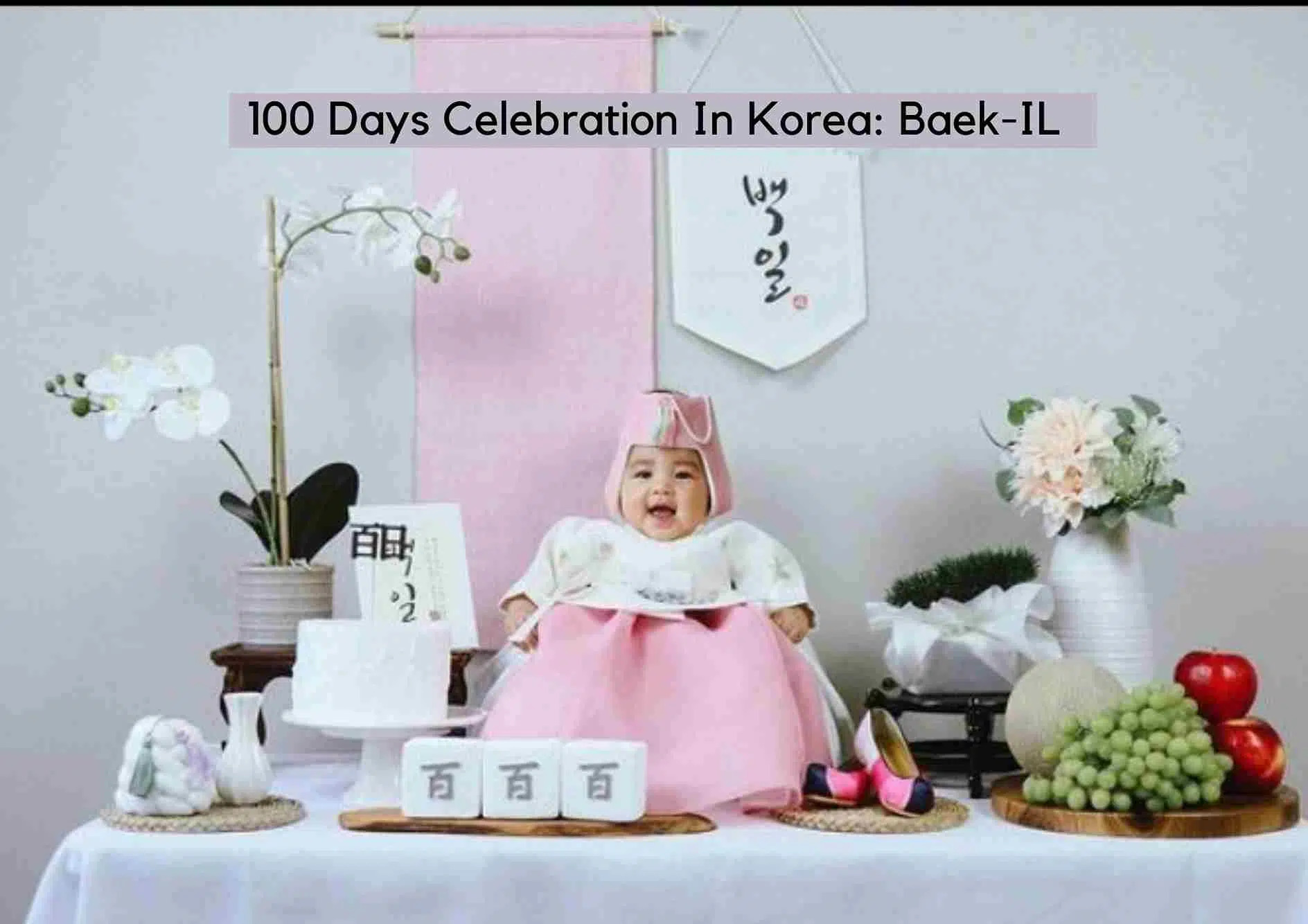
Baek-il, on the other hand, is the 100-day celebration of an infant. ‘Baek-il’, which translates to ‘one hundred days’, is celebrated on the 100th day after the birth of the child.
While today, the observation of Baek-il is not considered to be of significance and is hence not very prevalent, the hundred-day fulfilment of a child was widely celebrated by all families – rich or poor – in the past.
History Behind The 100 Days Celebration
The infant mortality rate in mediaeval Korea was once (like everywhere else!) through the roof.
And as one can only imagine, new-born infants were most prone to multiple maladies due to their low levels of immunity in the first few weeks.
Childhood diseases were rampant, and a lot of children lost their lives to such diseases even before turning one.

While a lot of reasons were responsible for such tragic well-being, the most relevant would be poor hygiene, lack of medical accessibility, and the extreme weather conditions in Korea (harsh winters followed by humid summers).
The high death rate among newborns made crossing the 3 month mark seem like an achievement, something that demanded a celebration.
Moreover, to ensure the survival of their newborns, a lot of parents did not take their babies outdoors at all, in the first few weeks after their birth, that is.
So the 100 day celebration of survival also turned into a tradition to mark the day the baby went outdoors for the first time.
Since then, the number 100 has started to hold a place of significance in Korean culture and customs. Prayers and food are offered, and a party is thrown by the parents.
The 100 days has evolved into being reinterpreted as a sign of maturity in modern day Korea. For infants, the 100 day celebration is a sign that they would make it to their first birthday, and make it out of infancy.
People in relationships also celebrate their 100 days anniversary, as do new mothers, and so on. While the intent behind the 100 day celebration has lost meaning over the centuries, it continues to thrive.
Traditions Of The 100 Days Celebration in Korea
As is custom, the family would pray on the 100th day. This would be followed by offering thanks – usually in the form of food – to the Shaman spirit of childbirth.
The food will usually consist of rice and sea mustard soup, and also rice cakes and wine. Rice cakes were placed in accordance to the four directions – at north, south, east and west points within the house.

Another belief held by the Koreans is that if the rice cakes were shared with a hundred people, the child would lead a long, prosperous life; hence rice cakes would be prepared and shared liberally among family, friends and neighbours.
This was an offering of gratitude for keeping the mother and the child in good health during this trying period. It was a reason to celebrate, and share their happiness with their near and dear ones.
However, if the child turns out to be sick during his or her 100 day anniversary, the parents would spend the occasion without celebration, considering it ot be a sign of bad luck. Read More…