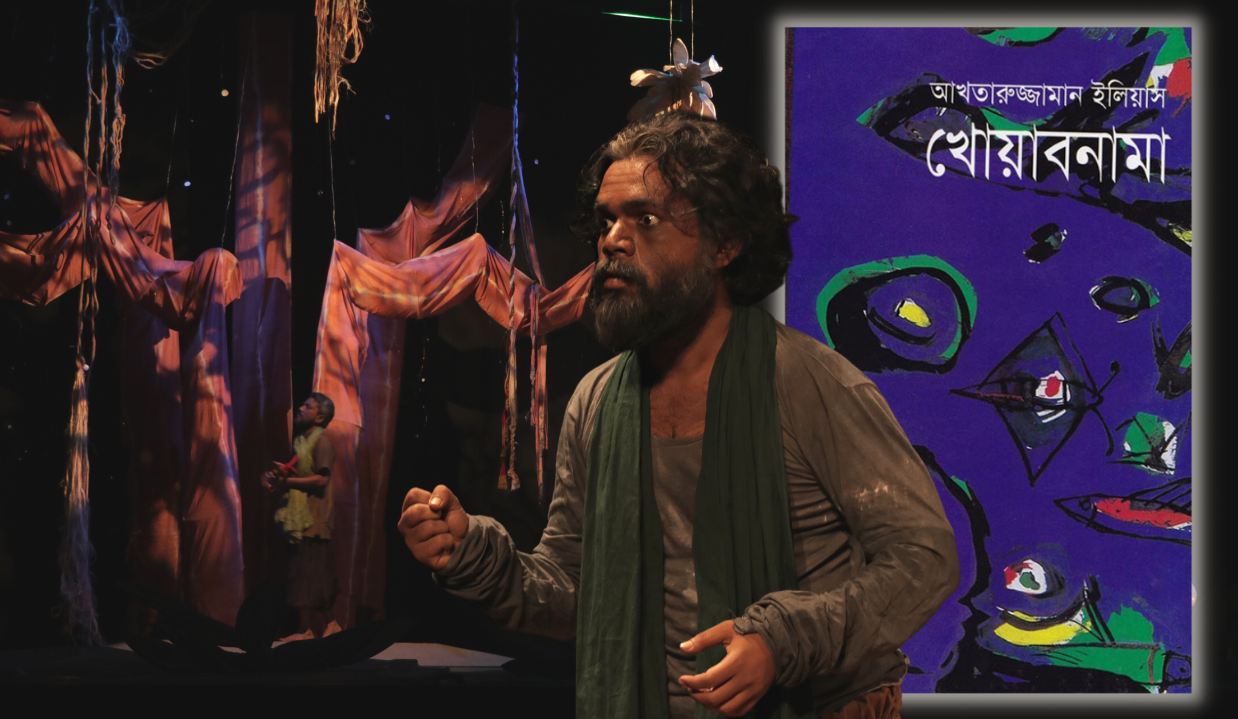
How I became Tamijer Baap in ‘Khowabnama'
-
 Loading...
 - Abani Uddin
- 20 Sep 2022
- 54 Views
- 0 Like
- 0 Comment
He doesn't have a name of his own in the story. Instead, he's given an identity founded upon his son's—Tamijer Baap. Yet he is one of the main characters of Akhtaruzzaman Elias's novel, Khowabnama (Mowla Brothers, 1996).
Tamijer Baap lives in the 1940s, a tumultuous time amidst the Tebhaga Movement, and the Partition on the horizon. But he dwells in a different world. He lives two lives—a regular life of a Bengali peasant, and another of fantasies and magical realities. Every night he leaves the house in his sleep and wanders around Kaltahar, the village lake, to find Munshi. He sees Munshi standing on a huge tree, shackled, fire burning his body. Munshi died in Fakir Bidroho, an uprising against the British. Through the passing of a hundred years he has become a myth. Every night, Tamijer Baap sees Munshi. But no one else does.
It was a dream for me, an actor, to portray Tamijer Baap. But I was scared. There was talk for quite some time that the rehearsals of the stage adaptation of Khowabnama would start in Prachyanat; it was back in October 2019. Kazi Toufikul Islam Emon, the director of the play, called an audition. I was a new member then, a mere six-month-old addition. I had auditioned for several roles but funnily enough, never for the role of Tamijer Baap. I never imagined myself being selected. When the rehearsals began, however, Emon Bhai asked me to read out the character's lines. When the rehearsals of blocking (working with performers to figure out the actor's movements, body positions, and body language in a scene) started, I was still the one rehearsing this role. Read More...