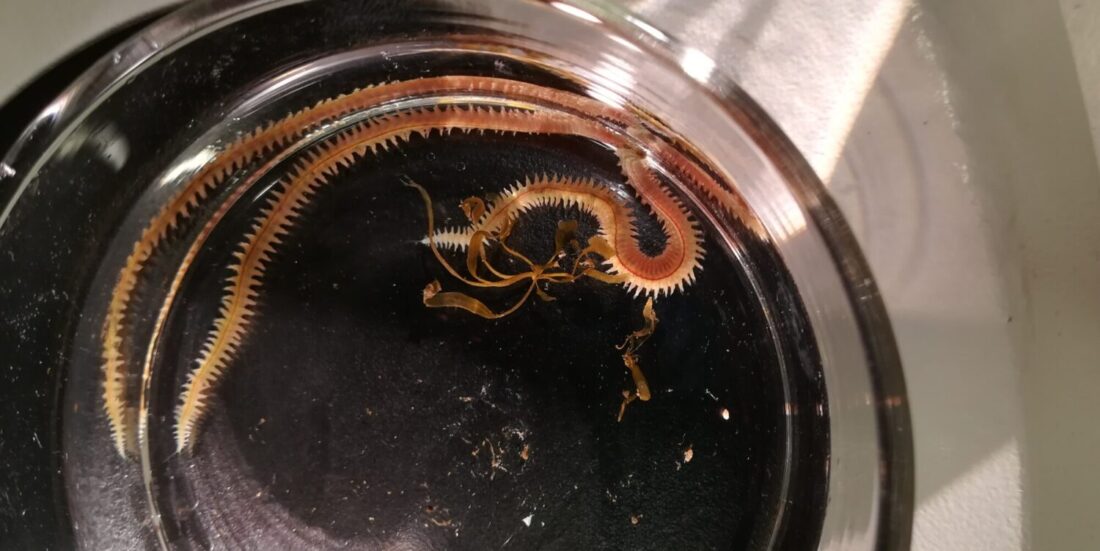
In the future, Norwegian salmon can be fed with locally-sourced ragworms
-
 Loading...
 - harley poppy
- 16 Aug 2022
- 64 Views
- 0 Like
- 0 Comment
Researchers had the crazy idea of feeding ragworms with locally-cultivated seaweeds. The results were as gold-edged as the worms themselves – a high-quality, locally-sourced and sustainable feed for farmed salmon.
“Ragworms are an exciting new feed raw material that can help to reduce the sector’s dependency on imported materials, thus making Norwegian salmon a more eco-friendly and sustainable product”, says SINTEF researcher Andreas Hagemann.
Seaweeds are also a major resource, and in recent years many companies have been established along the Norwegian coast to cultivate them. Researchers have now demonstrated that seaweeds are ideal as feed for ragworms, which in turn can be transformed into a high-quality feed for farmed salmon.
Demand for more sustainable feed alternatives
The seaweed-ragworm combination may also help to resolve a major problem. The salmon farming and feed sectors are crying out for new and sustainable raw materials. It is vital that they become less dependent on soya protein and other less environmentally sound raw materials that have to be transported for long distances in order to supply Norwegian fish farms.
“Seaweeds have high levels of carbohydrates but contain too little fat and so cannot be fed directly to farmed salmon”, says Hagemann. “However, by first feeding the seaweeds to ragworms, we obtain a high-quality feed that is rich in Omega-3, and with the right composition of other fatty acids and marine proteins. This is also a good way of exploiting residual raw materials derived from seaweed production”, he says. The research is being carried out as part of a project called POLYKELP, which is being coordinated by SINTEF Ocean.

A crazy idea
Even though seaweeds are not suitable to be fed directly to salmon, they have many valuable properties that open the door to multiple uses. Seaweeds for human consumption are commonly harvested in the spring. As the plants grow larger during the summer months, they often become fouled, which makes them look and taste less appealing as food for humans.
However, the plants are at their biggest at this time, so the farmers can harvest greater volumes. Moreover, seaweed off-cuts can be used as food. So, there is no shortage of seaweed raw material available that can be used for a wide variety of useful applications.
It was this that led to the crazy idea of first feeding seaweed to the ragworms, and then feeding the worms to the salmon. Read More…