Letters to the City: Art explores the complex relations of women and girls with their urban existence
-
 Loading...
 - Aadya Rana
- 24 Mar 2022
- 387 Views
- 0 Like
- 0 Comment
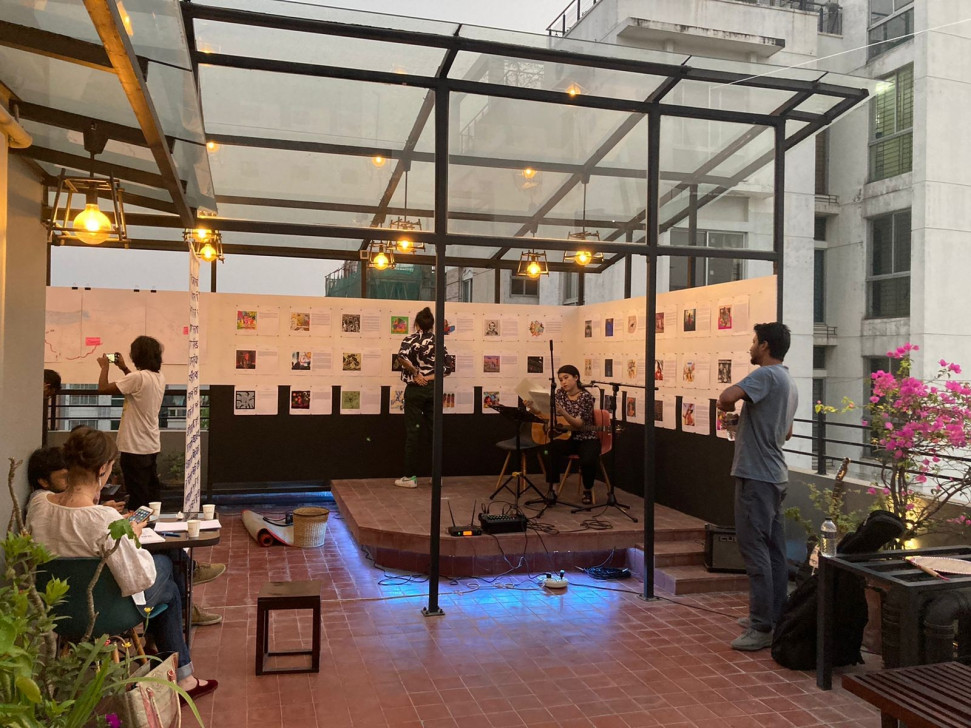
With an aim to create substantial social change, Dhaka Memory and Mongol Deep Foundation organised 'Letters to the city', an exhibition combining art, architecture, and gender politics. Employing a collaborative and interactive element, the exhibition dives into gender relations from personal yet common perspectives.
Spearheaded by Sadia Sharmin and Imran Hasan, in August 2021, the Dhaka Memory team issued an open invitation called 'An Open Letter to My City' for women and girls to express their opinions and aspirations for their towns.
Around 129 letters were submitted in response, from women and girls of various backgrounds and ages. The letters tell a complex story of nostalgia, aspiration, despair, hope and love. The emotions expressed in these letters open up space for rethinking gender interactions with cities and hegemonic practices.
Afterwards, a group of 30 artists came together to illustrate these letters and tell these unique stories in artistic ways, without words, such that its visual form was enough to convey the letters' messages.
The artworks exhibited utilise texts and symbols, and highlights the experiences of women. Despite the agenda behind this project being to create city designs inclusive and safe for everyone, 'Letters to the City' focused primarily on women.
Imran says, "When we talk about feminism, we talk about equality. We started with women because in cities they face the most barriers because of people's attitudes, and there needs to be dialogue for them."
Given that women tend to face more harassment and are under constant observation in society, Sadia and Imran believe that this was the right track to get their project moving.
The collaborative work of the artists is an integral part of the collective dialogue needed to create discourse surrounding gender disparities in a creative and interactive method.
"What we're doing here is not a campaign," says Sadia. "Society has unequal gender relations affecting city designs. This makes the creation of an inclusive city nearly impossible. We need to create collective dialogue and keep this dialogue moving such that women can equally partake in policy making, community work, and come to decisions collectively," she adds.
To emphasise why cities need to be redesigned for gender equality and safety, Imran alludes to his memories of growing up in a village. He recalls the intimacy and interpersonal connection which exist among villagers, but commonly absent among city dwellers. He believes that city dwellers and the building sector which are both heavily male dominated, lack empathy toward other genders. These affect the social attitude towards women and lead to women's harassment — unwanted touches and staring, both of which are symbolised in the artwork through the depiction of hands and eyes respectively.
"Think about it. If a space is safe for women and young girls, it's more than likely to be safe for everyone," he adds.
Both Sadia and Imran envision a future where cities can be inclusive and where problems are addressed at their roots, and not resolved with temporary and immediate solutions.
"We don't want to jump to a solution. Immediate solutions only work short term," they both agree,
The exhibition started on 18 March and is being held at Batighar – Smrititay Sharanay Aly Zaker in Banani, Dhaka. Being the first stage of a much bigger project, the aim of this exhibition is to create collective dialogue and discourse, motivate individuals to converse about their city life experiences and express their experiences in artistic ways, and eventually, come to a long-term solution to minimise gender inequality in cities, and in city design. Read More...