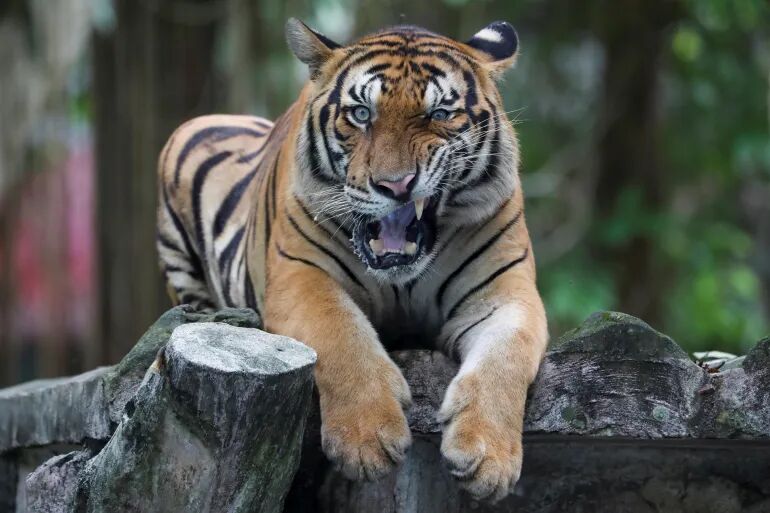
Malaysia: Is there still a chance of saving the Malayan tiger?

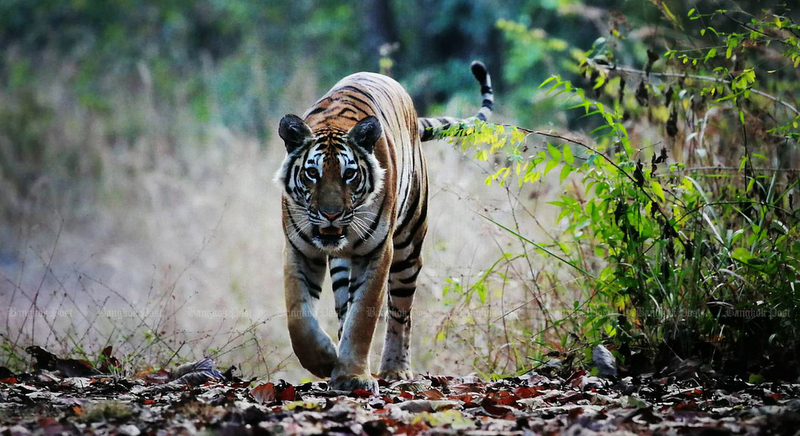
In 2019, Malaysian conservationist Mark Rayan Darmaraj warned that the critically endangered Malayan tiger would be extinct by about this year if efforts to save it were not intensified.
But while the pandemic has offered this subspecies – one of five remaining in the world – a brief respite from poaching, they are still only clinging on. A national survey concluded in 2020 estimated that there remain fewer than 150 wild tigers in Malaysia’s forests, where 3,000 once roamed in the 1950s.
It’s a global struggle.
A century ago, approximately 100,000 wild tigers existed worldwide; by 2010, roughly 3,200 remained, squeezed into seven percent of their historical range.
Over the past 10 years, conservation efforts in Malaysia and Southeast Asia have lagged behind other countries with tiger populations like India and Nepal – the difference due to “their substantial resource allocation and political will”, Darmaraj told Al Jazeera.
The number of Malaysia’s wild tigers continues to shrink despite promising initiatives, such as deploying the army and the Indigenous Orang Asli to patrol the jungle for poaching activity.
Darmaraj led WWF Malaysia’s tiger conservation efforts for more than 10 years and is now the country director of the Wildlife Conservation Society in Malaysia.
Al Jazeera spoke to him to find out why conservation efforts are failing and if there is still a chance of saving the Malayan tiger.
This interview has been edited for length and clarity.
Al Jazeera: In 2009, the National Tiger Conservation Action Plan was introduced to double the number of Malayan tigers in Malaysia to 1,000 by 2020. It’s now 2022, and it’s estimated that there are only about 150 wild tigers left. Why have conservation efforts since failed to work?
Mark Rayan Darmaraj: It is likely that we could have overestimated the figure of 500 tigers back then, but with numbers subsequently dwindling to less than 150, this still begs the question of how effective Malaysia’s action plan was and why it didn’t at least stabilise tiger numbers. To be honest, the action plan had the right recipe but was lacking in terms of political will, financing and resource mobilisation.
For example, in recent years it has been estimated that at least 2,500–5,000 rangers are needed to patrol wildlife habitats in Peninsular Malaysia. Throughout much of the action plan period, there had been a minimal increase in the number of rangers. Only from around 2018 onwards did we see an increase in patrolling through initiatives by the federal government, state parks and also NGOs. Even this is not sufficient, and it needs to be stepped up even further.
Another challenge was making sure tiger habitat remained as forest, and connectivity between forest patches maintained. This requires states [in Malaysia individual states have responsibility for land] to come on board and fully commit to actively devising a plan on maintaining natural forest, in which the protection or conversion of tiger habitat depends on decisions by the relevant state governments. This is where political will was and is mostly needed, coupled with innovative financing to ensure the preservation of intact, interconnected forest through a network of safe corridors within the country.
AJ: What are the most important factors causing the near extinction of the Malayan tiger?
MRD: The main cause of this drastic decline is poaching of tigers and their prey. Ten years ago, we only found isolated incidences of snaring, but since then hundreds of snares have been detected in our forests. Many more remain undetected, as we cannot patrol the entire forest complexes intensively. Massive snaring by Indochinese poachers has the potential to wipe out large mammals within a relatively short period of time. Local poachers are also a threat, but they focus mainly on forest fringes and areas which are accessible by car, off-road vehicles or boat.
Another major factor that is not enabling tigers to reproduce fast enough to repopulate an area is the decline of large tiger prey such as sambar deer. Sambar deer is the largest deer species in Malaysia and as such is likely the most preferred prey species based on their body weight ratio to tigers. The decline of sambar deer is also due to poaching, but mainly from local poachers who have long hunted the deer for its meat.
The other major threat is large-scale conversion of tiger habitat to other land use, as well as fragmentation of these habitats into smaller patches of forest. Tigers in tropical forests such as Malaysia have large home ranges, and huge areas of forest are required for a sufficient number of tigers to persist over the long term. Isolated patches of forest that lack connectivity are more susceptible to localised extinction due to diseases and also because movement of potential dispersing tigers into these areas are minimised, and thereby reducing chances of replenishing the population. Read More…