Migrating Birds That Travel 4,000 Miles to Greece Threatened by Extinction
-
 Loading...
 - Alban Dupont
- 06 May 2022
- 317 Views
- 0 Like
- 0 Comment
The Asproparis, a bird migrating almost 4,000 miles from Africa to Greece, is threatened with extinction.
The white vulture’s arrival heralds the end of winter and the arrival of spring in the Greek region of Epirus. But the perilous journey along the Mediterranean and through several countries, as well as the poisoned bait it ingests, threaten to finish off the species.
In Greece today, only five pairs remain, a decline from 15 pairs recorded in 2012 and 70 pairs recorded in 2000.
Threatened Birds Herald Arrival of Spring in Epirus
According to the Hellenic Ornithological Society, the avian scavengers arrive annually in Epirus. The society refers to the vultures as “Aoos,” deriving the name from the river valley where they nest and breed. The Asproparis manage to cross eight countries in about 40 days during their epic journey.
Beginning in Chad, they continue through Libya, Egypt, Israel, Jordan, Syria, and Turkey to finally arrive in Greece. Konitsa has become the breeding ground of choice that motivates the precise journey to the Aoos River valley.
“If we don’t take measures, this bird will be extinct within the next five years,” declares Roula Trigou, the communications spokesperson for the Hellenic Ornithological Society. “The fact that five documented pairs remain in Greece essentially means that the population has collapsed. It is very difficult to save this vulture now, but we want to at least safeguard the pairs that are left,” she added.
Greece is home to four types of vultures, all of which are endangered. These include the Aoos, the Egyptian vulture (Neophron percnopterus), the Griffon vulture (Gyps fulvus), the Bearded vulture (Gypaetus barbatus), and the Black vulture (Aegypius monachus).
Vulture Has Greek Mythical Beginnings
If the vulture’s genus name, Neophron, sounds familiar, it is due to the Greek mythological derivation. According to myth, Zeus transformed two friends turned enemies, Aegypius and Neophron, into vultures.
“The Asproparis was a common sight in the Meteora region,” Trigou states. “This bird was so popular and beloved in the community…it had 18 local names.” According to Trigou, there were hundreds of nests in the Meteora area as recently as the 1980s.
Migrating Birds Threatened by Poisoning
The migrating birds are threatened by what is called second degree poisoning. The Aproparis consumes animals targeted by poison bait, and that has taken a grim and unnecessary toll on this majestic vulture.
While strictly prohibited in Greece, illegal bait and pesticides are still used to poison animals, such as wolves and dogs. And while vultures are not the main target, they do prey on the wolves and dogs. Hence, the use of poison bait has proven catastrophic to local vulture populations. Secondary threats include accidental electrocution, nesting site disturbances, and the depletion of formerly available feeding sources.
In the northwestern part of Evros, World Wildlife Fund Hellas researcher Ela Kret and her team of trained canines focus on minimizing poison bait around the Asproparis’ breeding grounds. They patrol the area and rid it of both bait and poisoned animals, most of which are larger animals: dogs, foxes, and vultures, she stated.
Revered since ancient times, the vulture was considered sacred for many cultures. The ancient Egyptians highly honored this species in hieroglyphics and artworks. In ancient art, depictions of the bird adorned the headdresses of priestesses and goddesses.
The small vulture was considered the symbol of Isis, the goddess of fertility, motherhood, and magic. The respect for this bird was so deeply rooted in Egyptian culture that the white-winged vulture was officially protected by Pharaonic law. It was thus known locally as “the pharaoh’s chicken.”
The Egyptian vulture is a small bird, and the only member of the genus Neophron. It is widely distributed from the Iberian Peninsula and North Africa to India. The contrasting underwing pattern and wedge-shaped tail make it distinctive in flight, as it soars in thermals during the warmer parts of the day.
Intelligent Bird Uses Tools
The Aproparis feed mainly on carrion but are opportunistic and will prey on small mammals, birds, and reptiles, as well. They also feed on the eggs of other birds, breaking larger ones by tossing a large stone onto them. The use of tools is rare in birds, but Egyptian vultures also use twigs to roll up wool for use in their nest.
An intelligent, beautiful bird that has profoundly inspired mythology, religion, society, and local traditions for centuries, the Asproparis is now at the mercy of human intervention.
“Younger generations not exposed to local traditions, stories, and myths do not understand the importance of this vulture,” Trigou states. “It means nothing to them if the bird comes back or not. It’s sad. This is an example of how modern society has broken its link with nature,” she adds.
The migration journey is a honeymoon of sorts for the critically endangered birds. The Asproparis is a monogamous avian, choosing a mate in Africa. Pairs then fly up north together to nest.
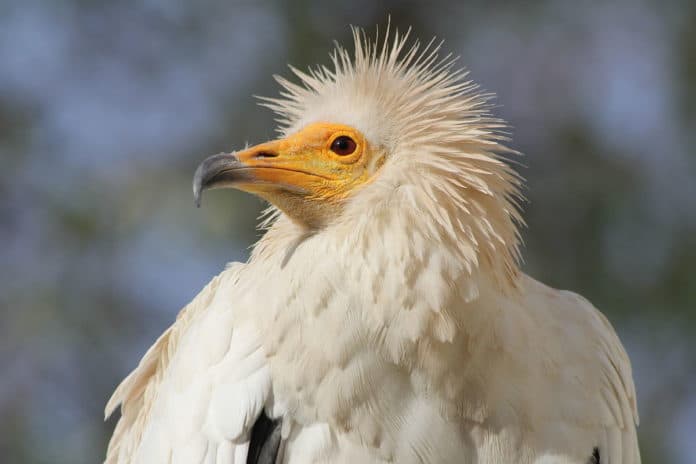
The Asproparis’ spiked head feathers resemble a lion’s mane, or a punk rocker’s hairdo. They have curved bills, slender and long, which extend from a featherless bright orange or yellow faces. Their wings sport distinct black feathers while their tail is wedge-shaped. The adult wingspan reaches almost six feet. They have a body length of approximately two feet. Read More...