Notion that noted artist created bird sculpture doesn't fly
-
 Loading...
 - Elijah Hughes
- 28 Jul 2022
- 127 Views
- 0 Like
- 0 Comment
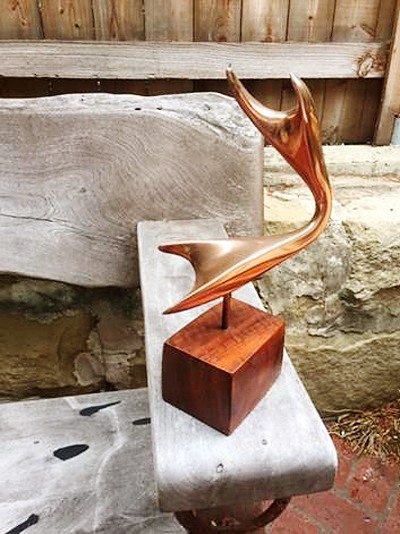
J.E. has a copper sculpture of a bird found in a thrift store that she believes looks like a Brancusi. It kind of does, but it misses something significant; it does not fly.
The claw end is a claw end (full stop), and what distinguishes works by Brancusi is that they seem to embody the essence of flight. What J.E. is referring to when she asks if this is a Brancusi, is Brancusi’s lifelong exploration into the bird in flight. His series, “Bird(s) in Space,” of which he made many forms until he died, is world renowned.
This quest was based on his early childhood in Romania, where he learned the myth of a certain golden bird that foretold the future and cured the blind. Brancusi grew up in the shadow of the Carpathian Mountains, tending sheep at 7, finding work in the next town at 9 and carving himself a violin at 11. A kind man enrolled him in the local craft school, then he went on to art schools in Budapest, Munich and Paris, finding himself in Paris in the 1910’s in the company of other artistic geniuses, one of which, Rodin, accepted him as apprentice, but Brancusi left him fast, saying “nothing can grow under big trees.” He began as a classically trained sculptor but found the essence of something was contained in its form, and therefore when he made a model for a sculpture, it was not in clay, but hand-carved out of wood. All his life he longed for the old myths, food and crafts of Romania, creating a monument in 1938 for Romania’s fallen soldiers of WWI who, in 1916, defended against the Central Forces. The work comprises three monumental sculptures: “Endless Column,” “The Table of Silence” and “The Gate of the Kiss,” at Targu-Jui. Although this job was a commission which took him years to develop, when it came time to be paid, he declined to accept any compensation. I would love to see this one day; it was restored in 2000 after years of neglect, and is now a World Heritage Site.
One of the most complex ideas in art is to understand when something totally new comes into our visual lexicon, and how we viewers might understand that we are in the presence of the new; when Brancusi first showed his work in 1920 at the Salon des Independents, his sculpture, “Princess X,” was withdrawn because it was both too abstract, and too specific, because the three elements of the columnar sculpture resembled a certain masculine “element.” Critics were all over this scandal, calling “Princess X” obscene (who’s laughing now: a similar work recently sold for $71 million), and Brancusi fired back that “Princess X” was the essence of the bosomy relative of Napoleon Bonaparte, Princess Marie Bonaparte. Brancusi explained that the base was her breasts, the shaft was her neck and her downturned head reminiscent of the way she was known to converse with a mirror on her table, so she could watch her beautiful self. Read More…