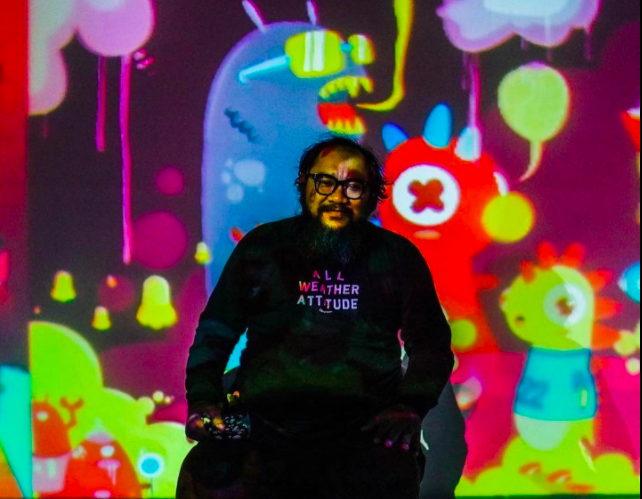
Orkibal, the prolific Malaysian urban art pioneer, has died aged 41
-
 Loading...
 - Ekansh Burman
- 18 Mar 2022
- 397 Views
- 0 Like
- 0 Comment
Urban art pioneer Azhar Osman, or better known as Orkibal, died today at the Kajang Hospital in Selangor. He was 41.
Orkibal was one of the graffiti scene trailblazers who championed and transformed urban art culture in Malaysia in the early 2000s.
The news of his death was confirmed by his family on his Facebook page this evening. The cause of death was not announced.
Orkibal, who got his unique moniker from the British dance group Orbital, was a self-taught artist who started out with doodle art and murals, which showcased a world of happy sad creatures, monsters and an exploding colour palette.
Inspired by pop culture, indie US comics artists and global street art, the Selangor-based artist-graphic designer had a prolific and ever-evolving career that spanned more than 20 years.

Creatively, the gentle-natured and personable Orkibal didn’t stay in one place for too long.
He gradually moved beyond small canvases and printed material, and turned to abandoned buildings and public walls to convey his artistic expression. In 2004, he began modestly with a stencil of monster characters done on stickers, on a wall near a township in Sungai Besi, Kuala Lumpur.
“My aim was to see how the public would react to my work. But back then, I was still afraid that people may not be able to accept my work so I did it at night. The next day, I went back to the location and spent half an hour there to look at how people reacted to it,” recalled Orkibal in an interview with The Star in 2015.
He was also a community-minded activist at heart, working to change the public and authorities’ perceptions surrounding the value of graffiti, or urban street art, which he viewed as a highly valued and socially relevant art form
.
In the early days, the graffiti movement in the Klang Valley spread like wildfire, and Orkibal’s vibrant and lively works could be spotted wherever there was a bare wall to be found. He also participated in volunteer art programmes involving community centres and schools.
Along the way, he also built a portfolio of commissioned works with international clients and brands, a move that paved the way for today’s generation of graffiti artists to make a stable living with urban art, which rarely fitted into the art gallery system back then. Read More...