Scientists have once again found mysterious holes in the deep sea
-
 Loading...
 - Domninguez Eduardo
- 15 May 2023
- 68 Views
- 0 Like
- 0 Comment
TLocated in the northernmost part of the Pacific Ocean, the Bering Strait holds a great mystery that has puzzled researchers for decades. In 2004, a group of researchers led by Odd Aksel Bergstad from the Institute of Marine Research made a surprising discovery while exploring the mid-Atlantic. They found a series of tracks on the seabed, consisting of rows of holes, appearing suddenly on the screen from a depth of 2,000 meters. In a recent publication, Bergstad and American researcher Michael Vecchione raised concerns about why these holes remained unexplained for almost two decades.
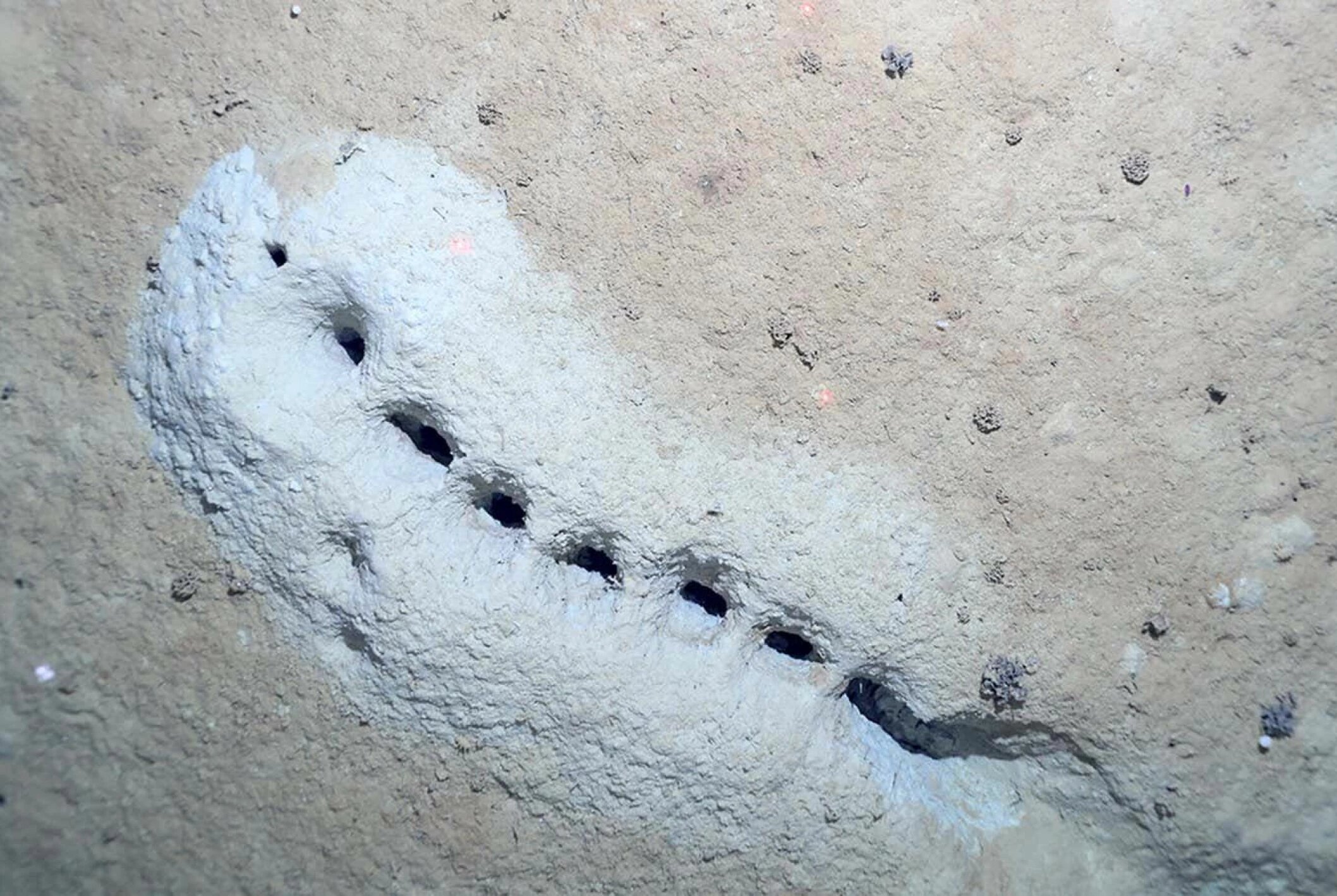
Anne Helene Tandberg, an expert on marine animals that live in extreme conditions, believes that she and her colleagues may have finally found an answer to this mystery. Last summer, Tandberg joined an expedition aboard the German research ship 'R/V SONNE' to explore the northern Pacific Ocean. While searching for life in the 7,000-meter deep Aleutian Trench, they stumbled upon something strange in the Bering Strait. Tandberg and her colleagues discovered rows of holes on the seafloor, numbering up to 200, in three different places.
Upon further investigation, the researchers found that each of these rows had a horizontal tunnel or passage beneath them. They also caught a crustacean using a special tool, which had front feet designed for digging. Tandberg confirmed that the crustacean belongs to the crustacean genus Maera and is likely a previously unknown species. The researchers believe that the animal is digging tunnels either for food or as a hiding place for its young. The clay visible on the side of the holes in the images is thought to be the debris resulting from the crustacean's digging activity.
Although this discovery provides an explanation for the rows of holes found in the Bering Strait, it does not solve the mystery of the holes discovered in the Atlantic Ocean almost 20 years ago. Tandberg and her colleagues found no passageways or tunnels under the rows of holes discovered north of the Azores, indicating that a different animal created those holes.
In conclusion, this discovery sheds light on the abilities of marine animals that live in extreme conditions and how they adapt to their environments. It is yet another example of the amazing and complex world that exists beneath the ocean's surface.