Street Photography And The Law (2022 Update)
-
 Loading...
 - Danny Jones
- 10 Mar 2022
- 654 Views
- 0 Like
- 0 Comment
I am regularly told by other photographers that shooting this or that is illegal and that they avoid street photography because they don’t want to get arrested. Sometimes it takes quite a lot of effort for me to convince them that their fears are unfounded, and it always makes me wonder where these ill-formed ideas come from and who spreads them.
Terror threats in the wake of 9/11 and the attacks in this country for a while did make life difficult for photographers, as suddenly taking pictures in public places was seen as a security risk by some police officers and lots of photographers were wrongfully stopped. Fortunately, that time has passed. It seems, though, the hang-over from those days of suspicion still has an influence on some photographers – though not, it seems, on the public.

New vague rules on ‘data protection’ also complicated the picture for a while, while recent poorly thought-out moves by Twitter have also brought up questions about the rights and expectations of privacy of the public. In truth though, despite all the noise, nothing has changed.
We can still photograph almost anything we want to, and we still need to be careful about the context in which those images are used. This article intends to examine the state of street photography today, and to reassure you that almost everything you’d like to do you can do.
What is street photography?
The term ‘street photography’ covers a pretty wide range of activities from photographing graffiti on walls to in-your-face pictures of people going about their business. Along the way it takes in semi-architectural work, portraiture, social documentary, performance and a bit of fine art – depending on what you fancy.
Pictures don’t have to be taken actually in the street as this type of photography can include indoor public places, cafes, beaches, shops, parks, churches and anywhere there is life or human activity.

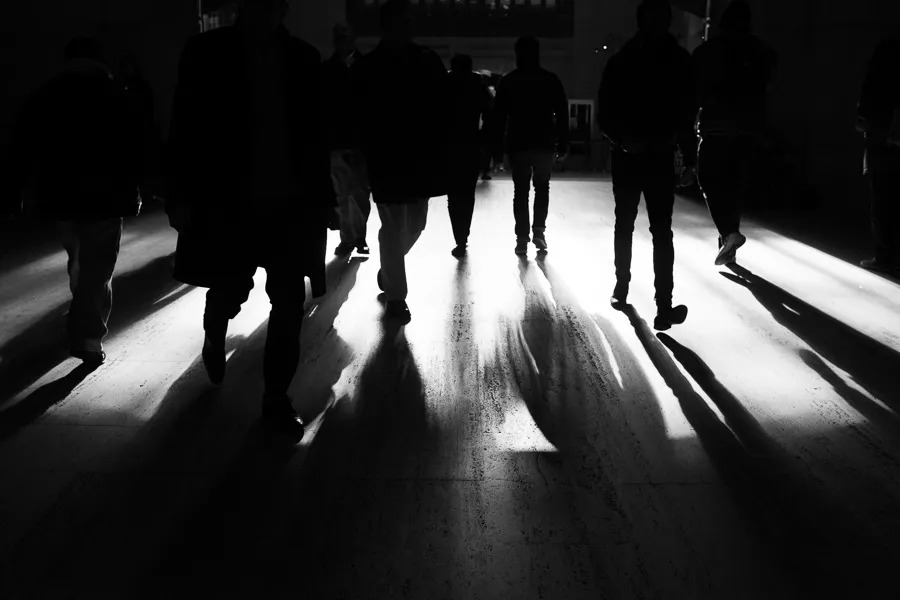
For me street photography generally includes people. That isn’t an absolute rule of course because there are always exceptions, though I would expect about 99% of my pictures to include if not an actual person their shadow or some mark that a person is, or has been, in the scene.
The reason street photography is an important genre is that it provides social commentary for us to see humanity as it is now – and when we look back, to see how it was then. As much as street pictures can be amusing, visually stimulating and enjoyable to take, they also provide a historic record for now and for later. And of course, great art has its own intrinsic value.
I have sometimes encountered other photographers who question the ethics of pointing a camera at people going about their business, and who suggest that it is in itself wrong. When they are reminded that Cartier-Bresson was a street photographer they say ‘Oh yes, of course’. It is easier to see the value in today’s old pictures than it is to see the worth of new pictures that will one day be old, and where would we be today without the likes of Cartier-Bresson, Vivian Maier, Saul Leiter and Dorothea Lange to look back on?

The fear
When I visit camera clubs for a street photography talk, one of the first things I ask is, ‘Who here shoots street pictures?’ Depending on the club, the number of hands that get raised varies from none to a very low number. This puzzled me for a while as I’d been booked to talk about street photography to clubs in which very few photographers were practising it.
After a while I tried following that question with ‘Who doesn’t shoot street but would like to?’ – and then the majority of hands would go up. With street photography it seems there’s a barrier that prevents people who would really like to go out to shoot from actually doing so. That barrier is fear laced with uncertainty – fear of offending people, and uncertainty about how they stand with the law and ethics.
Those who have been reading this magazine for some time may remember a period in which photographers of all kinds were being stopped by the police when out taking pictures in public. During that time, this magazine, and especially our News Editor Chris Cheesman, worked very hard with the Home Office and police constables to establish exactly what the law was on taking pictures in public places and ensuring that the message got out to the bobbies on the beat.

The fact was that despite there being a heightened terror alert and a general frenzy of suspicion, there were no laws that meant it was illegal for anyone to take pictures of pretty much anything they wanted to. And when that message finally got out photographers were left alone, and largely remain left alone today.
And if it is the fear of what the people you are photographing will feel about it, be reassured that if you use common sense they won’t even notice you are there.
Ethics of street photography
As Nick Dunmur of the AOP says, whatever the rules and the law states we can and can’t do, it is more important to make sure we ourselves are happy with our own behaviour. We need to self-regulate to ensure that we don’t shoot things, situations and people that leave us feeling uncomfortable or regretful afterwards.

The boundaries for this will be different for everyone because we all have different sensitivities – however, the basic premise is that we really want to avoid feeling ashamed of ourselves.
For me this means I try not to exploit, make fun of or humiliate anyone. That doesn’t mean I can’t notice and photograph funny behaviour, funny dress sense or funny expressions, but it should all be done to show the human condition and our diversity – and in good humour.
Not exploiting people for me means, for example, that I don’t shoot homeless people – unless in doing so I can help them. If I’m taking a picture of a disadvantaged person just to get the admiration of my viewers then I’m surely heading down the wrong path.
The trick here is to actually think about what you are doing and to not be driven just to think that because you’ve seen pictures of homeless people taken by other photographers that they are fair game. You need to take the situation and your intentions into account. I question myself, and ask, what is motivating me to take this picture. If the answer is anything but pleasant, positive or loving, I don’t press the shutter. Read More…