Superconductivity Model With 100,000 Equations Now Contains Just 4 Thanks to AI
-
 Loading...
 - Tracy Kamande
- 29 Sep 2022
- 74 Views
- 0 Like
- 0 Comment
Electrons whizzing through a grid-like lattice don't behave at all like pretty silver spheres in a pinball machine. They blur and bend in collective dances, following whims of a wave-like reality that are hard enough to imagine, let alone compute.
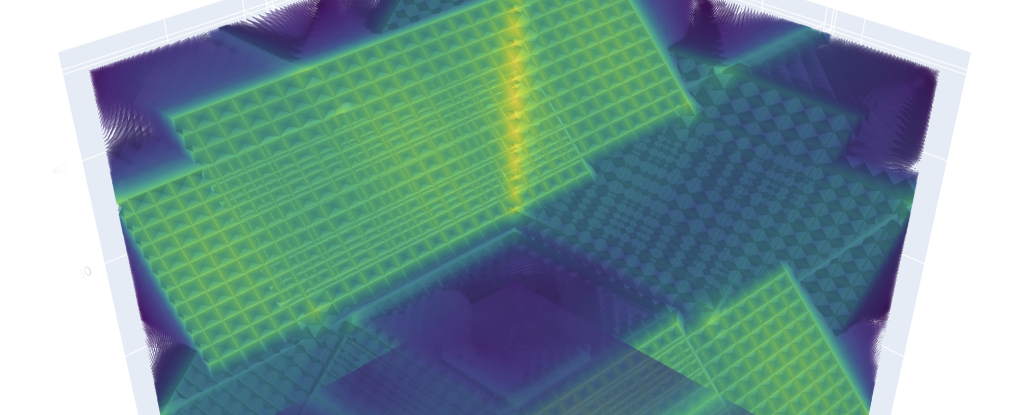
And yet scientists have succeeded in doing just that, capturing the motion of electrons moving about a square lattice in simulations that – until now – had required hundreds of thousands of individual equations to produce.
Using artificial intelligence (AI) to reduce that task down to just four equations, physicists have made their job of studying the emergent properties of complex quantum materials a whole lot more manageable.
In doing so, this computing feat could help tackle one of the most intractable problems of quantum physics, the 'many-electron' problem, which attempts to describe systems containing large numbers of interacting electrons.
It could also advance a truly legendary tool for predicting electron behavior in solid state materials, the Hubbard model – all the while bettering our understanding of how handy phases of matter, such as superconductivity, occur.
Superconductivity is a strange phenomenon that arises when a current of electrons flow unimpeded through a material, losing next to no energy as they slip from one point to another. Unfortunately most practical means of creating such a state rely on insanely low temperatures, if not ridiculously high pressures. Harnessing superconductivity closer to room temperature could lead to far more efficient electricity grids and devices.
Since achieving superconductivity under more reasonable conditions remains a lofty goal, physicists have taken to using models to predict how electrons could behave under various circumstances, and therefore which materials make suitable conductors or insulators. Read More…