Swedish-bred bluewings have made a comeback in the UK
-
 Loading...
 - Rogers Griffiths
- 09 Sep 2022
- 75 Views
- 0 Like
- 0 Comment
Despite efforts to save the species over 50 years, the black-spotted bluewing was declared extinct in Great Britain in 1979. Five years later, some individuals of the butterfly were brought from Sweden and released in Devon in southwest Great Britain. Further introductions were made in the coming decades and twelve sites have been restored to suit the life of the species. It has yielded results. Thanks to the joint efforts of scientists and nature organisations, south-west England now has the world's densest population of black-spotted bluewings. Considering that it is considered one of Europe's most threatened insects, it is a very positive development. It is also encouraging given that there is a continuing alarming and general decline in butterflies in the UK .
The efforts made for the butterfly to thrive, for example to recreate flower-rich meadows, have also benefited many other species. For example, backsippa, brown grass, twelve species of orchids, bumblebee, the May beetle Meloe rugosus , the hoverfly Villa cingulata and eight red-listed butterflies. Including the goldfinch butterfly, which is one of Britain's most endangered butterflies and which goes by the name "Duke of Burgundy".
Complicated life
Black-spotted bluewing is not entirely easy to help given its complicated life cycle. The larva first lives on the thyme or marjoram for three weeks. It then produces a smell and a sound that deceives red ants (especially the heather red ant) ​​that it is one of their larvae. They then carry the butterfly caterpillar with them to their anthill and place it among their ant larvae. The butterfly caterpillar eats the larvae of the ants for ten months before it pupates, hatches and crawls out of the anthill as a fully developed butterfly.
Swedish-bred bluewings have made a comeback in the UK
August 25, 2022 - News - Tagged: butterflies , butterflies , Great Britain , black-spotted bluewing , Swedish butterfly monitoring
Facebook
Twitter
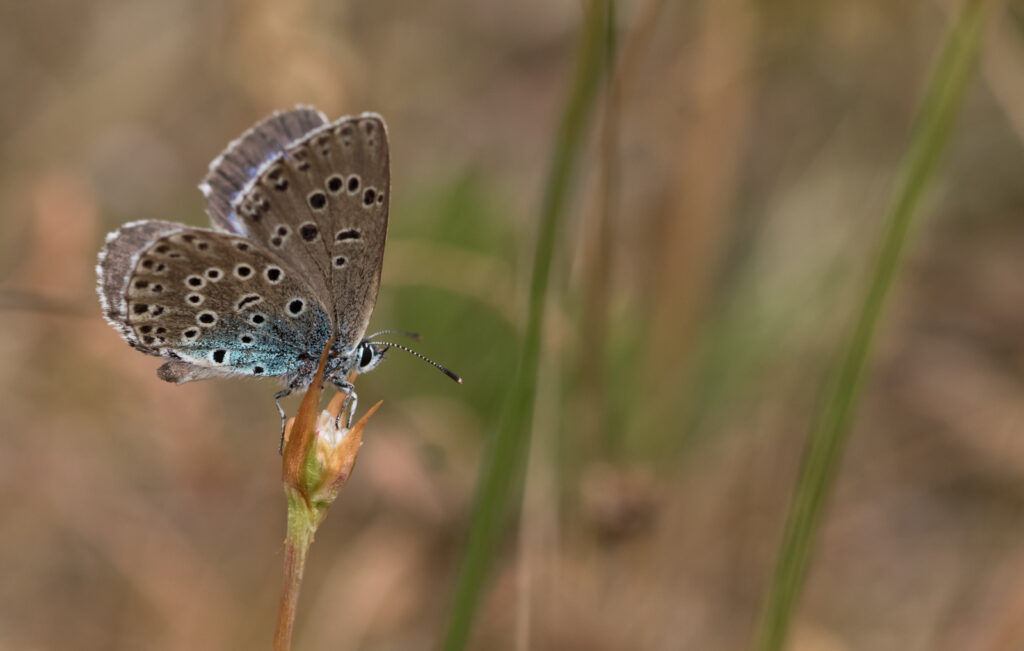
Black-spotted bluewing is similar to other bluewings, but has the typical large black dots with white edges on the underside. Photo: Erik Hansson
More black-spotted bluewings have been seen in Britain this year than in 150 years. It is thanks to Swedish butterflies and the world's largest conservation work for an endangered insect.
Despite efforts to save the species over 50 years, the black-spotted bluewing was declared extinct in Great Britain in 1979. Five years later, some individuals of the butterfly were brought from Sweden and released in Devon in southwest Great Britain. Further introductions were made in the coming decades and twelve sites have been restored to suit the life of the species. It has yielded results. Thanks to the joint efforts of scientists and nature organisations, south-west England now has the world's densest population of black-spotted bluewings. Considering that it is considered one of Europe's most threatened insects, it is a very positive development. It is also encouraging given that there is a continuing alarming and general decline in butterflies in the UK .
The efforts made for the butterfly to thrive, for example to recreate flower-rich meadows, have also benefited many other species. For example, backsippa, brown grass, twelve species of orchids, bumblebee, the May beetle Meloe rugosus , the hoverfly Villa cingulata and eight red-listed butterflies. Including the goldfinch butterfly, which is one of Britain's most endangered butterflies and which goes by the name "Duke of Burgundy".
Complicated life
Black-spotted bluewing is not entirely easy to help given its complicated life cycle. The larva first lives on the thyme or marjoram for three weeks. It then produces a smell and a sound that deceives red ants (especially the heather red ant) ​​that it is one of their larvae. They then carry the butterfly caterpillar with them to their anthill and place it among their ant larvae. The butterfly caterpillar eats the larvae of the ants for ten months before it pupates, hatches and crawls out of the anthill as a fully developed butterfly.
- This project shows how innovative habitat restoration and evidence-based management can benefit several important and rare species in the same landscape. We recognize that there is still much work to be done to understand the complex relationships between plants and insects to maximize their conservation success for future generations, and we have a great team of partners and experts to take the next step,” said Simon Ward, Chair for the Royal Entomological Society of Great Britain.

- The great success of the project is proof of what a large-scale collaboration between conservationists, researchers and volunteers can achieve. The biggest legacy is that it shows that we can reverse the decline of globally threatened species once we understand the driving factors, says Jeremy Thomas, Professor Emeritus of Ecology at the University of Oxford, and Chair of the Black-spotted Bluewing Reintroduction Committee.
Lighting also in Sweden
In Sweden, the situation for the black-spotted bluewing became serious during the extreme drought of 2018. It was thought to have died out in Sörmland and has declined sharply on Gotland . But Lars Pettersson at Swedish Butterfly Monitoring says that an inventory managed to find two individuals in Sörmland this year – the first to be seen in the landscape in several years. In total, targeted, systematic monitoring of the species is ongoing in Skåne, Öland, Gotland, Västra Götaland, Sörmland, Uppland and attempts are also being made to find it in Västmanland. Read More...