Taiko: The beat that goes 'straight to your soul'
-
 Loading...
 - Chiaki Makino
- 14 Jun 2022
- 252 Views
- 0 Like
- 0 Comment
In a hall on Sado Island, 71-year-old Yoshikazu Fujimoto strikes the imposing drum mounted before him, producing a boom so powerful that it reverberates through the floorboards.
Fujimoto is a veteran performer of Japanese taiko drumming, a musical form with roots in religious rituals, traditional theater and the joyous abandon of matsuri (festivals).
But for all its ancient pedigree, taiko as a stage performance is a fairly modern invention, developed by a jazz musician and popularized in part by one of Japan’s most famous troupes: Sado Island’s Kodo.
Fujimoto is the oldest of the 37 musicians that make up the group, which recruits members through a rigorous two-year training program.
It was founded partly to attract people to the Niigata Prefecture island, off Japan’s west coast, and tours internationally, spreading taiko’s gospel.
“Taiko itself is like a prayer,” says Fujimoto, who came to Sado in 1972 to join the group that evolved into Kodo.
“It used to be said that the area reached by the sound of a drum made up a single community,” he continues. “Through taiko … I want to become part of a community with the audience and send a message of living together, a message of compassion.”
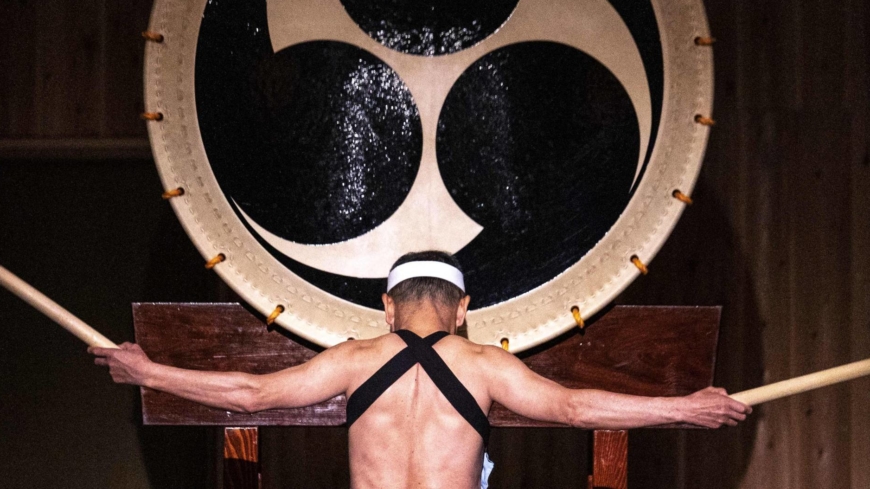
It has been a life-long project for Fujimoto, who is a specialist performer of the o-daiko, an enormous single drum mounted on a stand that is struck by a musician standing with his back to the audience and arms raised overhead.
The effect is an all-encompassing wall of sound that seems to enter the ribcage and vibrate through its bones.
And it is highly physical, with Fujimoto grunting in exertion as the muscles in his almost-bare back flex beneath the straps of his tunic with every strike.
“I become one with the sound,” he says. “Playing taiko makes me feel (like) I’m alive.”
Kodo’s performances range from the sombre power of the o-daiko solo to ensemble pieces featuring flute and singing, and even comic interludes that encourage audience participation.
The word “taiko” simply means “drum” in Japanese, and performers use two main types: The first is made from a single, hollowed tree trunk with cow or horsehide nailed over each end. The second uses hide stretched over rings attached with ropes to a wooden body.
They have been part of rituals and theatrical art forms such as noh and kabuki for centuries.
But drumming in those contexts is often a solemn practice,while modern taiko performance is closer to folk festivals where troupes, often made up of local residents, play in streets or fields to unite the community, drive away malign influences or pray for a good harvest.
“Contemporary taiko drumming took a lot of inspiration from this local festival drumming and combined with more formal traditional performing arts to evolve into what we see as taiko drumming today,” explains Yoshihiko Miyamoto, whose company Miyamoto Unosuke has made taiko for more than 160 years.
Key to that evolution was jazz drummer Daihachi Oguchi, who moved festival drumming onto the stage in the 1950s and ’60s.
Then in 1969, musician Den Tagayasu moved to Sado to found a taiko troupe that he hoped would attract young people to the island and revitalize it.
Fujimoto left his native Kyoto to join the group known as Ondekoza, and when they split he stayed and helped found Kodo.

Joining now involves an arduous two-year training program, where apprentices between the ages of 18 to 25 live in dorms, without phones or televisions.
“The day starts at 5 a.m., when we get up and immediately go out to stretch. Then we start cleaning and polishing the floors,” says Hana Ogawa, a 20-year-old who completed the trainee program this year.
After cleaning, the trainees go for a run and then spend the entire day practicing, with breaks only for food. They have one day off a week.
It might not be for everyone, but Ogawa, who decided to join Kodo after seeing them perform in high school, has no regrets. Read More...