Tamà¡s Fà¶ldes: "Every role is a blessing"
-
 Loading...
 - Jantina Tueling
- 20 Jun 2022
- 230 Views
- 0 Like
- 0 Comment
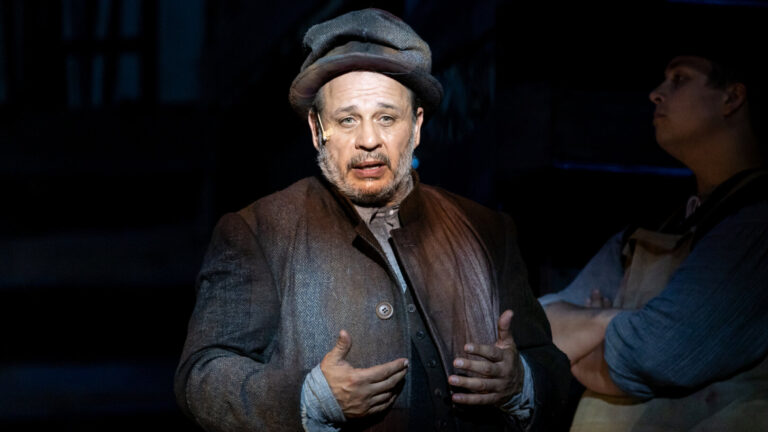
Spectators of Jekyll and Hyde in the afternoon are probably still at the excited account of the experience, while the evening audience of the Wildhorn musical is already gathering in NagymezÅ‘ Street . Tamás Földes is waiting in Sir Denvers Carew costume on Mozsár Street.
- It's doubling. Is that when you schedule your energies?
"On, but that doesn't mean I save for the afternoon or spend less in the evening." Of course, it takes time for a person to learn how to do this well: watch out for the great old people and for themselves to experience what works for him. We are luckier when we play the same thing twice. It also depends on the piece, but when it comes to two different performances, it requires much more attention.
- Two years ago, in an interview on the Attila Kaszás Award, he said that "the roles are running out of me".
- In contrast to his prose, musical literature is quite special in that most major roles require young people.
"Jean Valjean or Javert isn't that young bullshit."
"Not really, but they're played around forty." I graduated from college with a degree in prose, so I dare say we men are more fortunate in terms of the prose repertoire. But I don’t complain, there are father roles, smaller, exciting character roles in the music genre as well.
"They're as big as the Violinist on the Roof." Did your camel wait for you?
- How did you wait? I do not know that.
- And you were waiting for him?
- A little bit yes. I was a member in Fehérvár, and when we found out that the theater was presenting the Violinist on the Roof, Uncle Gyuszi Szabó remarked that “well, Johnny will have a good role”. Then it turned out differently because I didn't get your camel. And thank God I missed it then, I would add quickly, because then I would have been very young, inexperienced in life. When it turned out that there would be the Violinist on the rooftop here at the Operetta, I secretly hoped to get one of the casts. It’s a fantastic task, in this age, a real gift role in the musical genre.

"Everything had to go deep?"
“A lot of things, practically everything that happens in a father about his children. This role is about acceptance, love, forgiveness, the meaning of life. There are very serious questions in the story from the outset, but in the current war situation, a few sentences sound even more creepy.
- Is it an blessing or a curse for an actor who, in his own words, “always plays himself a bit on stage” to play a role like Camel? Even if it is not exactly the same as the civilian Tamás Földes, it is similar to you in many things, from the mentality to the marital status.
- Every role is a blessing, because if you take them and your own business here in the theater seriously, it is actually a therapy, an inner journey leading to getting to know ourselves, accepting ourselves and others.
"I'd go back a bit to his prose roots." What was it like to meet Csaba Kiss, the director of Tajtekos Songs, a prose theater director who goes on a trip to the musical genre?
- Really good! It’s a special piece, perhaps not offensive, if I were to define it as a prose piece with musical inserts. Although I haven’t gotten so far away from prose because I’ve been playing the title role of The Devil in the Carinthy Theater for a few years now, and a special production about Antoine de Saint-Exupéry’s life, more specifically about Saint-Exupéry and his wife’s relationship with I feel Crispy Songs is an important stop on this new journey back to prose. Anyway, musical and prose theater are no different at all, I confess both genres are about characters and story, and both are based on accurate analysis. Musical theater, on the other hand, is so much harder that you have to adapt to music as well.

- To what extent did the director of Nine, Zoltán Balázs, who also comes from the prose world, move him out of his comfort zone? And how much space did the acting individual leave in his world of fine arts and choreography?
“It was a very interesting rehearsal process, and within the framework he invented, Zoli tried to give him freedom, but really, every moment here is as invented and fixed as a choreography. The end result was special, and it’s true that it’s not necessarily my theater, but the trip was definitely an exciting experience.
"Speaking of the encounter of different worlds, we can't miss The Land of Smiles." Moreover, not only the Lehar operetta talks about it, but also the rehearsal process. How did you work with English Stephen Medcalff, who came from the opera?
“He also had a lot of confidence in the actor, and it’s true that we worked with an interpreter, but we were soon able to get a common denominator. Although Stephen is basically an opera director, he is also a believer in a creative process that is thoughtful, analyzed and focuses on personality development. It proved to me that there is no secret, nothing new under the sun, regardless of genre, what makes a performance work.
- After Fönuch and Chiang, there were one or two father roles in Jekyll and Hyde, respectively.
"Emma's father is a pretty simple task from an actor's point of view." A father who accepts his daughter’s decision supports him in everything, yet sees exactly that Jekyll may not have a good life for her. It grinds between these two feelings, which are basically driven by love and fear. These are completely pure motivations, easy to build on. Jekyll's father had to go deeper, he had to study him more meticulously. It was also a much more difficult situation for me mentally because there was an illness in the family that I could cite on stage.

“He taught young people at the Operetta Studio for several years, and after a short break, he returned to teaching this year. What are the students of acting in the operetta musical and how do they work together?
- Enthusiastic, inquisitive, hardworking and open. And we have a huge responsibility, like any relationship in which we get close to the souls of young people, in which we “herd” young people. Our situation is exceptional because we have been given the unique opportunity this year to talk about nurturing talent and personality development, not to burden them with productions, but to help them get to know and represent themselves. To be able to articulate on their own, which if we want to do it authentically, is not easy at all. Read More...