The best hiking trails in Ethiopia
-
 Loading...
 - Grace Githinji
- 30 Dec 2021
- 432 Views
- 0 Like
- 0 Comment
Before getting started with how to find hiking trails in Ethiopia, let's start by introducing this beautiful country. Ethiopia is located in Africa. The country is entirely within tropical latitudes and is rather compact, with north-south and east-west dimensions that are similar. Addis Ababa, the country's capital, is located near the country's center. Ethiopia is the Horn of Africa's largest and most populous country. Ethiopia became landlocked after Eritrea, its former province along the Red Sea, seceded in 1993. Ethiopia is one of the world's oldest countries, with a long history of changing borders over millennia. It was once centered on Aksum, an imperial capital located in the present state's northern region, roughly 160 kilometers from the Red Sea coast. As European powers encroached on Ethiopia's historical dominion in the 19th and 20th centuries, the current territory was solidified. Ethiopia rose to prominence in modern international affairs after defeating colonial Italy in the Battle of Adwa in 1896 and again when it was invaded and occupied by fascist Italy in 1935–36. The liberation of Ethiopia by Allied forces during World War II paved the way for Ethiopia to take a more prominent position in international affairs. Ethiopia was one of the first sovereign states to sign the United Nations Charter, and it lent moral and material support to Africa's decolonization and the expansion of Pan-African cooperation. These efforts resulted in the founding of the Organization of African Unity and the United Nations Economic Commission for Africa, both of which are headquartered in Addis Ababa. After all this information, it is time for Ethiopia hiking trips. Let's start!
What to bring for Ethiopia hiking?

Which hiking trails are open? Here are some sites to visit with the guidance of Pickvisa.
Dinsho

If you decide to travel to Ethiopia, consider going to Dinsho. Dinsho is a settlement in Ethiopia's south-central region. This town, at an elevation of 3207 meters, is located in the Bale Zone of the Oromia Region, in the heart of the Bale Mountains. It is Dinsho woreda's administrative hub. Dinsho was once a tiny village located to the west of its current location; Fiona Flintan was shown the lone, elderly eucalyptus tree that marked the original site's marketplace. In 1934, the village was relocated along the main road between Goba and Shashamane, and by 2000, the town had grown significantly, with the construction of roughly 60 dwellings surrounding a new market site on the town's north side. Flintan discovered that Dinso's commercial and retail activity mostly consisted of dwellings, shops, 'hotels,' and tea houses during her visit in 2000. "Poorly stocked with few tinned and few dried foods such as spaghetti and basic cookies," she discovered in the shops. The Wolf's Den Cafe, which provides trekking services, including the hiring of guides and horses, was the main tourist attraction. Dinsho has a primary and secondary school, the former of which was reconstructed in the late 1990s and the latter of which was constructed around 1970. Around 1996, a new health clinic was erected to replace an old one that had become dilapidated. In the town, there are two diesel-powered mills that grind barley. Dinsho had two market days in 2000: a small local one on Saturdays and a larger one on Tuesday that drew people from as far as 25 kilometers away from the town; both markets were conducted in open spaces. Soon after Flintan's settlement, a mosque was built in the heart of town to accommodate the Moslem majority, while an earlier Christian church was "tucked away among trees and the river." The Scandinavian-style lodge was built in the early 1990s to replace the old guest house, which had burned down in November 1982 after being built by a Belgian sheepherder. The village has sporadic access to power. A few kilometers outside of Dinsho sits the Bale Mountains National Park headquarters. For many years, the town was also the major location for the Ethiopian wolf conservation effort, and some wolves can still be seen nearby.
Simien Mountains National Park

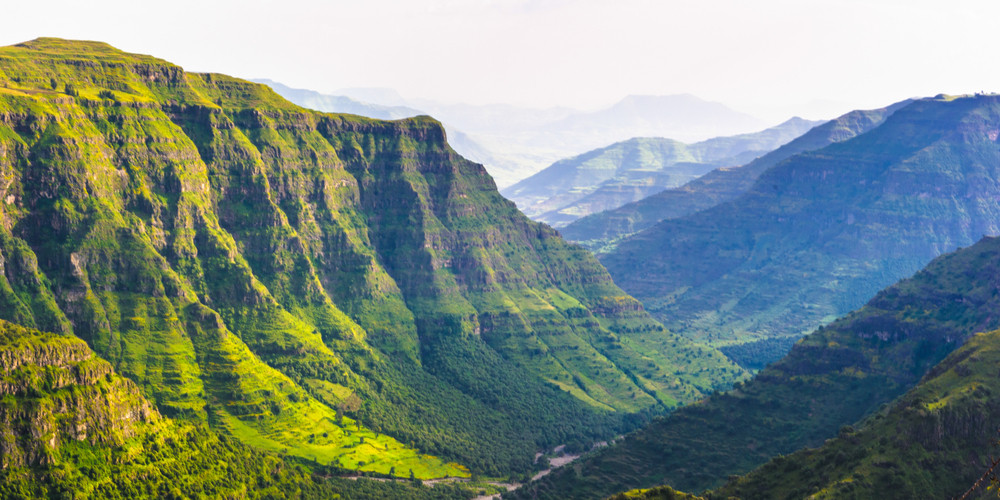
Northern Ethiopia's Simien Mountains National Park is an exotic environment with distinctive fauna and breathtaking views of a landscape influenced by nature and traditional agriculture. The natural splendors of this region have traditionally awed visitors from Ethiopia and beyond. The high plateau, which ends abruptly at 1000- to 2000-m deep escarpments, is filled with gentle highland ridges at heights above 3600 meters above sea level where it is suitable for Ethiopia hiking trips, covered with grasses, solitary trees, and the odd Giant Lobelia. Precipitous rocks and steep canyon-style gorges line the edges of this high plateau and create the best hiking in Ethiopia. The escarpment generates minor elevations in several spots, providing excellent natal observation points. The breathtaking views from the observation stations at Gidir Got and lmet Gogo in the park's heart provide unrivaled panoramas of the high plateau and lowland lowlands for the best hiking trails. Views up to a hundred kilometers across the valleys and terraces of the Tekeze lowland basin are possible under the correct climatic circumstances. They alternate and form a vast complex with a thickness of around 3000 meters. This complex was built 20-30 million years ago by volcanic eruptions during the Tertiary Oligocene-Miocene Age, and it has been undergoing uplifting and erosion ever since. The ecosystem of the Simien Moumains National Park is its main attraction: the sheer cliffs and mild climate at the Erica tree line (3600 to 4000 m) have produced ideal circumstances for the survival of an ibex species peculiar to the Simien Mountains for the best hiking trails. Several hundred creatures have persisted to the present day despite severe habitat restrictions over the millennia. Many other animal species, including the rare Simien fox or Ethiopian wolf, various birds of prey, the indigenous Gelada baboon, the Klipspringer, and the bush deer, can be found in the park. The area's rarity became the backbone of the conservation concept, which led to the creation of the Simien Mountains National Park in 1969 and its designation as a UNESCO World Heritage Site in 1918. Read More...