The Exile of Guatemala's Anti-Corruption Efforts
-
 Loading...
 - Milan Klein
- 29 Apr 2022
- 327 Views
- 0 Like
- 0 Comment
One morning in January, Rudy Herrera, a thirty-seven-year-old federal prosecutor, was working in his office on the fourth floor of the Public Ministry, in downtown Guatemala City, when a colleague pulled him aside to ask about a case. They stepped into a nearby bathroom, where no one else was around. The case in question, known as “comisiones paralelas,” involved a group of political operatives and public officials who illegally conspired to place favorable judges on two high courts. The country’s élite anti-corruption unit, where Herrera worked, had exposed the perpetrators, and brought them to trial. But some members of the current government were clearly agitated. Herrera’s colleague asked if there had been anything irregular about the investigation.
Eventually, it became clear that he wanted damning information about two people in particular. One of them was Herrera’s former boss, Juan Francisco Sandoval, who’d been in charge of the anti-corruption unit at the time of the investigation. The other was the judge hearing the case, Erika Aifán, one of the most respected jurists in the country. “Either you give up something on them, or you’re going to be in trouble,” Herrera’s colleague said.
By then, Herrera told me, “there wasn’t a night when I wouldn’t get a message from someone telling me that the next day the authorities would be coming after us [anti-corruption] prosecutors.” He and his wife had developed a routine. Before dawn, Herrera would drive to a nearby gas station and wait in the parking lot with a cup of coffee until around six, when his wife would send him a text confirming that there weren’t any police cars in the driveway. Only then would Herrera return to get dressed and head into the office. “The whole thing had us in a kind of psychosis,” he said.
Herrera is trim and clean-cut, with close-cropped hair, dark eyes, and a slight lisp. Born and raised in the capital, he is the son of a bus driver and a stay-at-home mother. When he was a teen-ager, the study of law appealed to his bookish nature; at university, he took an internship at the Public Ministry, the country’s equivalent of the Department of Justice, and eventually made his way to the anti-corruption office. “The cases were serious and important,” he told me. “It was opening a new door.” For the next nine years, he couldn’t imagine doing anything else. But, when some of his colleagues began receiving threats, he made contingency plans: twice, he got in touch with a representative from the United Nations High Commissioner for Refugees to open a preliminary file for himself and his family, just in case he came into the crosshairs. What made the situation so striking was that he worked for the government, yet it was the government itself that he’d grown most afraid of.

In Guatemala, officials who cross special interests have often been targeted with bogus lawsuits, arbitrary firings, or physical threats. But, in recent years, the campaign against them has intensified, owing to a wider crackdown within Guatemala’s Public Ministry. The attorney general, a conservative named María Consuelo Porras, had already served half of her four-year term when Alejandro Giammattei, the President of Guatemala, assumed office in January, 2020.
They seemed to be in instant alignment. With Consuelo Porras at the Public Ministry, the government targeted lawyers and judges who were involved in the state’s own fight against corruption, in some cases arresting them outright. In July, 2021, Consuelo Porras fired Sandoval for insubordination, forcing him to flee to El Salvador in the middle of the night to avoid arrest. Key personnel at the Special Prosecutor’s Office Against Impunity (feci), where Sandoval and Herrera worked, were replaced or transferred. A few days after Herrera’s colleague approached him in the bathroom, Aifán, the judge on the comisiones paralelas case, was served with a fresh set of impeachment charges; the Public Ministry was also trying to revoke her judicial immunity, which is typically a prelude to being arrested.
In early February, Herrera quit his post and began to make plans to leave for the U.S. with his wife and their daughter. On the night of February 5th, a Saturday, he received a phone call on Signal from a friend with knowledge of the inner workings of the ministry. “We’re seeing information that they’re going to come after you,” his friend said. “On Monday morning, you must leave with your family.” The next day, they visited doctors and squared away their paperwork. Herrera drove to his parents’ house to explain the situation. “I’d rather have a son who’s alive and in exile than one who dies in jail,” his mother told him. There was only one problem.
That afternoon, his wife tested positive for covid; she wouldn’t be allowed on a plane. They agreed that Herrera would go first, and that his wife and daughter would follow a week later. Nine days after he left, and a day before his family arrived in Washington, D.C., the government published its official order calling for his arrest.
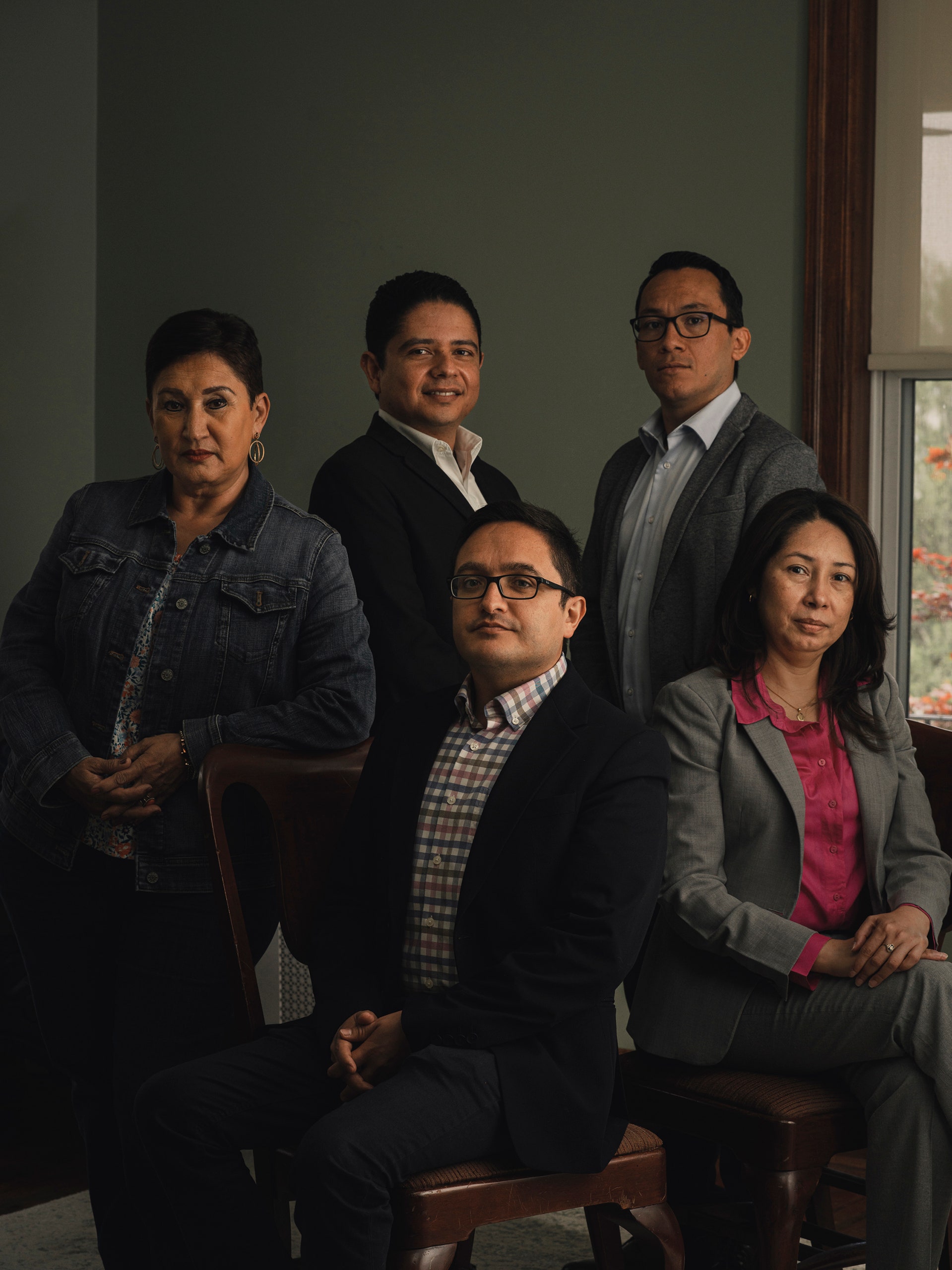
On a rainy Thursday afternoon last month, I met Herrera at a row house in Washington, where Sandoval, his former boss, had arranged a meeting of colleagues living in the area. Since 2018, twenty-two Guatemalan judges and anti-corruption prosecutors have gone into exile.
Many of them are living in Mexico, El Salvador, and Spain, but the largest share is concentrated in and around D.C. Sandoval, short and bespectacled, with a wry sense of humor, is forty and the group’s social center. There’s a WhatsApp chat thread, and its members often gather at the house of Vicki Gass, an American who used to work at the Washington Office on Latin America. She had set out cookies and coffee on the dining-room table when I arrived, just after lunchtime, and in a small living room some chairs were arranged in a circle.

The fate of Guatemala’s justice system has long been tied to Washington. In 2007, at the behest of Guatemalan human-rights advocates, the United Nations established the International Commission Against Impunity in Guatemala (cicig), an independent anti-corruption body, to investigate criminal groups that had come to dominate the country after three decades of civil war. Its mandate, according to “El Experimento,” a podcast about the history of the cicig, was “to collaborate with national institutions,” such as the police, the Public Ministry, and the existing court system. But, because many of these offices were controlled by organized crime, top lawyers working with the cicig created new institutions.
One was the special prosecutor’s office known as the feci, which Sandoval would head; another was a set of courts, such as the one where Aifán later presided, that handled complex investigations. By 2015, the legal fight against corruption in Guatemala was reaching its high-water mark.
That April, the country’s then attorney general, Thelma Aldana, together with the cicig, announced a criminal investigation into the President and Vice-President, accusing them of running a huge smuggling operation through the customs offices.
The Vice-President resigned the following month; at one of her legal hearings, prosecutors played a wiretapped phone call that directly implicated the President in the bribery-and-kickback scheme. Thousands took to the streets to call for his ouster, and he was eventually arrested. Later that year, a political outsider named Jimmy Morales, a former comedian with no prior public-service experience, won the Presidential election by campaigning on the slogan “Neither corrupt nor a thief.”
The U.S. publicly supported the work of the cicig, which lent the organization a certain amount of protection. At the time, the Obama Administration was investing some seven hundred and fifty million dollars in the region, under a program called Alliance for Prosperity, to address, among other things, an increase in asylum seekers arriving at the U.S. southern border. People emigrated for all sorts of reasons—violence, poverty, persecution—but one of the common threads was government mismanagement and a climate of corruption so pervasive and stultifying that people felt they couldn’t stay.
The cicig was confronting what those in Washington called “root causes” of emigration. “The cicig was a barrier of protection that was very important,” one Guatemalan judge told me. “It had the support and credibility of the international community. They couldn’t be investigated. They couldn’t be charged with crimes. And that gave them a crucial guarantee. They helped insure the rule of law.” Read More...