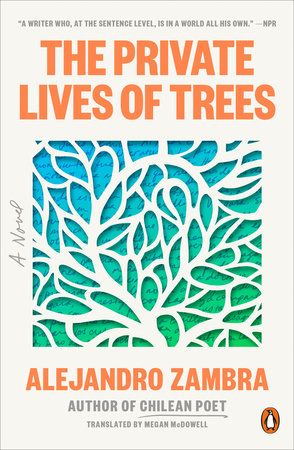
The Private Lives of Trees
-
 Loading...
 - Emilia Salo
- 05 Apr 2023
- 211 Views
- 0 Like
- 0 Comment
In the artificial light of the present, his life with Karla appears to him like a cloud, like a lake. He thinks of it as a way station, a country seen from the window of a slow-moving train. The night of the message on the wall, Julián kept picturing a scene that he thought was inevitable, but that never actually took place: he foresaw himself sitting across from Karla over an obligatory cup of coffee—she would build sudden and dramatic pauses and then utter devastating words, rehearsed at length and yet completely honest. Later, back in his new life, Julián would hit upon the answers he’d been trying dolefully to stammer out.
But the moment for appeasing Karla’s fury or indifference never came. More than once he almost instigated that final scene, but the force that drove him was apparently very weak: the mere idea of getting wrapped up in an argument provoked a profound apathy in him. Julián didn’t want to recover their love; he had stopped loving her a long time ago. He had stopped loving her a second before he started loving her. It sounds strange, but that’s how he feels: instead of loving Karla, he had loved the possibility of love, and then love’s imminence. He had loved the idea of a mass moving under dirty white sheets.
I’m alone, Karla would say when anyone asked about her family. I don’t have parents, I don’t have a family, I’m alone. And it was true: Karla’s father had died recently, and her mother had been dead for many years, ever since she abandoned her husband and daughter and took off for Cali, chasing a vague and esoteric dream. Karla’s advantage was that she didn’t have a family; Julián’s disadvantage was that he had not only a father and a mother and a sister, but also a messy bunch of grandparents, aunts and uncles, cousins, and even a couple nephews. Karla offered him a perfect place to insulate himself from the past. There was nothing in Julián’s past from which to flee, but that was exactly what he was escaping: mediocrity, untold hours wasted in nobody’s company.
Karla was studying philosophy at the University of Chile, but she didn’t aspire to get a degree or a job or any such thing. Her only desire was to stay home listening to music and smoking weed. She ate, almost exclusively, chocolate bars or pasta with Parmesan cheese, although when Julián, who was a good cook, moved in, the menu broadened to include pasta with pesto, ravioli, fried chicken, and even some traditional porotos granados. He taught his classes, and the money from Karla’s inheritance afforded them certain luxuries: he bought books, and she bought CDs, pot, and benzos, which were really more of an obligation than a vice. Read More…