Trained dogs sniff out COVID-19 as well as lab tests do
-
 Loading...
 - Valentina Bianco
- 02 Jun 2022
- 260 Views
- 0 Like
- 0 Comment
Dogs are as reliable as laboratory tests for detecting COVID-19 cases, and may be even better than PCR tests for identifying infected people who don’t have symptoms. A bonus: The canines are cuter and less invasive than a swab up the nose.
In a study involving sweat samples from 335 people, trained dogs sniffed out 97 percent of the coronavirus cases that had been identified by PCR tests, researchers report June 1 in PLOS One. And the dogs found all 31 COVID-19 cases among 192 people who didn’t have symptoms.
These findings are evidence that dogs could be effective for mass screening efforts at places such as airports or concerts and may provide friendly alternatives for testing people who balk at nasal swabs, says Dominique Grandjean, a veterinarian at the National School of Veterinary Medicine of Alfort in Maisons-Alfort, France.
“The dog doesn’t lie,” but there are many ways PCR tests can go wrong, Grandjean says. The canines’ noses also identified more COVID-19 cases than did antigen tests (SN: 12/17/21), similar to many at-home tests, but sometimes mistook another respiratory virus for the coronavirus, Grandjean and colleagues found. What’s more, anecdotal evidence suggests the dogs can pick up asymptomatic cases as much as 48 hours before people test positive by PCR, he says.
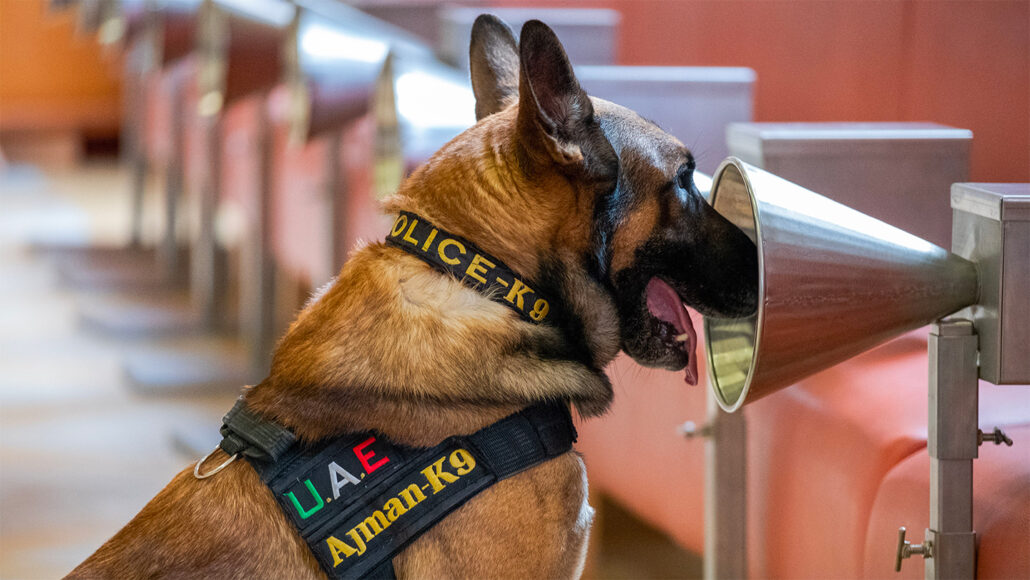
In the study, dogs from French fire stations and from the Ministry of the Interior of the United Arab Emirates were trained in coronavirus detection by rewarding them with toys — usually tennis balls. “It’s playtime for them,” Grandjean says. It takes about three to six weeks, depending on the dog’s experience with odor detection, to train a dog to pick out COVID-19 cases from sweat samples.
The dogs then sniffed cones housing sweat samples collected from human volunteers’ underarms. Swabbing the sweat off the back of people’s necks or giving the woofers a whiff of used face masks worked just as well, Grandjean says.
Those results indicate that odors from multiple body sites can be used for canine screening, says Kenneth Furton, a forensic chemist at Florida International University in Miami who was not involved in the study.
The results are similar to previous, smaller studies that also found that dogs perform as well as or even better than PCR tests for detecting SARS-CoV-2, the virus that causes COVID-19, Furton says. He and colleagues have used dogs at schools, a music festival and in a small trial screening airline employees for coronavirus infections.
One of the biggest advantages dogs have over other tests is their speed, Furton says. “Even with what we call a rapid test, you’re still going to have to wait tens of minutes or even hours, where the dog in a matter of seconds or even fractions of seconds can make a response.”
It’s not clear exactly what dogs are smelling when they detect COVID-19 or other diseases, says Cynthia Otto, director of the University of Pennsylvania School of Veterinary Medicine’s working dog center, who was not involved in the study. It may not be a single chemical, but rather a pattern of increasing and decreasing levels of certain aromas. “It’s not like you could create an odor perfume bottle that would be the scent of COVID,” she says.
Even with repeated studies demonstrating dogs’ COVID-detection prowess, some doctors, scientists and government officials have been skeptical of the claims, Grandjean says. He finds the reluctance puzzling, because dogs are already used to sniff out drugs and explosives, and are being tested for detecting other diseases, such as cancer, he says. “Every time you take a plane, it’s because dogs have been sniffing your luggage [and found] no explosives. So you trust them when you take a plane, but you don’t want to trust them for COVID?”
One challenge with dogs, says Furton, is that people don’t think of them as high-tech the way electronic sensors are. “But dogs are one of the highest-tech devices we have. They’re just biological sensors, instead of electronic sensors,” he says. Read More...