What is social media monitoring: everything you need to know (and best social monitoring tools to start)
-
 Loading...
 - Emmanuella Dofa
- 21 Sep 2022
- 68 Views
- 0 Like
- 0 Comment
The truth is, if you’re not engaging in social listening, you won’t be able to help customers, you won’t reach those who’re interested in your products, you won't find new social audiences, and you’ll be completely out of the loop in your industry.
That doesn’t sound like an effective business strategy, does it?
A lot of marketing managers and businesses ignore social media monitoring because of the assumed complexity of the process.
I can assure you that a social media monitoring strategy is one of the simpler (if not the simplest) elements of social media marketing to learn. Actually, it saves you a lot of time and effort and helps you manage social media and marketing activities. You'll definitely see incredible ROI if you try it.
In this article, I’ll guide you through the concept of monitoring social media, and its use cases, I'll explain how to do media monitoring and listening, and list the most popular social monitoring tools to do it.
Now let’s go into the details and start with the first question: what is social media monitoring anyway?
What is social listening (and what is social media monitoring)?
The basic definition is that social media monitoring is the process of applying a social media intelligence tool to track assigned words or word combinations, and phrases, which are called keywords, on social media.
Essentially, you "listen" to the social media noise and find conversations relevant to your business goals. Simple, right?
If you were paying attention, you probably noticed that I keep altering different terms, such as “social media intelligence”, “social listening” and “social media monitoring”. Social media listening, like some crime novel writers from the XX century, has many aliases including but not limited to:
Online Analytics
Social listening
Social media monitoring
Buzz Analysis
Social Media Measurement
Social Media Intelligence
That's one of the reasons why it can be hard to provide one robust definition.
Most specialists agree that social media monitoring is a part of listening: social monitoring triggers an immediate response (you see a post and respond to it), whereas social listening is that plus analyzing collected social data and customer feedback, identifying marketing trends, and implementing the insights in your social media strategy.
Think about it this way: by using social media monitoring, you can understand whether your customers like the shoes you sold them, while listening helps you understand what kind of shoes people like, how and when they buy them, and so on. Social media analytics reports based on monitoring can tell you how many positive reviews you got, and social listening reports explain why they are positive.
So it's not just analyzing customer feedback: it means proactively looking for trends and social feedback on your competitors to benefit your brand. You then integrate this social media analysis into your business strategies, therefore improving your performance on social media.
In this blog post, however, I'm going to use those terms interchangeably.
How do social listening tools work?
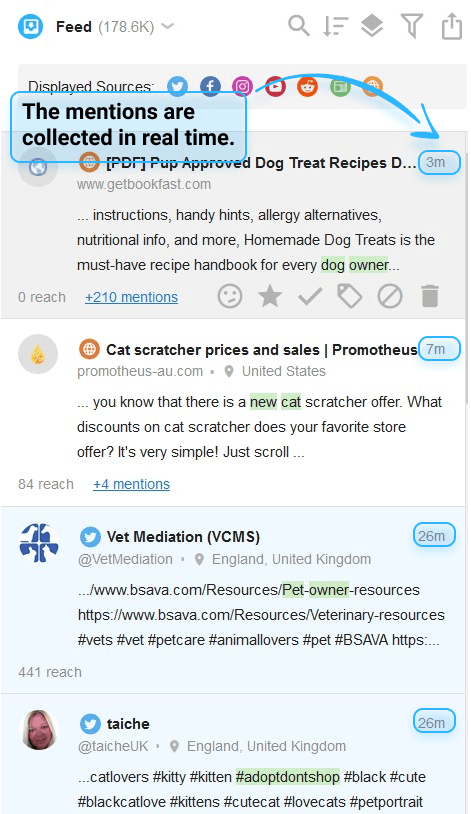
To put it simply, monitoring tools get relevant conversations containing your keywords in real-time and gather them in one dashboard.
The “real-time” aspect of online monitoring is very important – 60% of customers expect brands to respond to them within an hour.