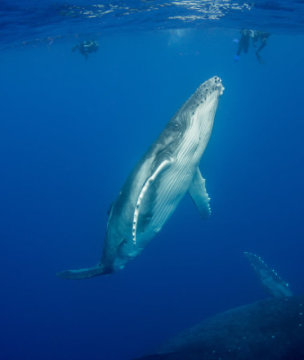
Why are whales so big?
-
 Loading...
 - Ivana Lucija
- 27 Mar 2021
- 1159 Views
- 0 Like
- 0 Comment
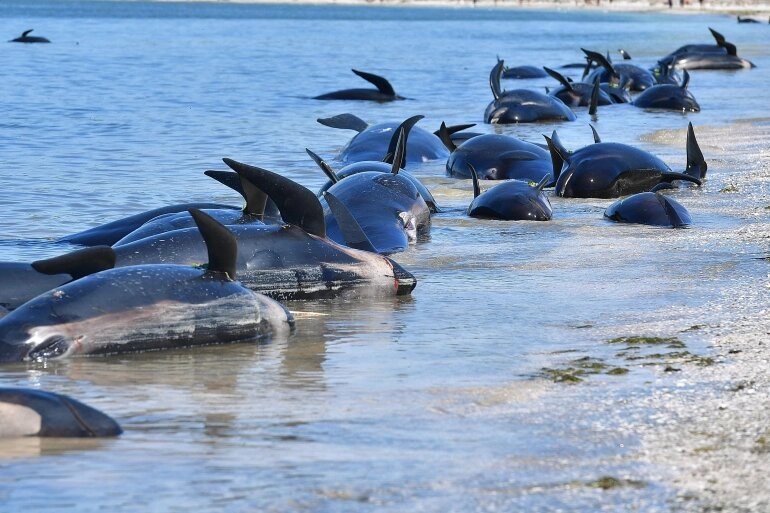
Anyone who has witnessed majestic whales or lumbering elephant seals in person would be forgiven for associating ocean life with unlimited size in mammals, but new research reveals that mammal growth is actually more constrained in water than on land.
This finding by Stanford researchers is in contrast to previous theories suggesting that pressure on body size should be more relaxed in water, perhaps because of the large environment and ability for animals to float rather than have to support their body weight on legs.
Instead, the group found that aquatic mammal size is bounded at the small end by the need to retain heat and at the large end by difficulties getting enough food to survive. The group published their findings March 26 in Proceedings of the National Academy of Sciences.
"Many people have viewed going into the water as more freeing for mammals, but what we're seeing is that it's actually more constraining," said co-author Jonathan Payne, a professor of geological sciences at Stanford's School of Earth, Energy & Environmental Sciences (Stanford Earth). "It's not that water allows you to be a big mammal, it's that you have to be a big mammal in water -- you don't have any other options."
Getting big, but not too big
Although mammals that live in water share a similarly oblong body shape, they are not closely related. Rather, seals and sea lions are closely related to dogs, manatees share ancestry with elephants, and whales and dolphins are related to hippos and other hoofed mammals.
To learn more about how these groups of land mammals took on their characteristic girth when they turned aquatic, the researchers compiled body masses for 3,859 living and 2,999 fossil mammal species from existing data sets. The analysis includes about 70 percent of living species and 25 percent of extinct species. They analyzed the data with a set of models developed in collaboration with Craig McClain of the Louisiana Universities Marine Consortium.
From this analysis, the group found that once land animals take to the water, they evolve very quickly toward their new size, converging at around 1,000 pounds. Smaller ancestors like dog relatives increased in size more than larger ancestors like hippos to reach that optimal weight, suggesting that bigger is better for aquatic life, but only up to a point. The group points out that otters, which took to the water more recently, don't follow that trend, perhaps because many otter species still live much of their lives on land.
"The key is having a phylogenetic tree to understand how these species are related to one another and the amount of time that has taken place between different evolutionary branching events," said lead author Will Gearty, a graduate student at Stanford Earth. "The tree of ancestral relationships allows us to build models based on data from modern species to predict what the ancestors' body sizes would have been and see what evolutionary trajectories best fit with what we see in the modern day."
Heat and food
The group argues that the larger size helps aquatic mammals retain heat in water that's lower than body temperature. "When you're very small, you lose heat back into the water so fast, there's no way to eat enough food to keep up," Payne said.
They also suggest that metabolism increases with size more than an animal's ability to gather food, putting a boundary on how big aquatic mammals can grow. "Basically, animals are machines that require energy to operate. This need for energy places hard limits on what animals can do and how big they can be," said McClain, who was a co-author on the study.
"The range of viable sizes for mammals in the ocean is actually smaller than the range of viable sizes on land," Payne said. "To demonstrate that statistically and provide a theory behind it is something new."
If otters are the exception at the small end, baleen whales prove the exception at the larger size. These whales expend much less energy on feeding than their toothed counterparts because they filter all their food, which makes them more efficient and allows them to grow larger than toothed whales.
"The sperm whale seems to be the largest you can get without a new adaptation," Gearty said. "The only way to get as big as a baleen whale is to completely change how you're eating."
The researchers began working on the study in 2014 and they are currently assessing how well similar approaches can be used to explain body size distributions in other animal groups, especially those that have both terrestrial and aquatic species.
"The hope is there's simpler explanations that can apply to other species, including terrestrial animals," Payne said. "It opens up some possibility that body size can be explained by basic principles of physics and chemistry."
Payne is also a member of Stanford Bio-X and an affiliate of the Stanford Woods Institute for the Environment.