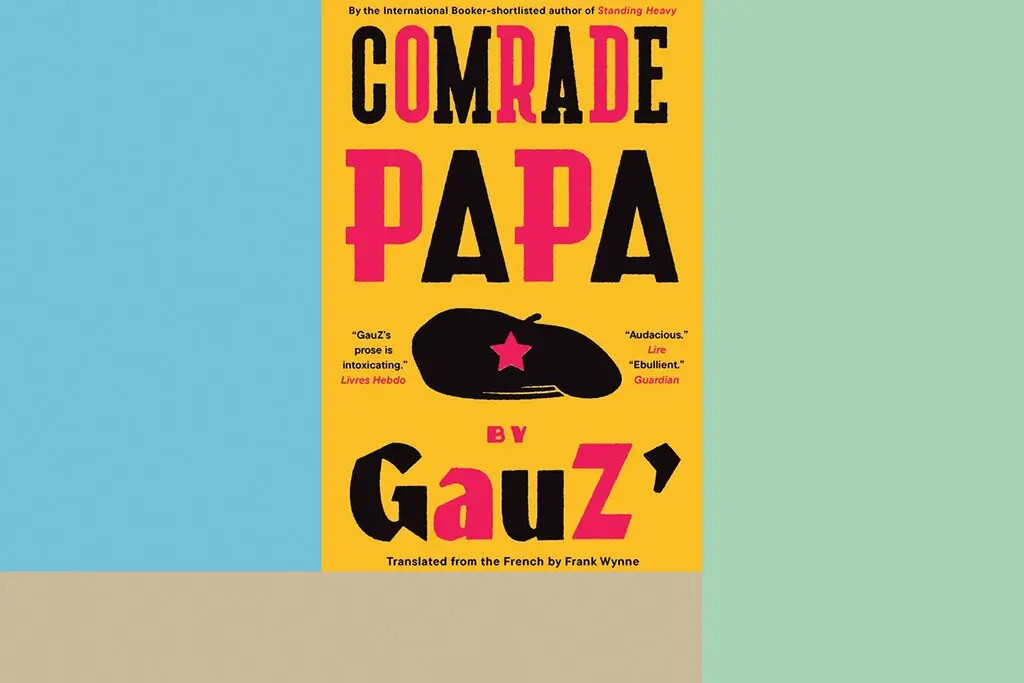
A Patchwork Satire of Ivory Coast, Pre- and Post-Independence: A Review of "Comrade Papa"
-
 Loading...
 - Kumi Mintah
- 24 Dec 2024
- 35 Views
- 0 Like
- 0 Comment
“Comrade Papa,” the second novel by the pseudonymous Ivorian author and newspaper editor GauZ’, presents a whimsical and satirical exploration of Ivory Coast’s history through the eyes of two European arrivals, nearly a century apart. Originally published in France in 2018 and newly translated by Frank Wynne, the novel alternates between 19th-century colonial Ivory Coast and 1970s Amsterdam, weaving together a rich tapestry of legends, folk tales, revolutionary diatribes, and expeditionary reports.
In Wynne’s nimble and playful translation—his previous work on GauZ’ was shortlisted for the International Booker Prize—the narrative is anchored by Maxime Dabilly, a young factory worker from war-torn Alsace. Dabilly, who has always dreamed of leaving his village, embarks on a journey to West Africa in 1880 aboard a boat carrying munitions. His encounters with sickly, pompous white settlers and traditional Ivorian chiefs are rendered with humor and verve, reminiscent of Ahmadou Kourouma’s “Waiting for the Wild Beasts to Vote.” Dabilly’s self-importance is comically juxtaposed with the realities of colonial life, as he likens himself to the famous explorer Henry Morton Stanley, despite the absurdity of his situation.
As Dabilly learns local languages and mythologies, GauZ’ cleverly intertwines fact and folklore, such as the “legend” of Aniaba, an Assinian boy treated as a prince in the court of Louis XIV. This blending of history and myth allows for a nuanced critique of colonialism, where conversations, treaties, and cultural exchanges often overshadow violence. The narrative captures the complexities of power dynamics, leaving much to fate and the whims of tropical medicine.
Nearly a century later, the story shifts to Anouman, a red-haired boy living in Amsterdam’s red-light district. Anouman, abandoned by his Maoist parents—who are more invested in their political careers than in their son—believes he is on a mission as an “undercover agent” in Ivory Coast. His childlike understanding of communism is peppered with malapropisms, adding a layer of charming comedy to his perspective. As he departs the Paris Commune, he expresses disdain for airlines that cater to the bourgeoisie, revealing his youthful idealism and naivety.
Upon arriving in Ivory Coast, Anouman’s expectations clash with reality. Initially viewing the residents as “lunatics and devils” based on his father’s propaganda, his political mission quickly transforms into a personal quest for connection. By the end of his journey, he realizes that his desire to reunite with his parents outweighs any ideological commitment to socialism or revolution.
While the two narratives could have been more fully developed and connected by stronger thematic links, GauZ’ compensates for any structural shortcomings with the novel’s originality and the joy of its playful language. “Comrade Papa” is a mosaic of history and storytelling, incorporating a variety of tones and styles—some flat and dull, others dazzling—into a cohesive and engaging whole.
In conclusion, “Comrade Papa” offers a unique and humorous perspective on the complexities of colonialism and post-colonial identity in Ivory Coast. Through the eyes of Dabilly and Anouman, GauZ’ invites readers to reflect on the legacies of history, the absurdities of power, and the enduring quest for personal connection amidst the chaos of political ideologies.