Arctic mercury levels drop during the depths of the winter

Over the last decade, researchers have learned a lot about the polar night — discovering everything from how tiny marine critters migrate up and down in the sea in response to the weak light of the moon, to seabirds that dive into the pitch-black ocean to feast on bioluminescent plankton and krill.
But what is less well known is how the chemistry of Arctic Ocean water changes during this period, when the sun remains completely below the horizon for a full 24-hour day.
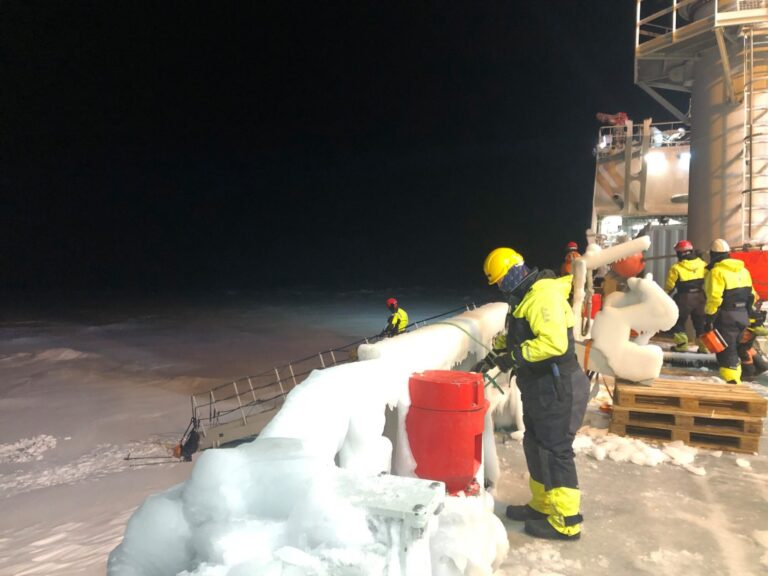
It’s not easy studying the Arctic during the dark of the polar night. The Nansen Legacy project aims to shed light on the physical, chemical and biological processes in the Barents Sea across all four seasons.
Now, in an article published in Nature Geoscience, Norwegian University of Science and Technology (NTNU) researchers report on a surprising trend they discovered in mercury levels in the ocean during the polar night.
“We found that total mercury concentrations in the Barents Sea decreased by about 33 percent from summer to winter,” said Stephen G. Kohler, a PhD candidate at NTNU’s Marine Chemistry and Biogeochemistry group in the Department of Chemistry and first author of the article.
First-ever winter measurements
These measurements are the first-ever winter reports on this element in Arctic Ocean waters.
They were conducted as a part of the Nansen Legacy Project, a 7-year-long collaborative between 10 Norwegian research institutions that involves studying the physical and biological aspects of the Barents Sea during all four seasons. (See box). Read More…