Why Doesn't Jupiter Have Even More Spectacular Rings Than Saturn?

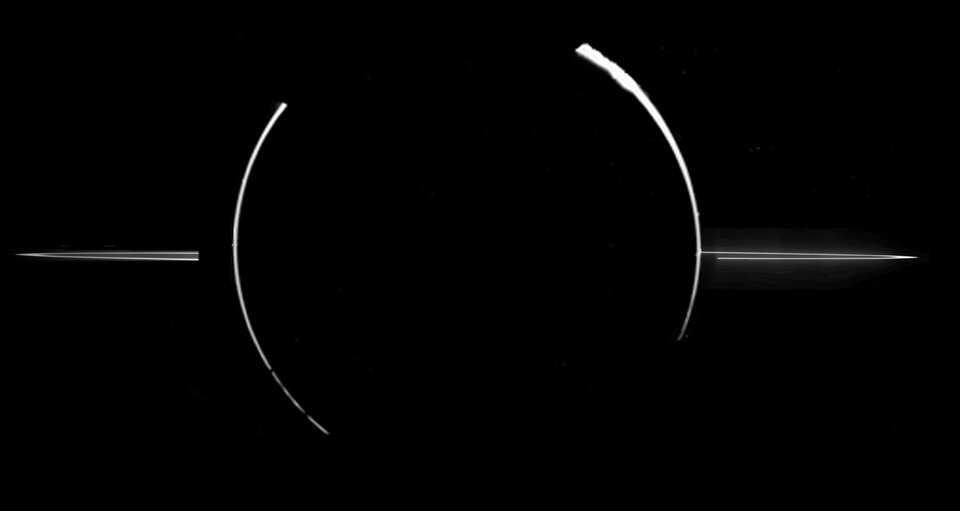
I don’t think a lot of people know that all four giant planets in our solar system have rings; Saturn’s are by far the most obvious, but Jupiter, Uranus, and Neptune own a set themselves. As I wrote in that article, Jupiter’s main ring is primarily made of dust, and may be due to small particles impacting the two moons Metis and Adrastea; sunlight would push on the dust particles and remove them rapidly, so they must be replenished on a similar timescale.
But… Jupiter is about three times more massive than Saturn, so its gravity is much stronger. You’d expect it to have a much larger ring system. Why doesn’t it?
New research just published puts the blame on Jupiter’s moons.

Now, we don’t know exactly what formed Saturn’s rings, but it might either be from comets that get close to the big planet and get disrupted, or from a collision of icy moons. Saturn’s rings are almost pure water ice. We know that comets hit Jupiter fairly often — several impacts have been seen over the years, though some may be from asteroids, but the 1994 impact by comet Shoemaker-Levy 9 was well observed.
So where are Jupiter’s rings?
In the new work [link to paper], they used a simulator that reproduces the effects of gravity on an orbiting particle or particles. They included not just the gravity of Jupiter but, critically, all four of its big moons, called the Galilean satellites: Io, Europa, Ganymede, and Callisto. These moons range from decent-sized to enormous; Ganymede is the largest moon in the solar system and is bigger then Mercury! So their gravitational influence is necessary to include, especially because any ring system would likely exist in proximity to them in terms of distance from Jupiter.
In the simulation they placed test ring particles around Jupiter, making them spherical with a diameter of about two meters, and put them in circular orbits over Jupiter’s equator. The distances ranged from about 110,000 km from Jupiter’s center all the way out to about 5 million kilometers. Any closer and Jupiter would tear the particles apart from tides — a distance called the Roche limit — and if they got much farther out then over time the Sun’s gravity would dominate over Jupiter’s — a distance called the Hill Radius.
They ran the code for a million and ten million simulated years, to really give things a chance to brew. Read More...