Belgian Scientist Bottles Smell of Bones to Help Solve Cold Cases
-
 Loading...
 - Jocelyn Tailor
- 31 Jan 2025
- 38 Views
- 0 Like
- 0 Comment
Belgian research scientist Clement Martin is collaborating with the federal police to create a synthetic scent that mimics the smell of dried human bones, aiming to enhance the capabilities of sniffer dogs in locating long-lost remains. Based in Gembloux, Belgium, Martin has already isolated the scent of decomposing human flesh, which is currently used to train the country’s cadaver dogs. However, he notes that once soft tissue has decomposed, the scent molecules associated with the remaining bones become significantly less detectable.
"Bones smell different over the years too. A 3-year-old bone will smell different from a 10-year-old one and even a 20-year-old one," Martin explained. Additionally, skeletal remains are porous and can absorb odors from their surrounding environment, including soil and vegetation.
Kris Cardoen, head of federal police dog training, highlighted a critical gap in the current capabilities of cadaver dogs: "In the situation of cold cases, our dogs were not able to find dried bones."
At a police training center outside Brussels, inspector Kristof Van Langenhove and his springer spaniel, Bones, demonstrated part of the training process using Martin's corpse scent. During the exercise, Cardoen concealed some tissues among cinder blocks, contaminating only a few. The dog successfully identified the scent, barking to indicate its discovery. "The scent of death is one of the three tools we use during the basic training of our human remains dog," Cardoen noted.
Training cadaver dogs is a lengthy process, requiring approximately 1,000 hours of training, and Belgium typically has only four such dogs available at any given time.
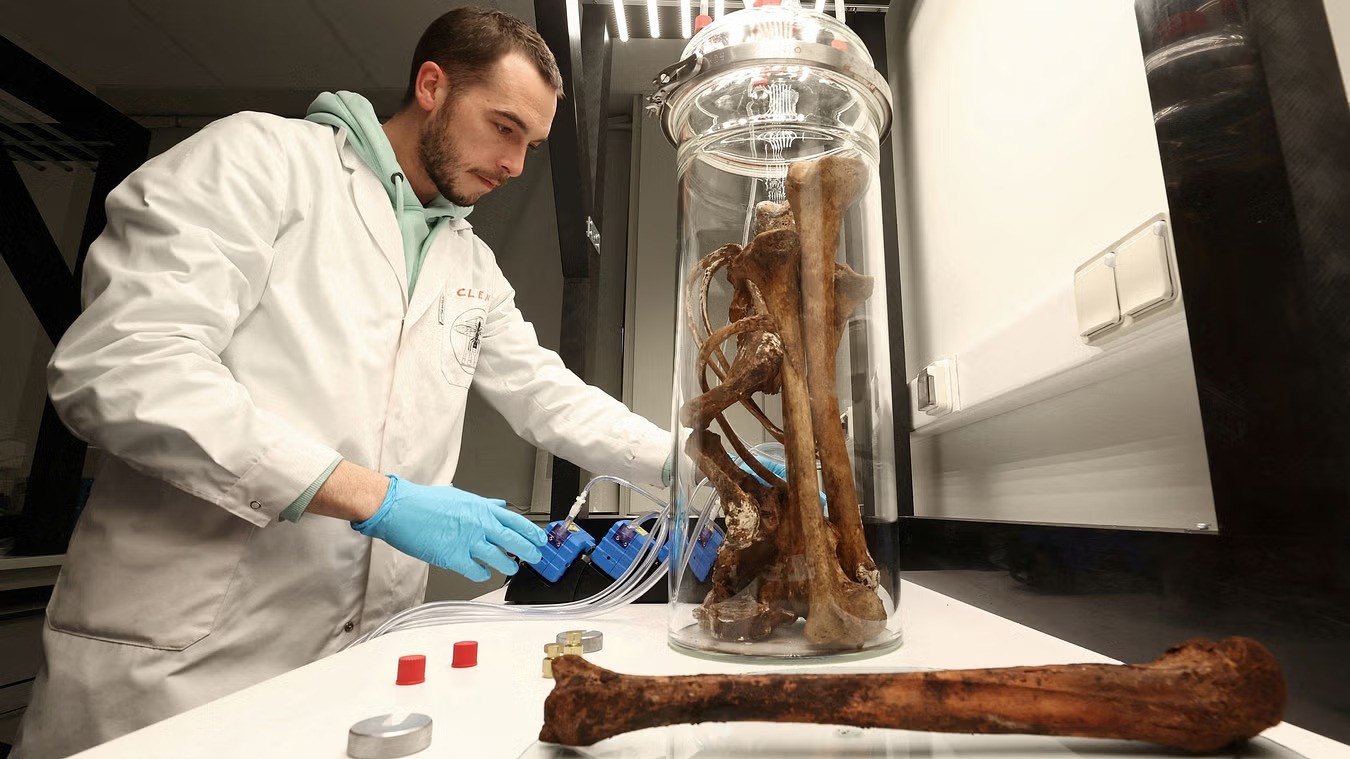
To develop the new scent, Martin is utilizing various samples of dried bones, including those of an unidentified man found in a suitcase. These samples are stored in a glass cylinder, allowing the scent molecules to permeate the enclosed space for extraction. Martin likens his work to that of a perfumer, stating, "It's a bit like a perfumer developing his perfume; he's going to mix different aromas."
This research aims to improve the effectiveness of cadaver dogs in locating skeletal remains and represents a significant advancement in forensic science, potentially aiding in the resolution of cold cases that have long remained unsolved.